
UofA Museum of the North
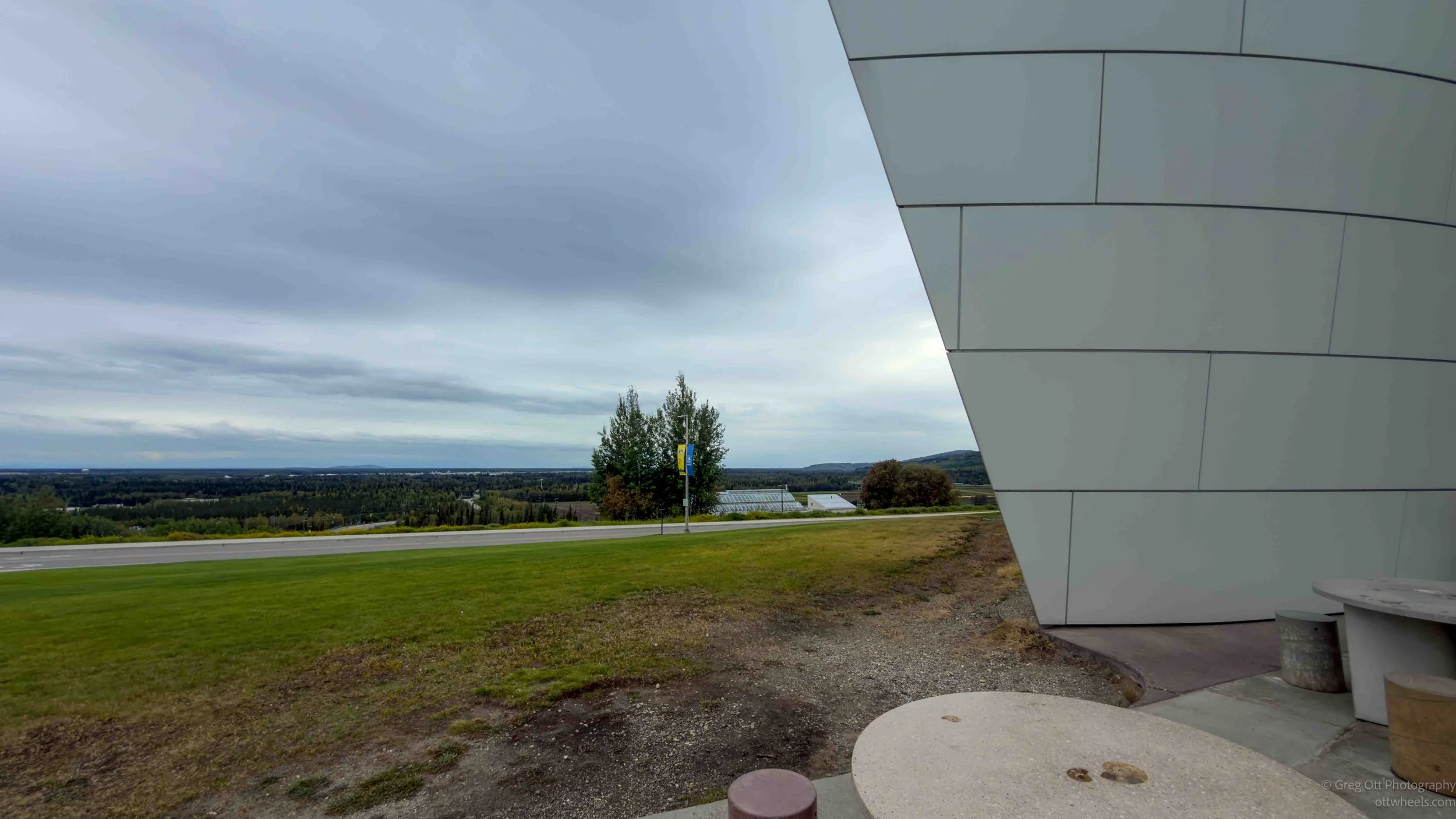
I started the day with lunch at the Museum of the North café: a Caesar salad, a Danish and a coffee. I found a seat next to the Alaska Range Viewing Window, a huge wall of glass overlooking the Tanana Valley. It was somewhat cloudy, and the Alaska Range would appear and disappear as the clouds moved through. From my seat I could also watch planes approaching and landing at Fairbanks International Airport. It wasn't a bad place to spend some time before starting through the museum.
The University of Alaska at Fairbanks Museum of the North has been around almost as long as the university itself. According to university history, it began in 1922 as a single display case in the office of Charles Bunnell, the university's first president. Bunnell envisioned the university as a center for collecting and studying Alaska, and that little display case eventually grew into a museum with millions of biological, geological and cultural specimens. The collections moved around campus for decades before the museum finally got its own building on West Ridge in 1980.
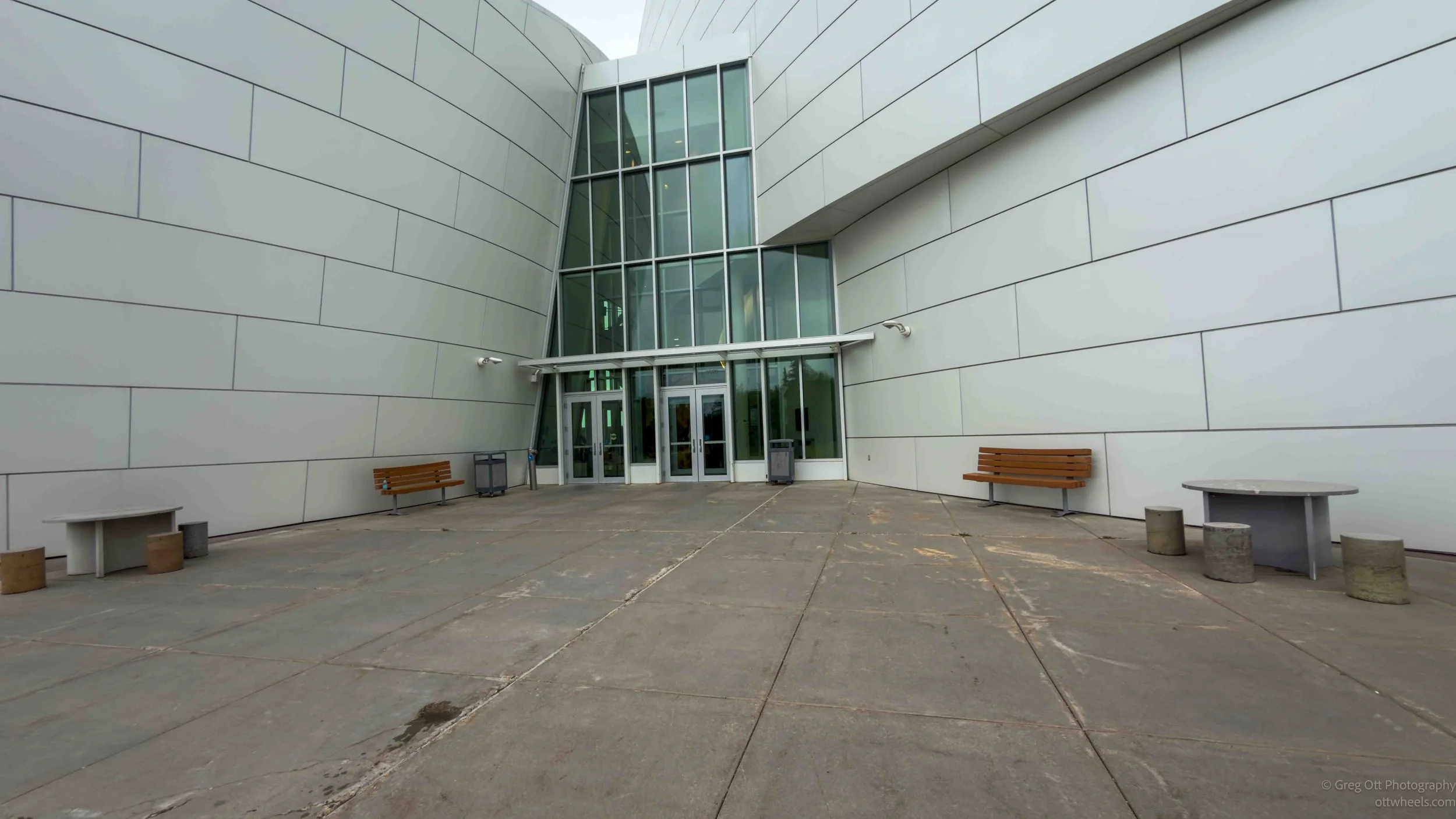
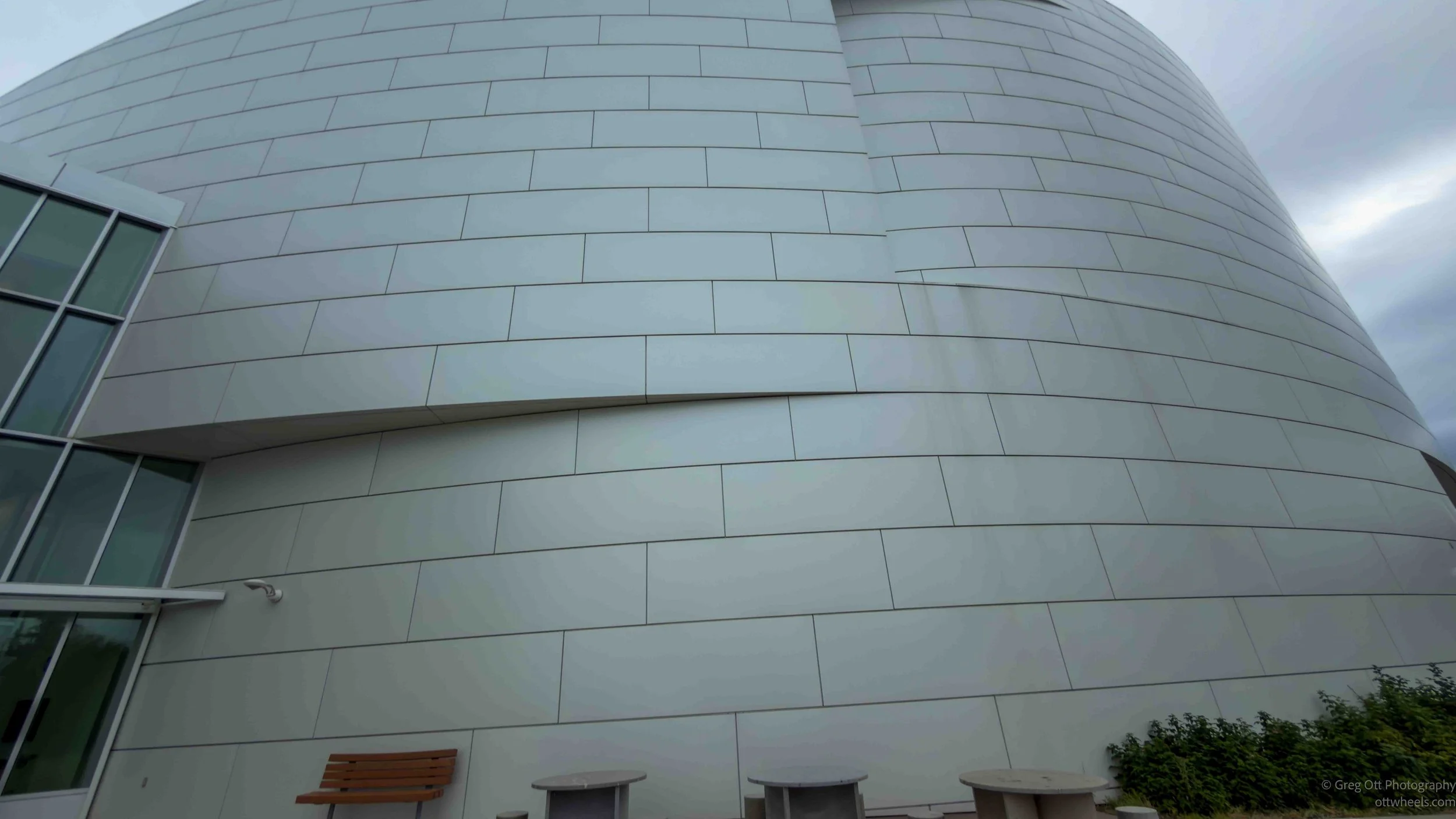
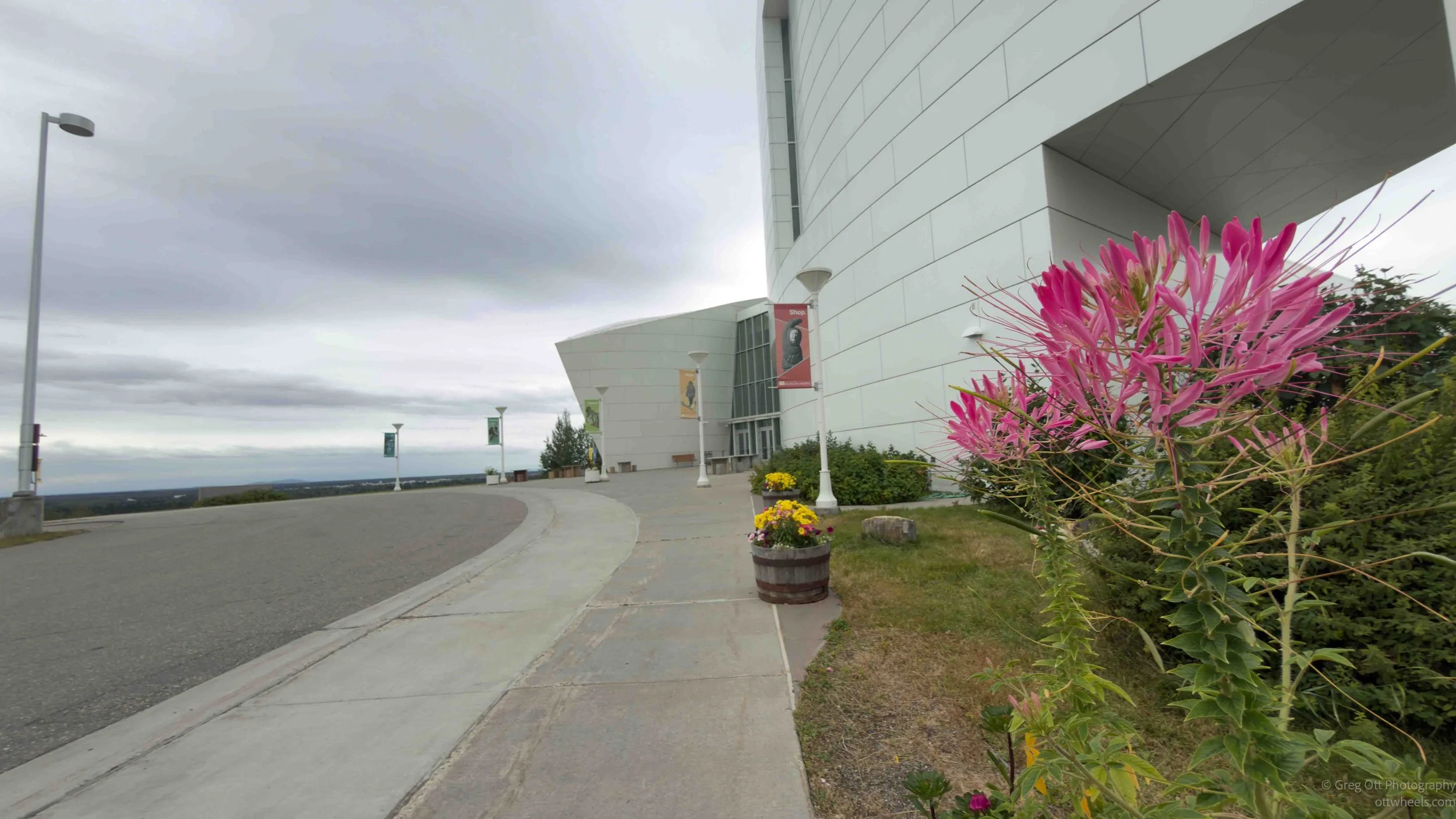
The building I walked into looks nothing like a traditional museum. A $42 million expansion transformed the original structure, with the expanded museum opening in 2005. Architect Joan Soranno and a team designed it specifically around Alaska. The curved and angled forms are intended to suggest things like glaciers, alpine ridges, the breakup of ice on the Yukon River and even the aurora. The large windows were also deliberate, connecting the museum with the Alaska Range, Denali and the Tanana River Valley outside. The result is a building that is almost an exhibit itself.
Collections Gallery
I spent quite a bit of time in the Collections Gallery, which I found fascinating. This wasn't just a collection of things found in Alaska. Many of the exhibits showed what researchers are studying right now and some of the tools and specimens they use to do it.
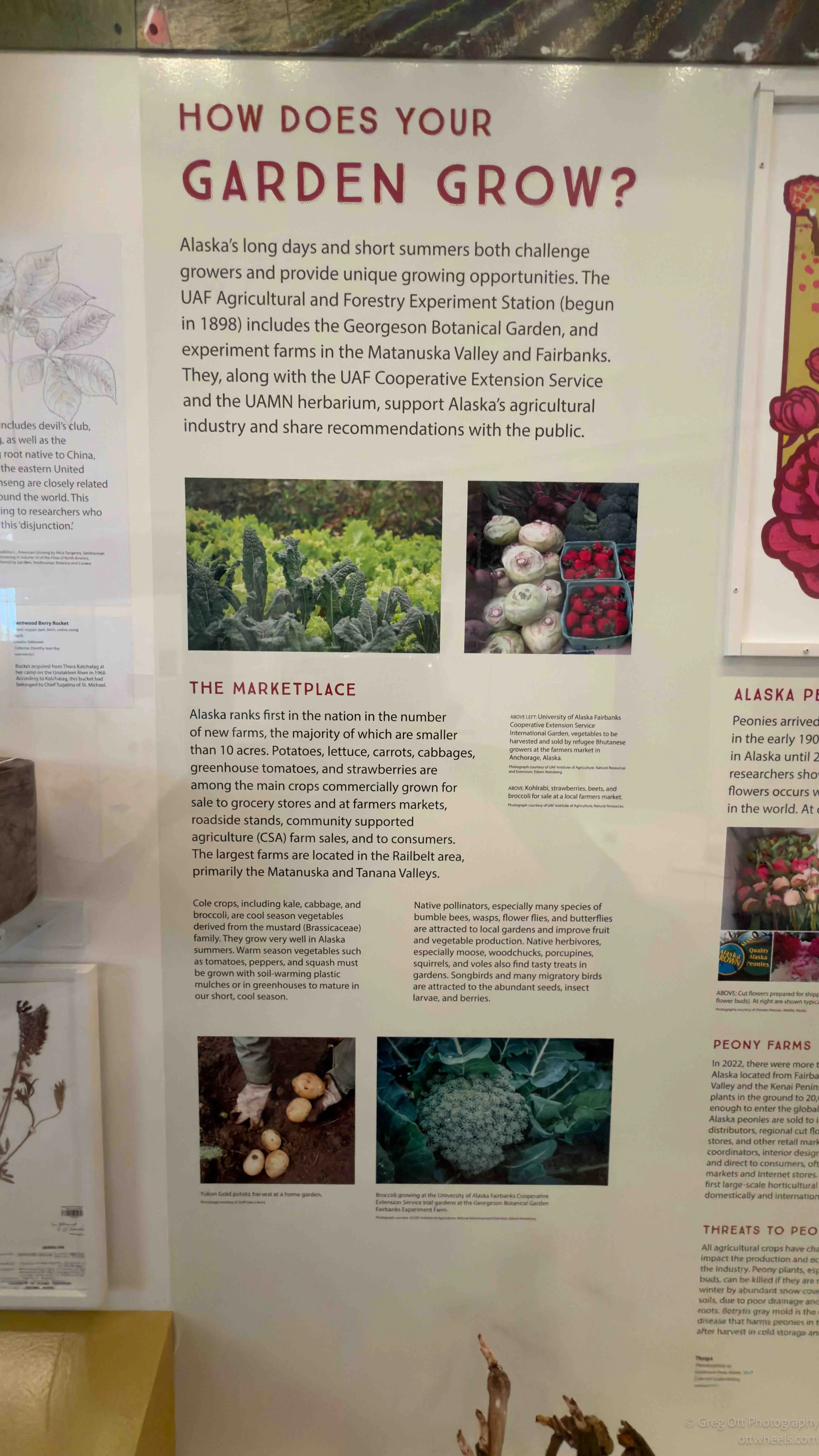
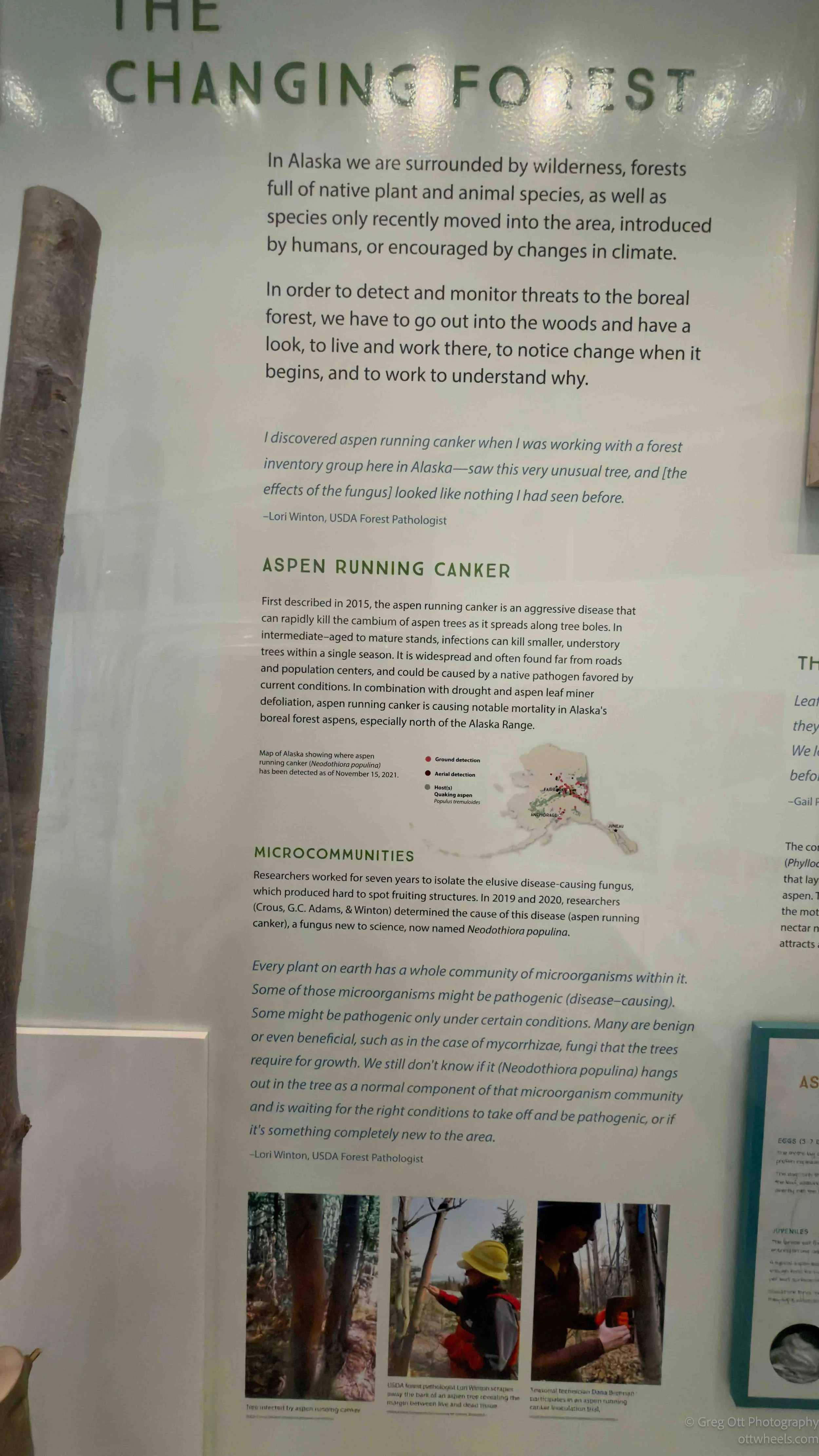
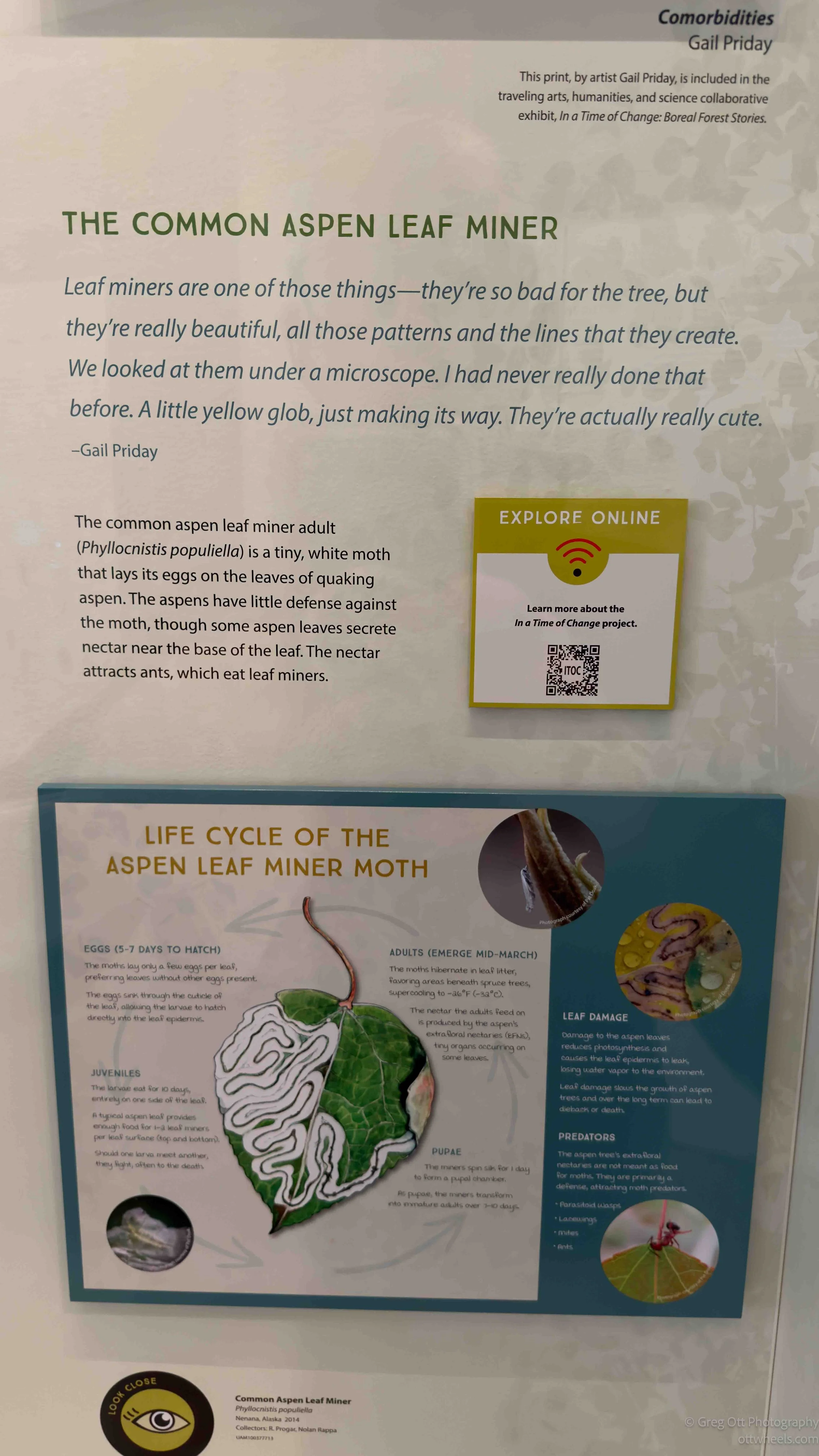
One display looked at Alaska's changing forests. I learned about the common aspen leaf miner, a tiny moth whose larvae create the winding patterns I've seen on aspen leaves, and aspen running canker, a fungal disease that can rapidly damage and kill trees. Another section focused on growing food in Alaska, where the short season is partly offset by incredibly long summer days. There were displays on potatoes, cabbage, broccoli, berries, greenhouse crops and Alaska's surprisingly large peony industry, which started in Fairbanks.
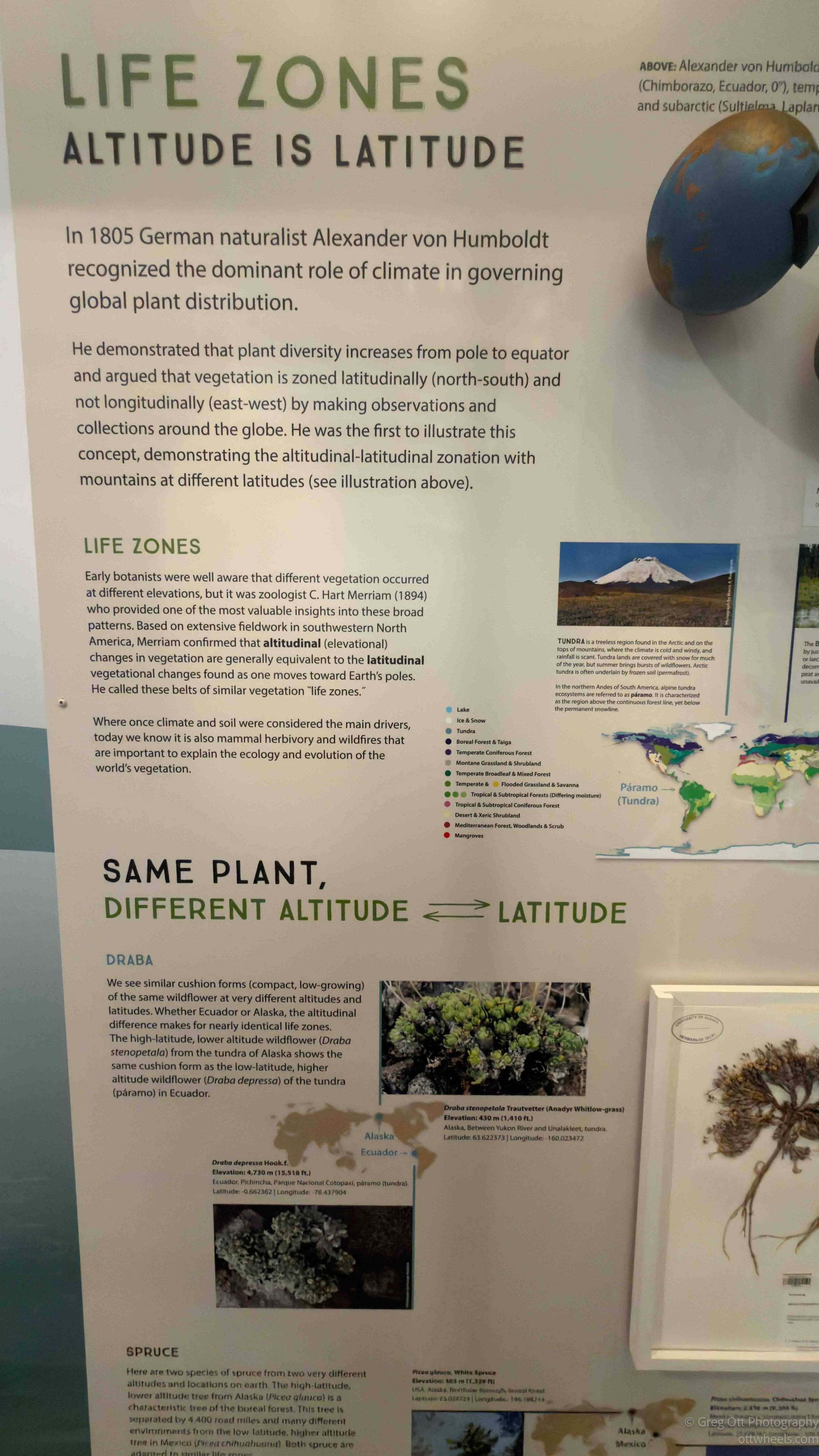
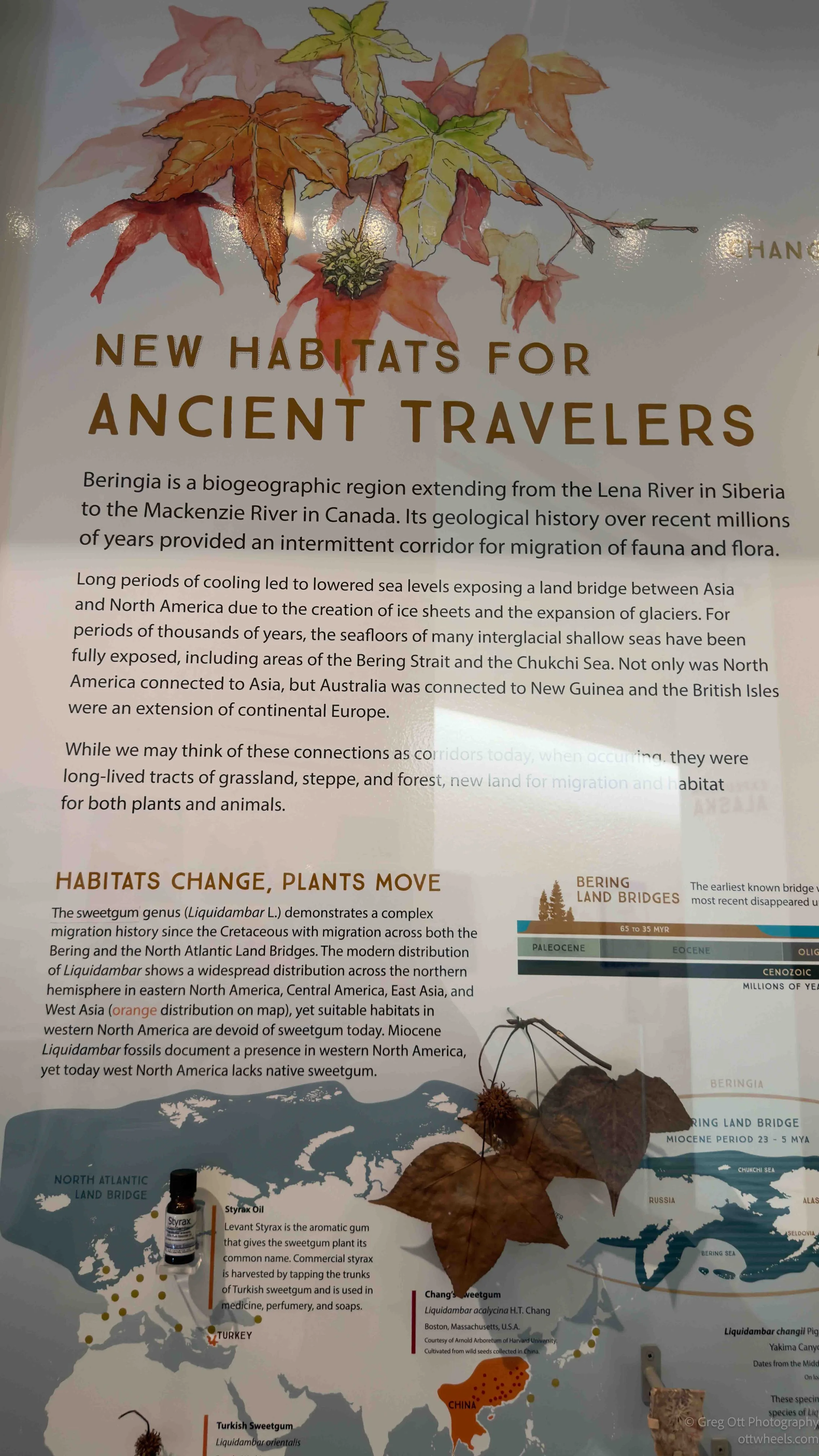
I also stopped at an exhibit explaining the idea that "altitude is latitude"—as you climb a mountain, the changes in plants can resemble what happens as you travel farther north. Nearby was a display on Beringia and the movement of plants between Asia and North America. I tend to think of the Bering Land Bridge in terms of people and animals, but plants traveled across it as well.
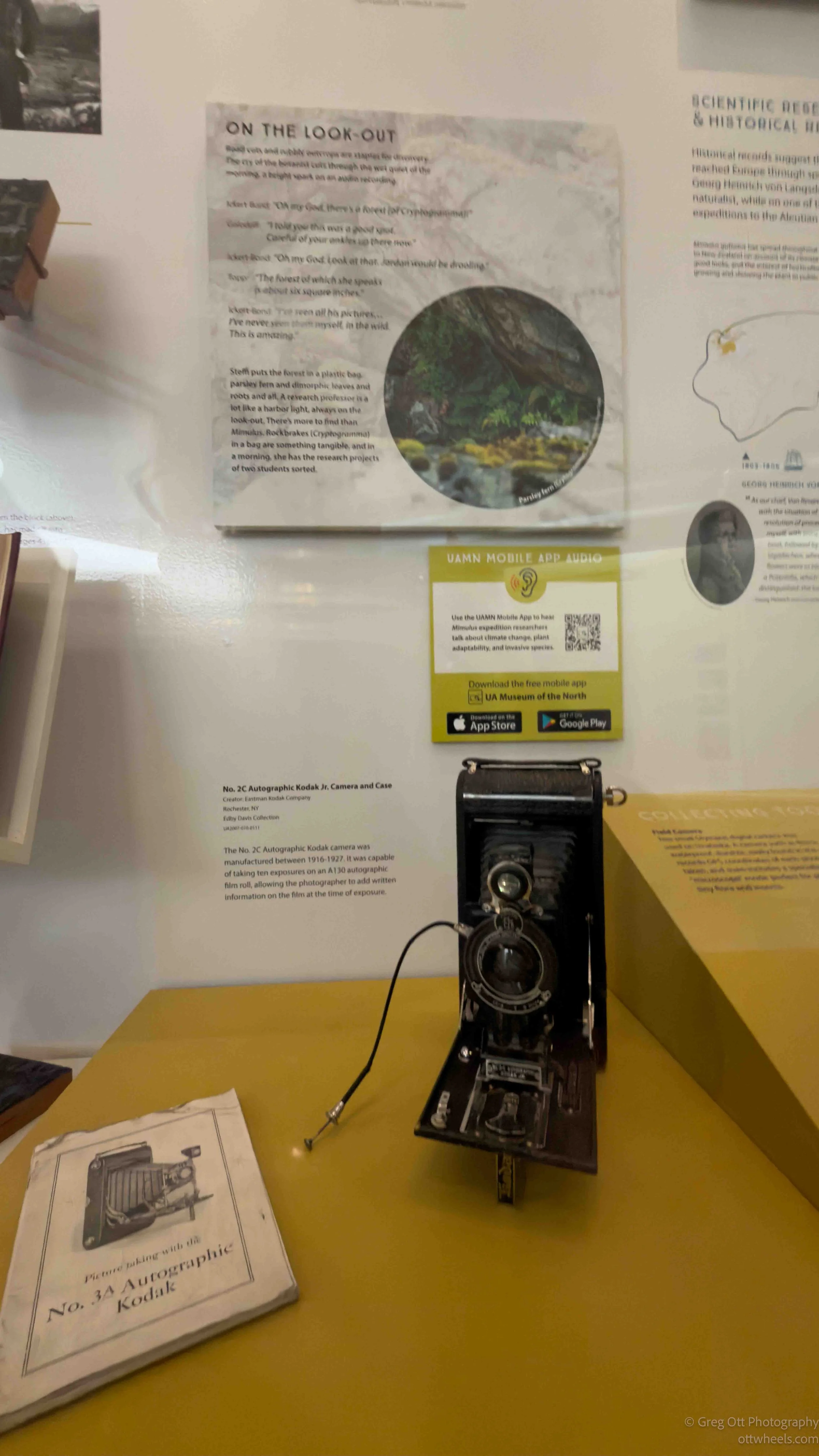
One of my favorite displays was much simpler: old botanical books, printing blocks used to illustrate plants, and an early folding Kodak camera that researchers once carried into the field. Looking at those tools next to today's research made the whole gallery feel less like a collection of specimens and more like a continuing effort to understand Alaska.
Walt & Marita Babula Planetarium
Around 2 p.m., I went to the new Walt & Marita Babula Planetarium for two shows. The first was Aurora: Lights of Wonder, a 4K film about the northern lights and the science behind them. I had already seen the same film at the Visitor Centre in Watson Lake, Canada, but watching it spread across the planetarium's large curved dome was a completely different experience.
I stayed for the second presentation, Pretty Cool Space Movie, which took us from Earth out through the solar system and eventually into distant nebulae and galaxies. The planetarium is brand new, opening this year, and with the image surrounding you overhead instead of sitting on a screen in front of you, it was worth spending an hour there.
Gallery of Alaska
Next I moved into the Gallery of Alaska, where the first thing you encounter is hard to miss: an enormous brown bear standing nearly nine feet tall. One of the things I've learned traveling through Alaska is that brown bears and grizzly bears aren't separate species. They're both Ursus arctos. The names generally describe where and how they live, with the huge coastal bears usually called brown bears and the generally smaller inland bears called grizzlies. This particular bear is 8 feet 9 inches tall.
The gallery is divided into different regions of Alaska. Much of the Southwest section was now familiar to me. There were exhibits on the Unangax̂ people, traditional kayaks, hunting, clothing and the Japanese invasion of the Aleutian Islands during World War II. Having been to Dutch Harbor and Unalaska, I had already seen many of these stories where they actually happened. The museum also covered the forced evacuation of the Unangax̂ from their villages during the war and their confinement in terrible conditions in Southeast Alaska. Decades later, the federal government formally acknowledged the injustice and provided restitution.
The Interior exhibits were more about how people lived here: hunting, clothing, boats, tools and spiritual beliefs. There were kayaks made for different regions and conditions, masks, elaborate fur clothing and small carved objects made from ivory and bone. One display explained the Inuit belief that living things, and even natural objects, possessed spirits. Ceremonies involving masks, dancing, singing and feasting were ways of honoring the animals that sustained the community.
Pleistocene Alaska
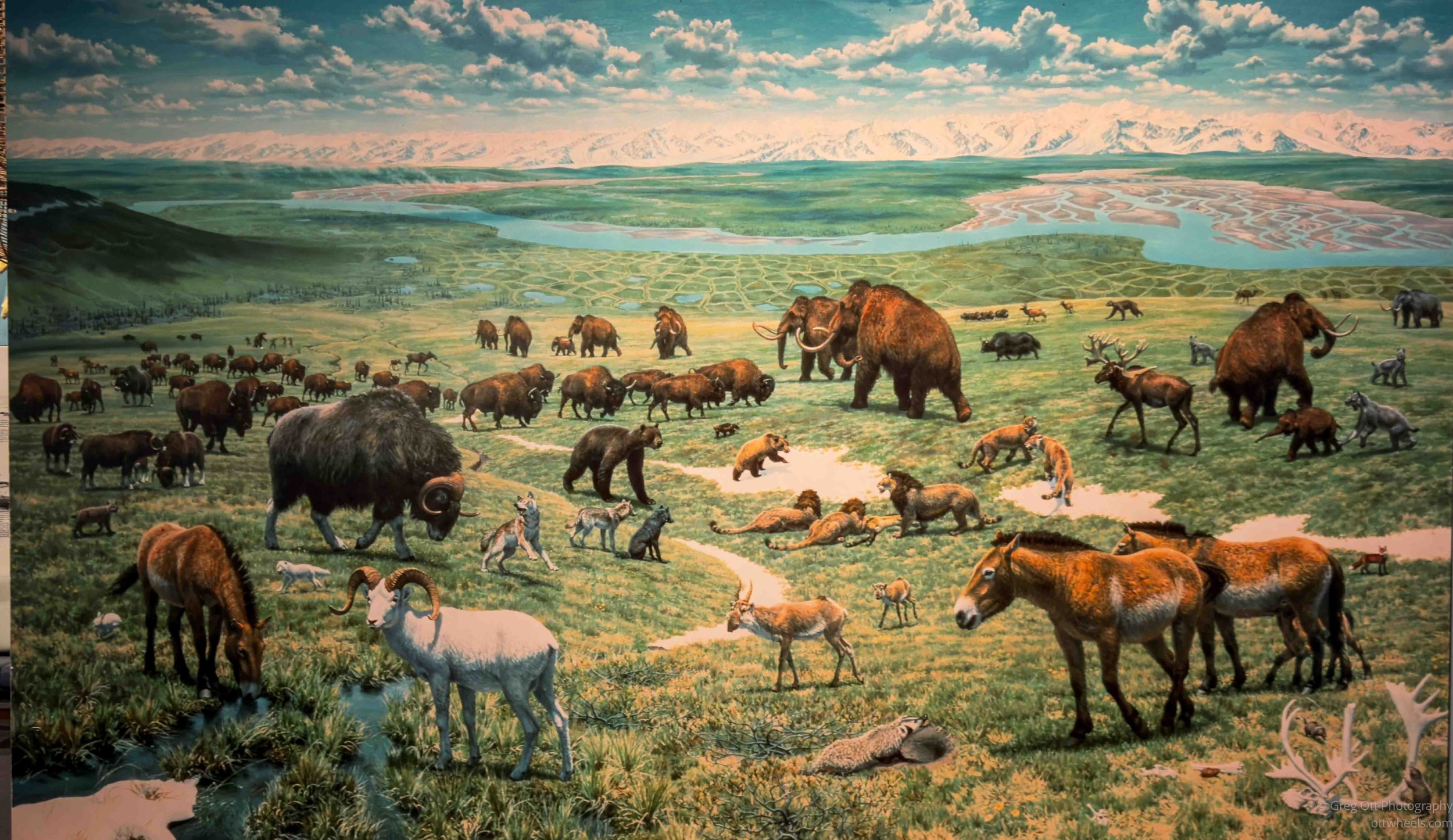
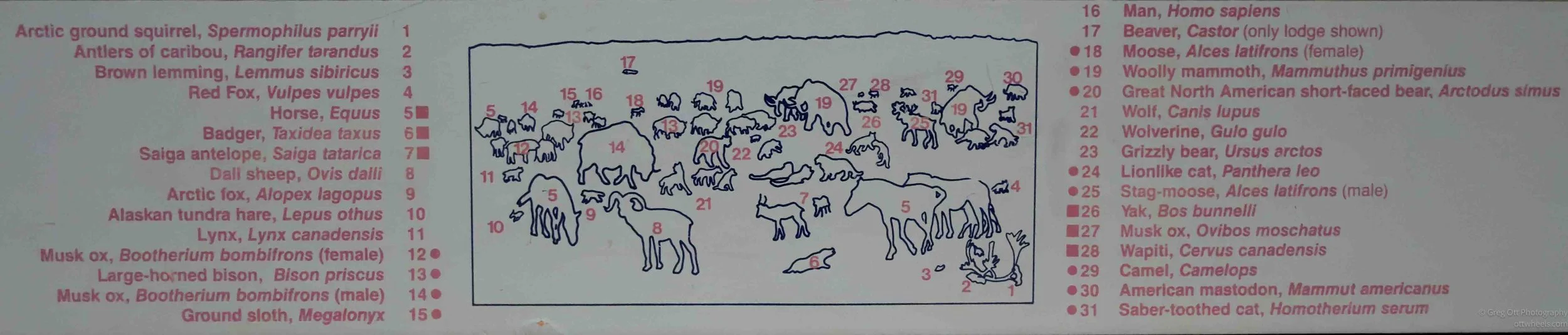
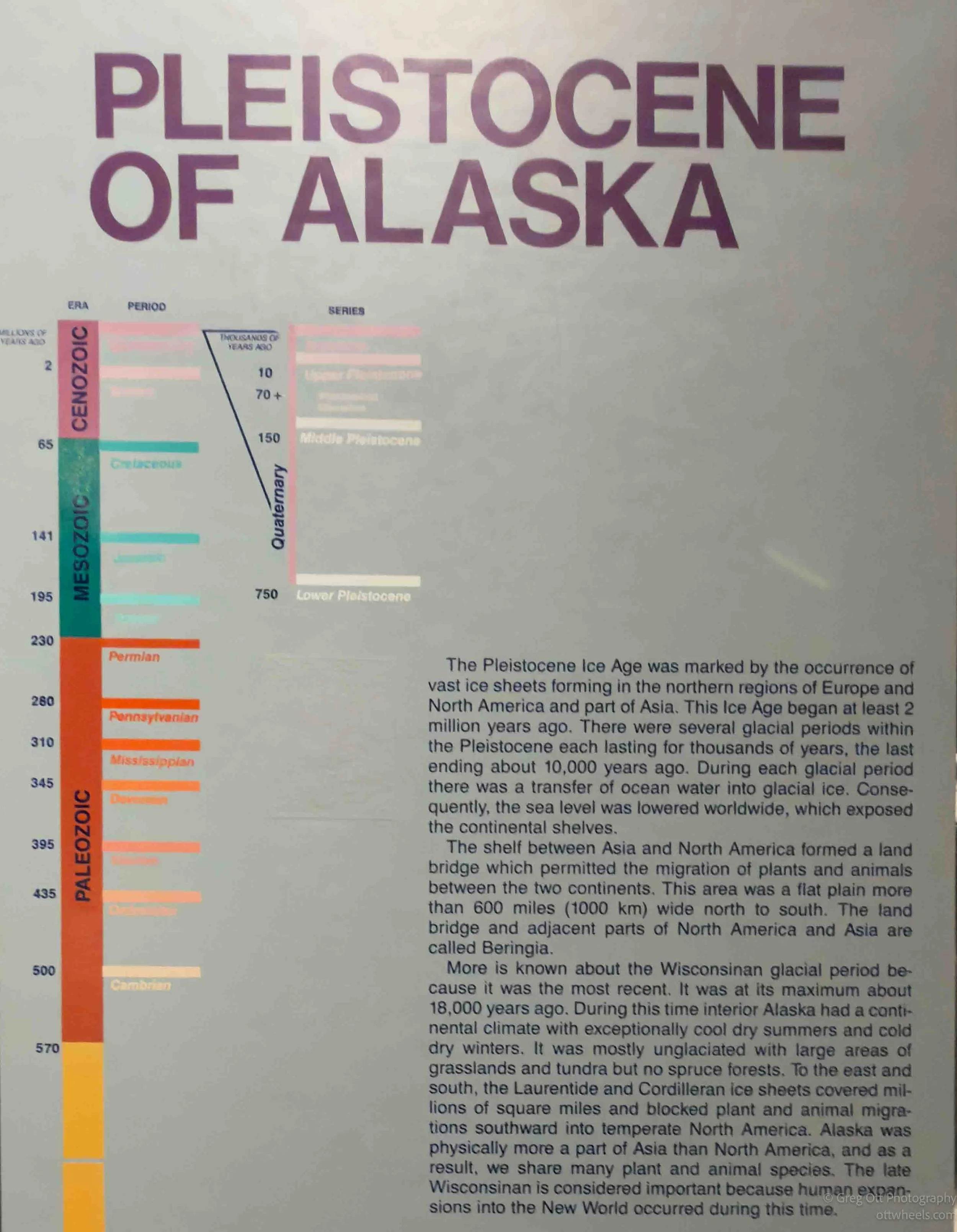
The part that really caught my attention was Pleistocene Alaska. A huge mural showed what the Tanana Valley outside the museum might have looked like 16,000 to 20,000 years ago. Instead of today's boreal forest, it was largely open grassland filled with animals. Mammoths, steppe bison and horses were among the most abundant, but the mural also included caribou, musk ox, wolves, lions, bears and other animals. Some are still here. Others disappeared from Alaska thousands of years ago.
It was fascinating to look at the mural and realize that this wasn't some imaginary landscape on the other side of the world. It was Fairbanks. The Alaska Range painted across the background was essentially the same range I had been looking at through the museum window during lunch.
Blue Babe
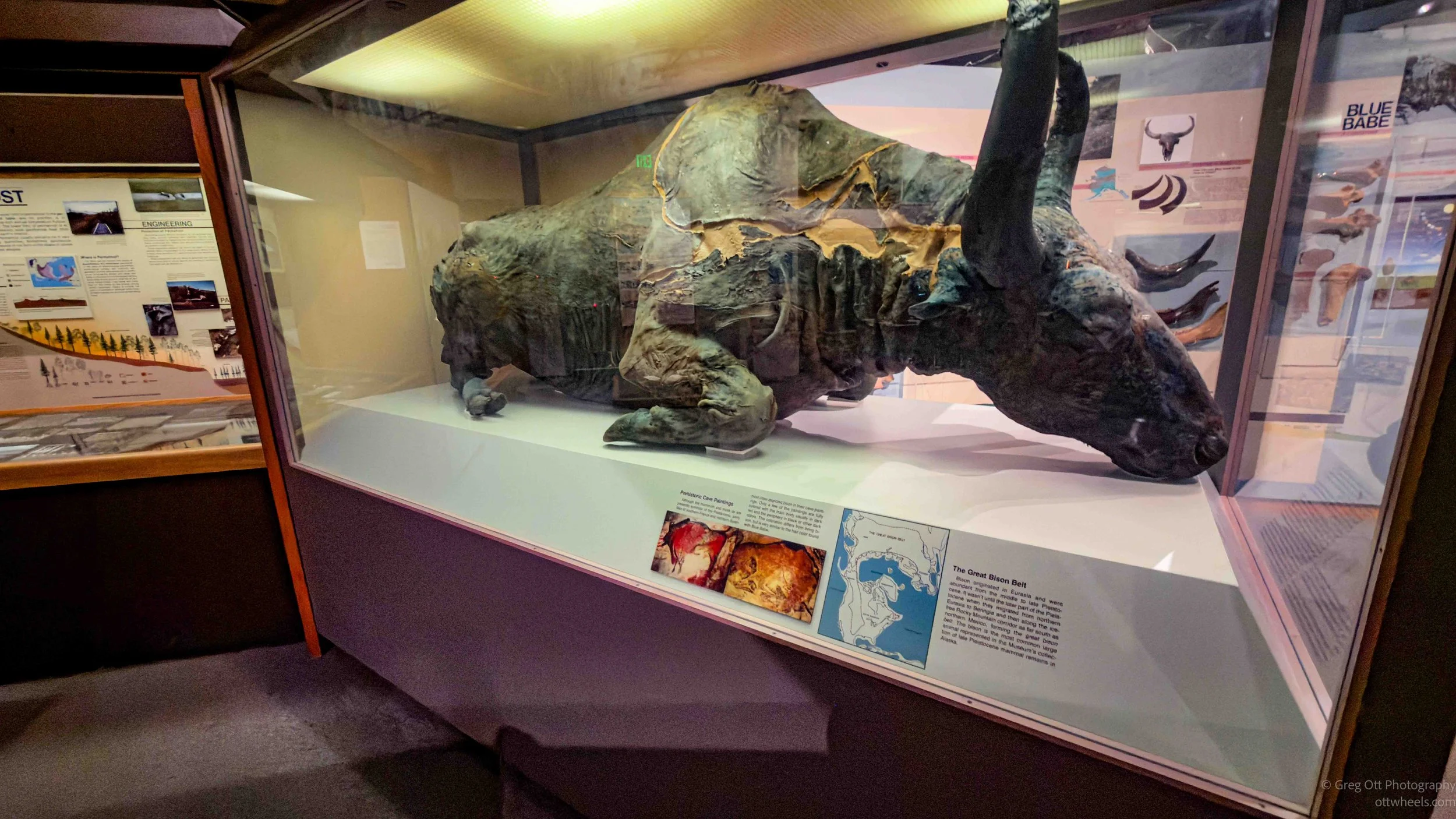
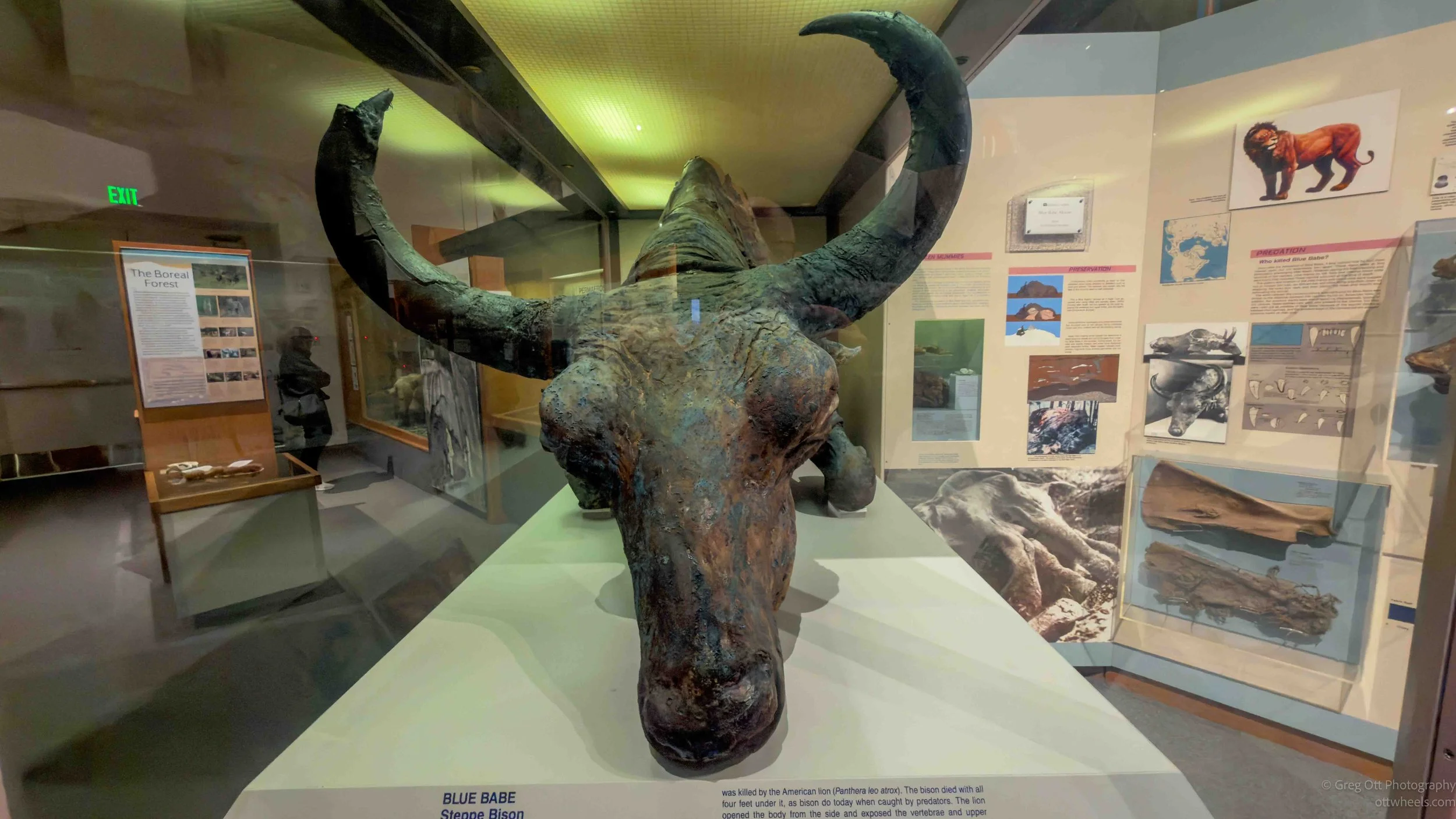
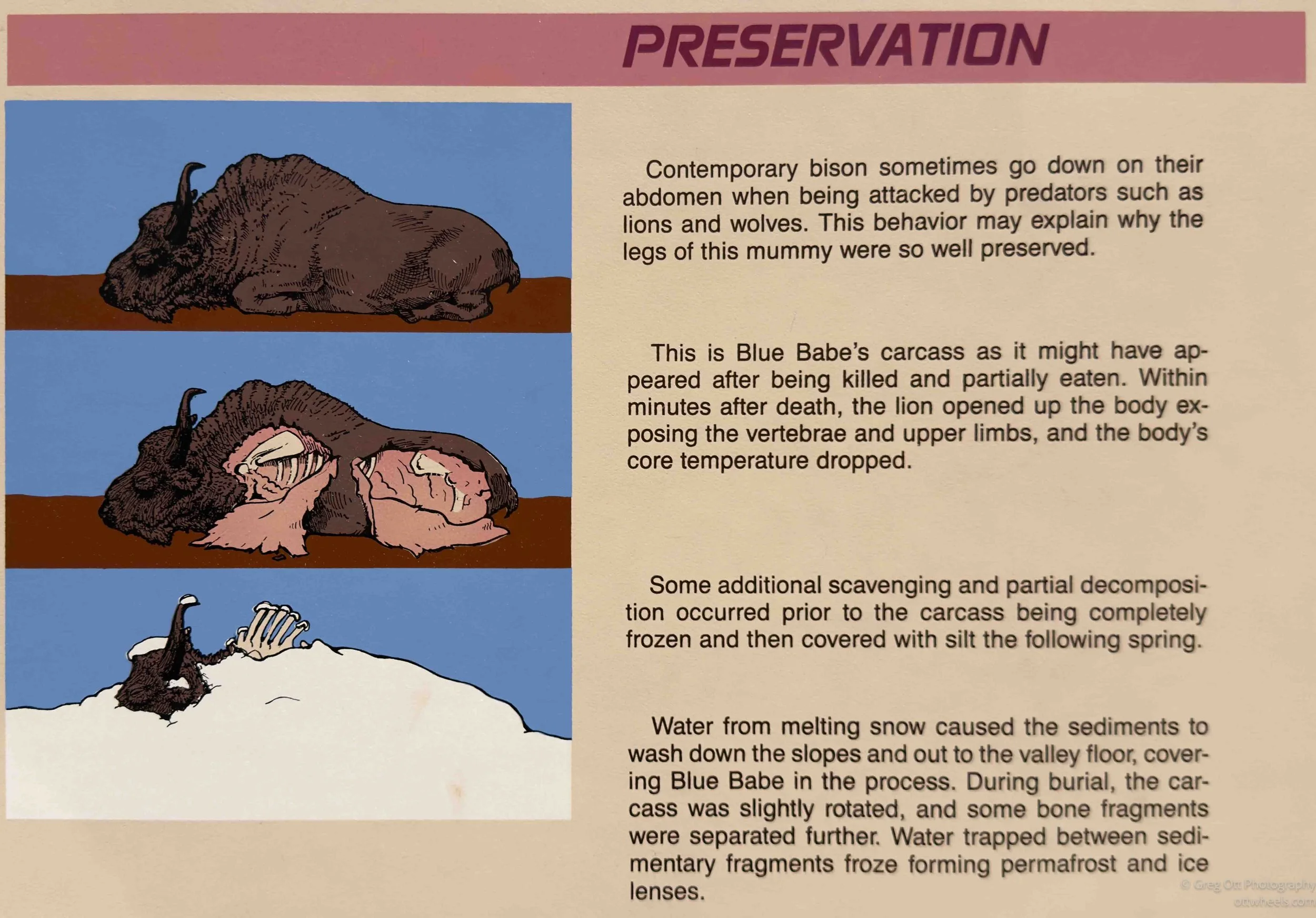
Then I came to Blue Babe, one of the museum's most famous exhibits. Blue Babe is a steppe bison discovered by gold miners north of Fairbanks in 1979, frozen in the permafrost. The animal is more than 50,000 years old and was killed by an American lion, an extinct relative of today's lions. Puncture wounds and other evidence preserved in the hide helped researchers reconstruct what happened.
At first I wasn't sure what I was actually looking at. It looked almost too complete to be the original animal. It turns out that it is both real and reconstructed. The body underneath is a model, but the skin stretched over it is the actual preserved hide of Blue Babe. The bones were removed and are maintained separately in the museum's research collection, while the head and horns have been kept frozen for continuing research.
That changed the way I looked at the display. This wasn't simply someone's idea of what a steppe bison looked like. I was standing a few feet from the actual skin of an animal that walked around Interior Alaska more than 50,000 years ago. Stunning!!
Permafrost
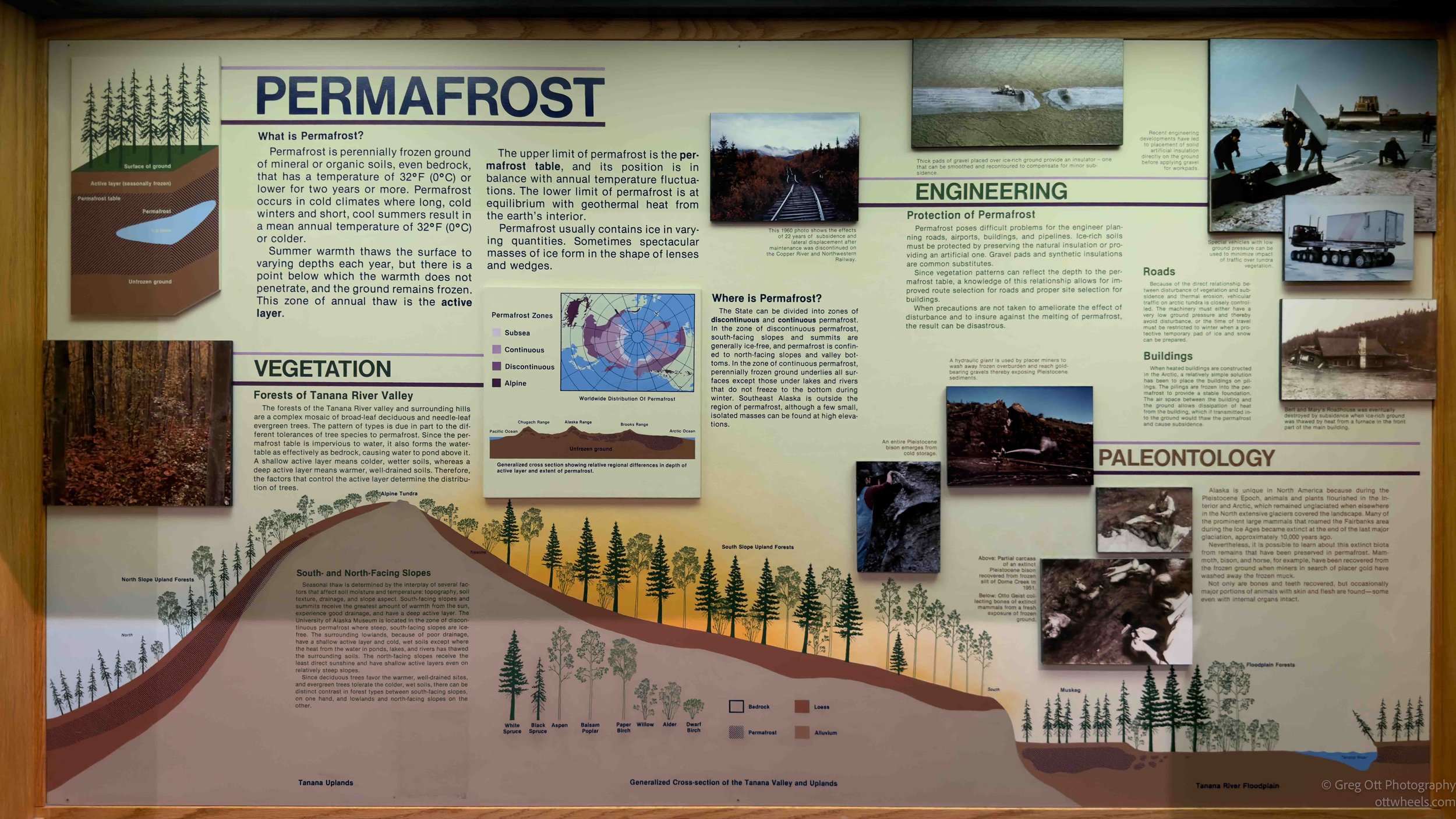
I've been fascinated by permafrost since I first stopped along the highway in Canada and read about thermosyphons. Since then, I seem to notice them everywhere. After traveling north through Alaska and seeing buildings, roads and the Trans-Alaska Pipeline engineered around frozen ground, the museum's permafrost exhibit tied a lot of what I'd been seeing together.
Permafrost isn't necessarily ice. It is ground that remains at or below freezing for at least two consecutive years. The surface above it can thaw every summer, creating what is called the active layer, while the ground underneath remains frozen. The problem comes when ice-rich permafrost thaws. The ice melts, the ground loses volume and can sink or shift, which is obviously not good if you've built a road, runway, building or pipeline on top of it.
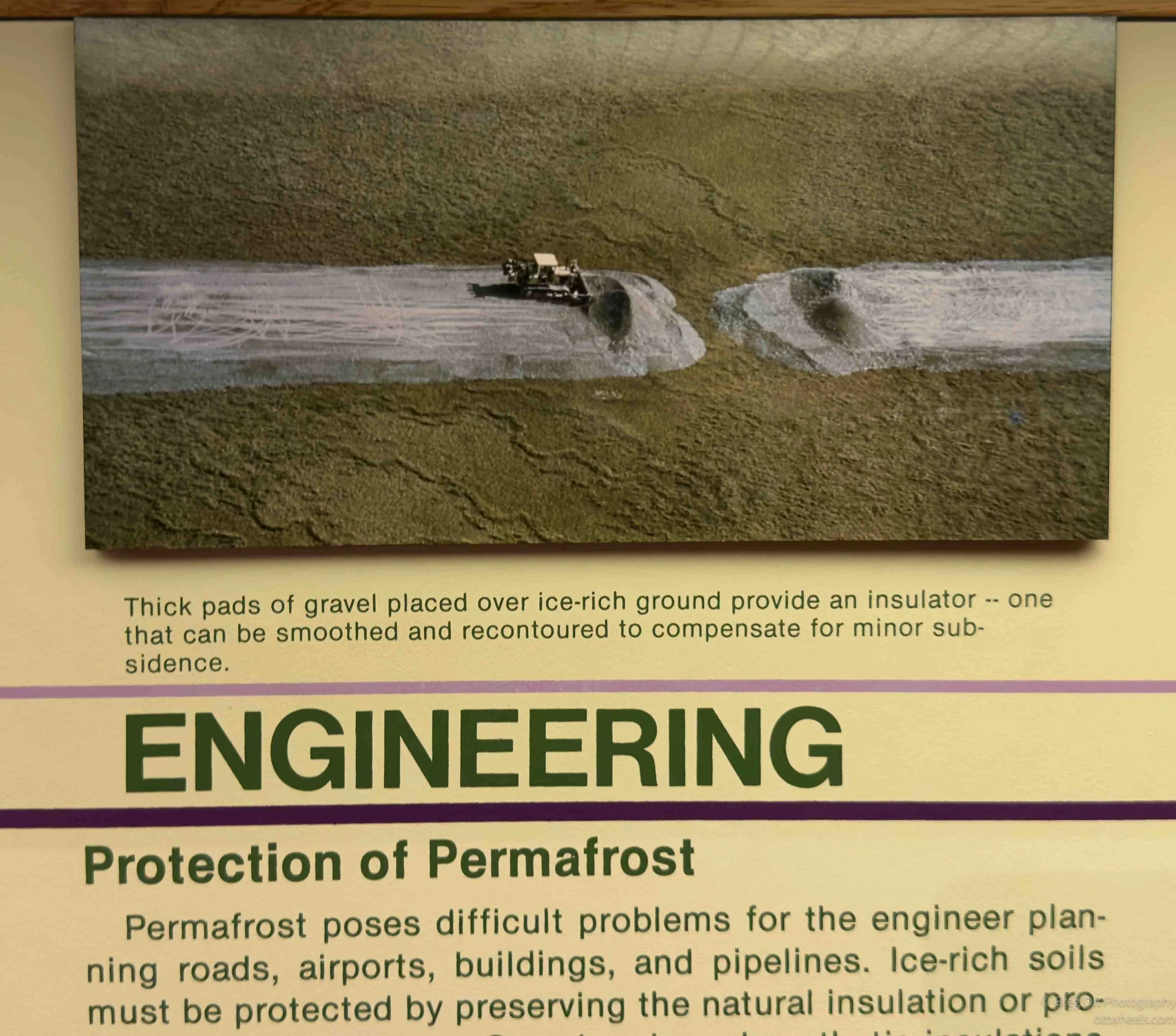
The exhibit showed some of the ways engineers deal with the problem. Thick gravel pads insulate the ground and spread loads, while some newer construction uses rigid insulation beneath the gravel. Thermosyphons take the idea further by passively pulling heat out of the ground during cold weather, helping keep the permafrost frozen. After seeing them along highways, beside buildings and supporting sections of the pipeline, I finally had a much better understanding of why they are so important in Alaska.
Claire Fejes
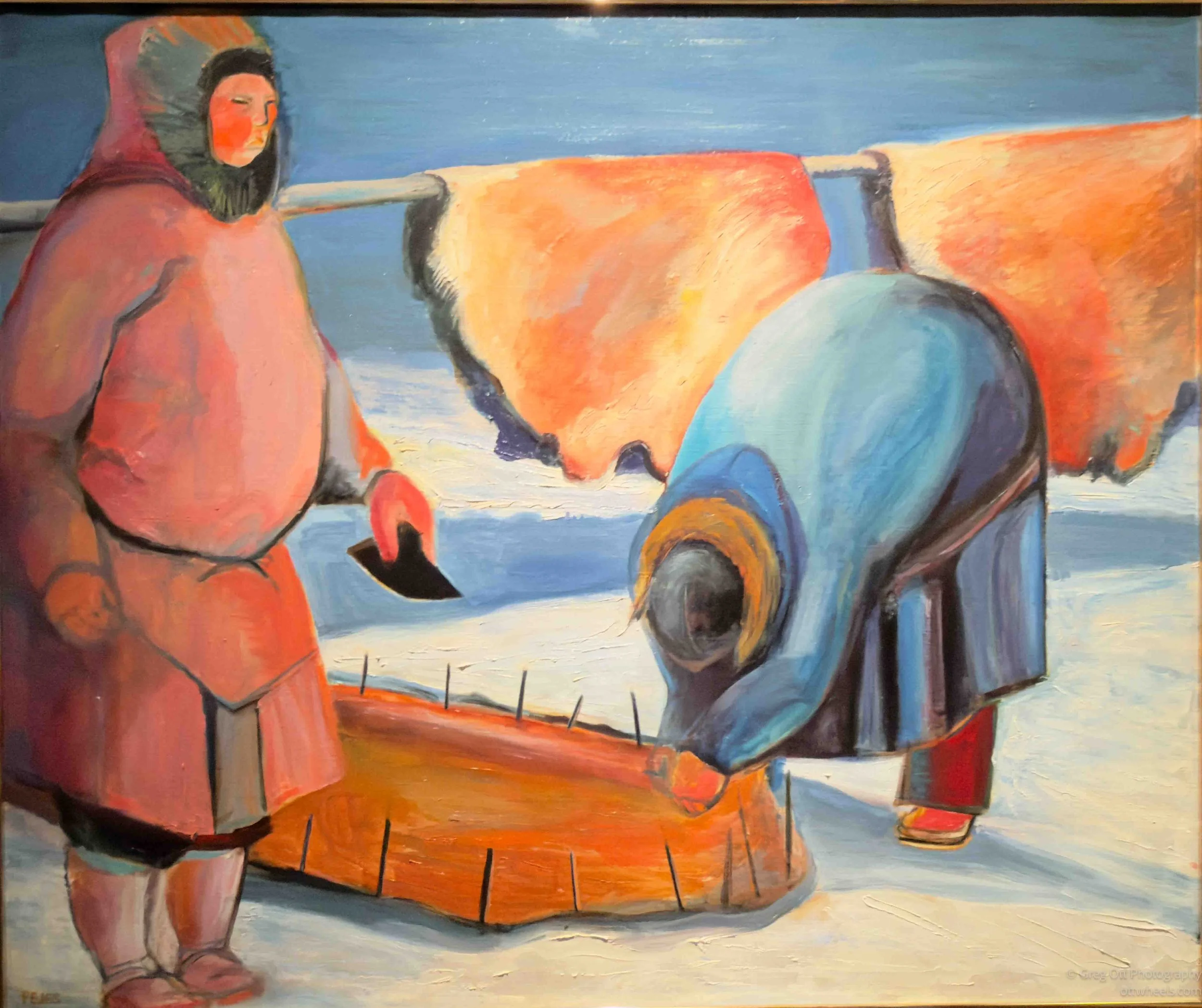
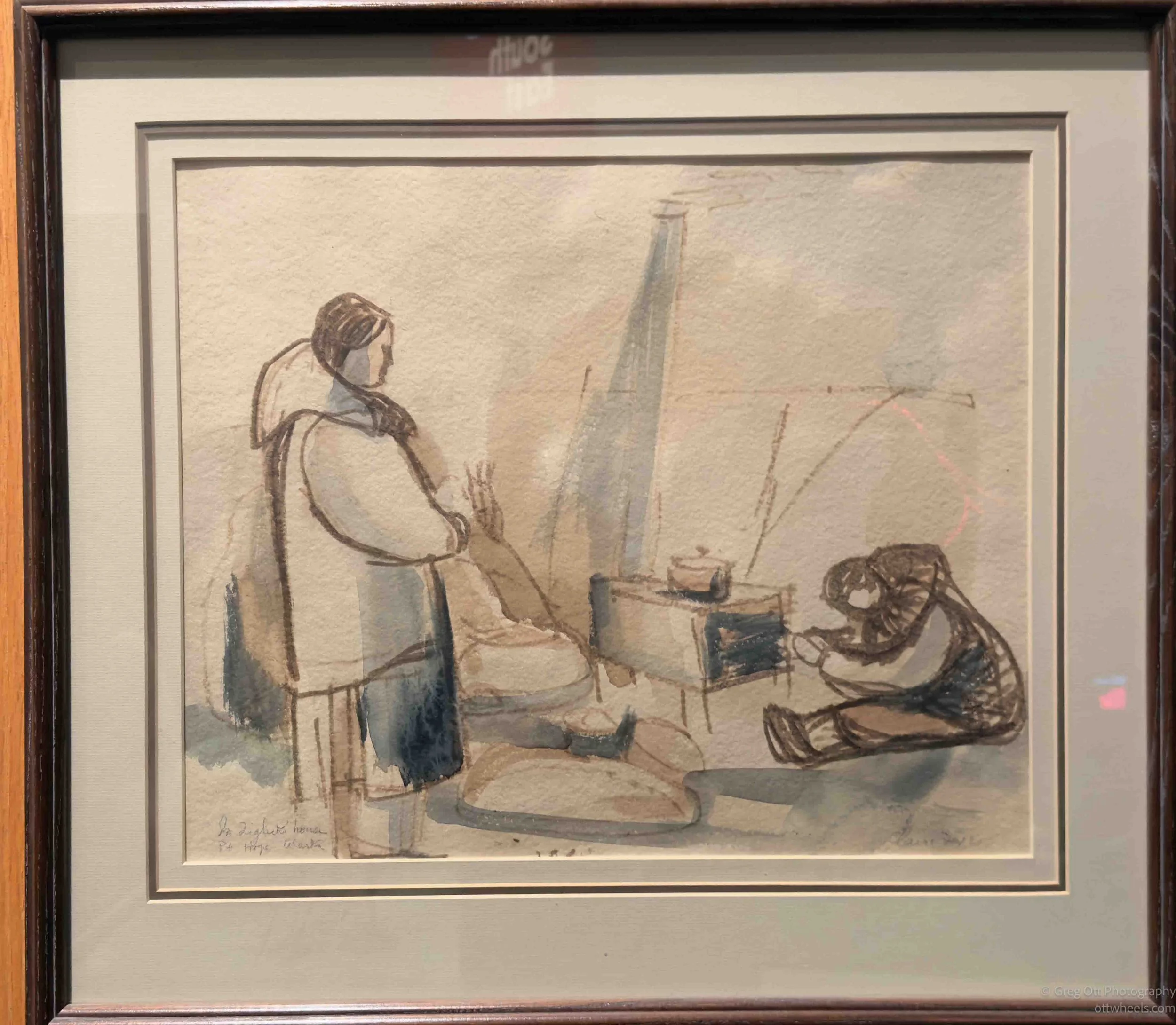
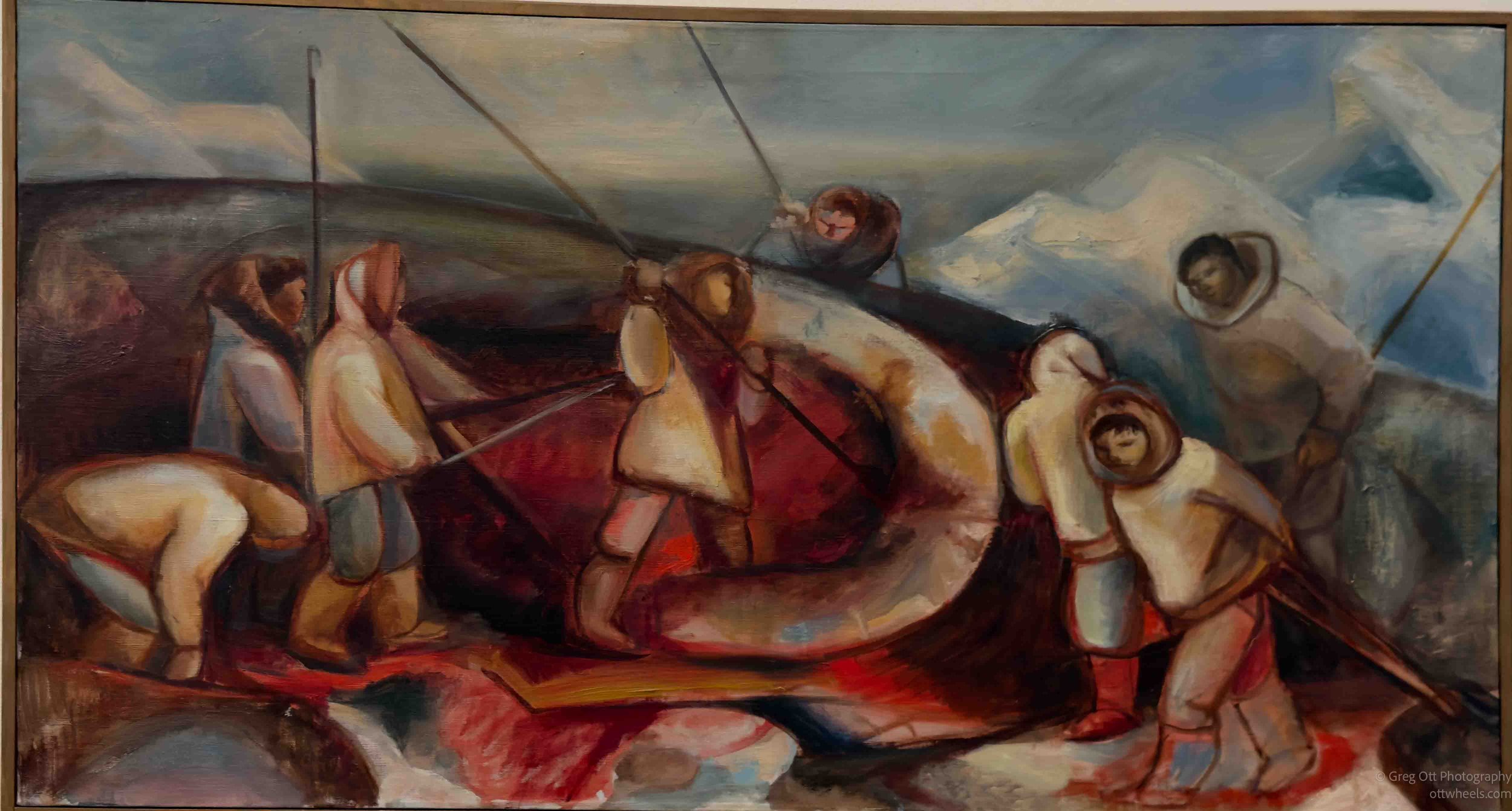
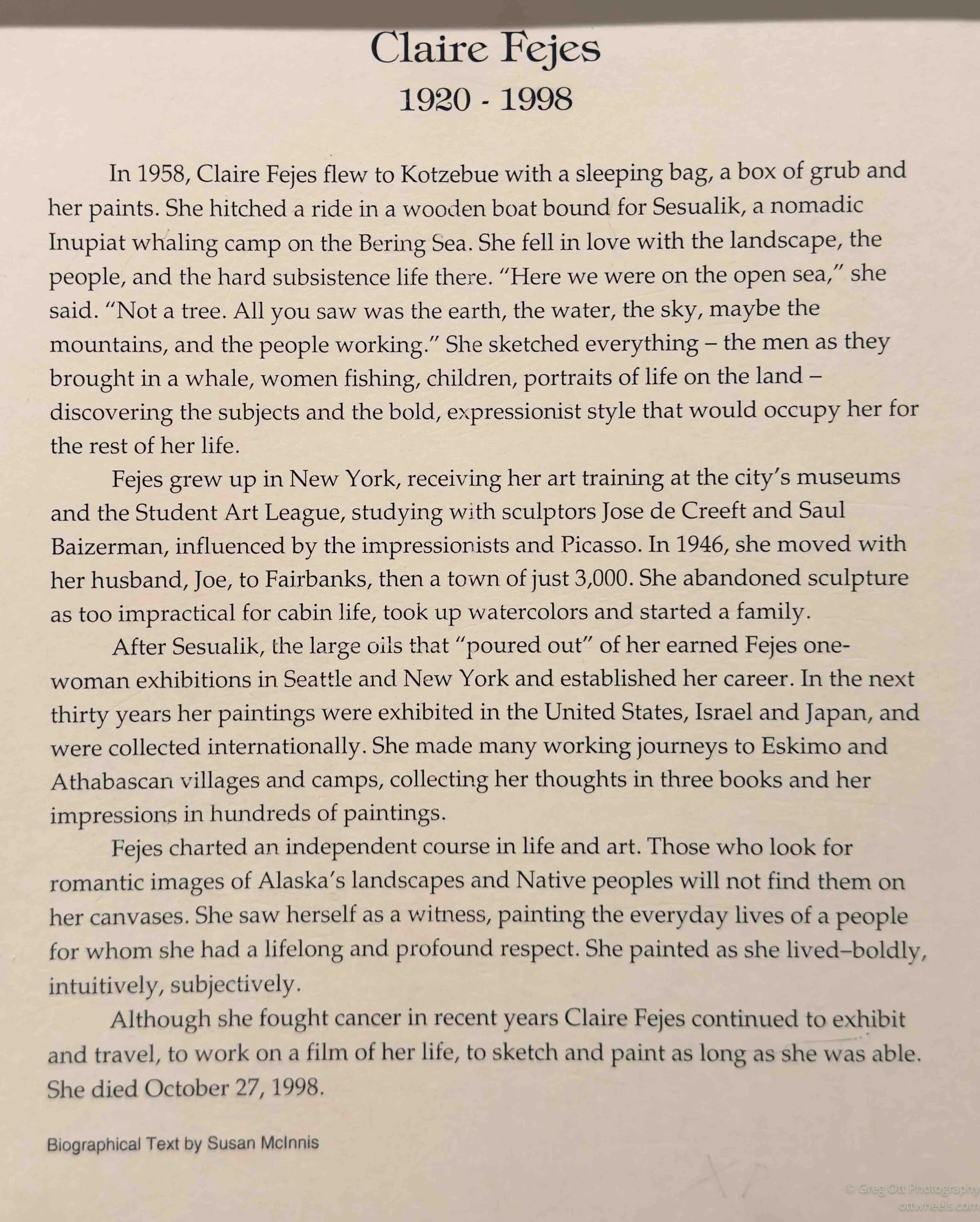
There was also a section devoted to Alaska artists, including Claire Fejes, whose work immediately caught my attention. She came to Fairbanks with her husband in 1946 and, in 1958, traveled to a nomadic Iñupiat whaling camp near Kotzebue with little more than a sleeping bag, food and her paints.
Her style was impressionistic, with broad, loose brushstrokes, strong colors and simplified forms. She wasn't trying to reproduce every detail of a scene. Instead, she captured the people, movement and feeling of everyday life—people working, fishing, bringing in whales and simply living on the land. There was an energy to the paintings that I really liked.
Her work wasn't a romanticized, picture-postcard version of Alaska. Fejes considered herself a witness to what she saw, and over the following decades she traveled extensively throughout Alaska, particularly to Iñupiat and Athabascan villages and camps, producing hundreds of paintings.
The Trans-Alaska Pipeline
I'd already seen several exhibits and presentations about the Trans-Alaska Pipeline, and after following it for hundreds of miles along the Dalton Highway, much of the story was familiar. Still, this exhibit was short, visual and particularly well done.
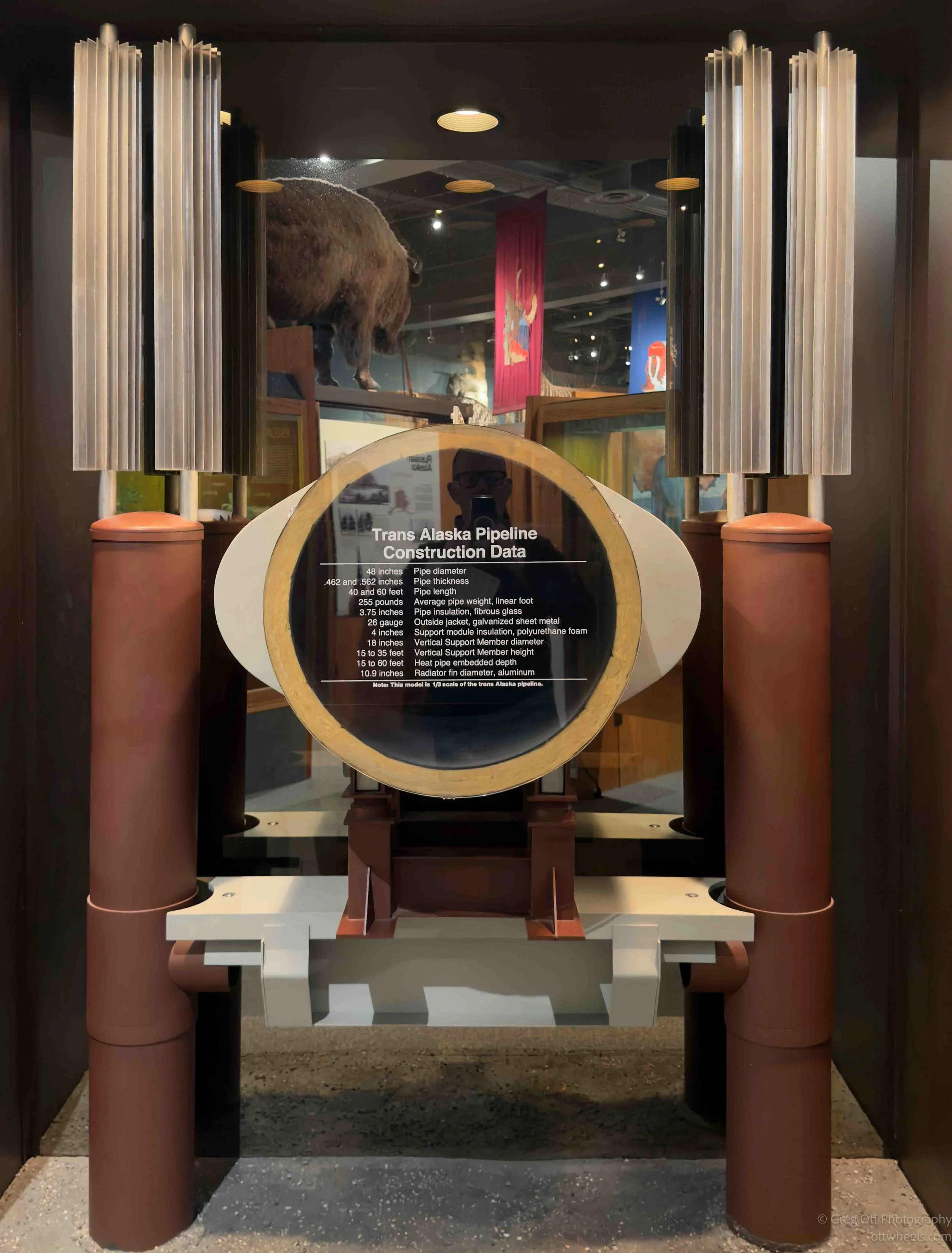
A detailed cutaway model showed the 48-inch pipeline, its insulation, outer jacket and the vertical supports used where the pipeline runs above ground. It also showed the thermosyphons I'd been noticing since Canada, which pull heat from the ground and help keep the permafrost frozen.
The exhibit also explained why the pipeline is buried in some places and elevated in others. In areas with ice-rich permafrost, the warm oil flowing through a buried pipeline could thaw the frozen ground and destabilize it, so the pipeline is raised above the surface. After seeing so much of the real thing, the model did a nice job of pulling everything together.
There were so many more exhibits that were well done. These were the ones that I stopped and spent time with before finding my way to the second floor.
The Place Where You Go to Listen
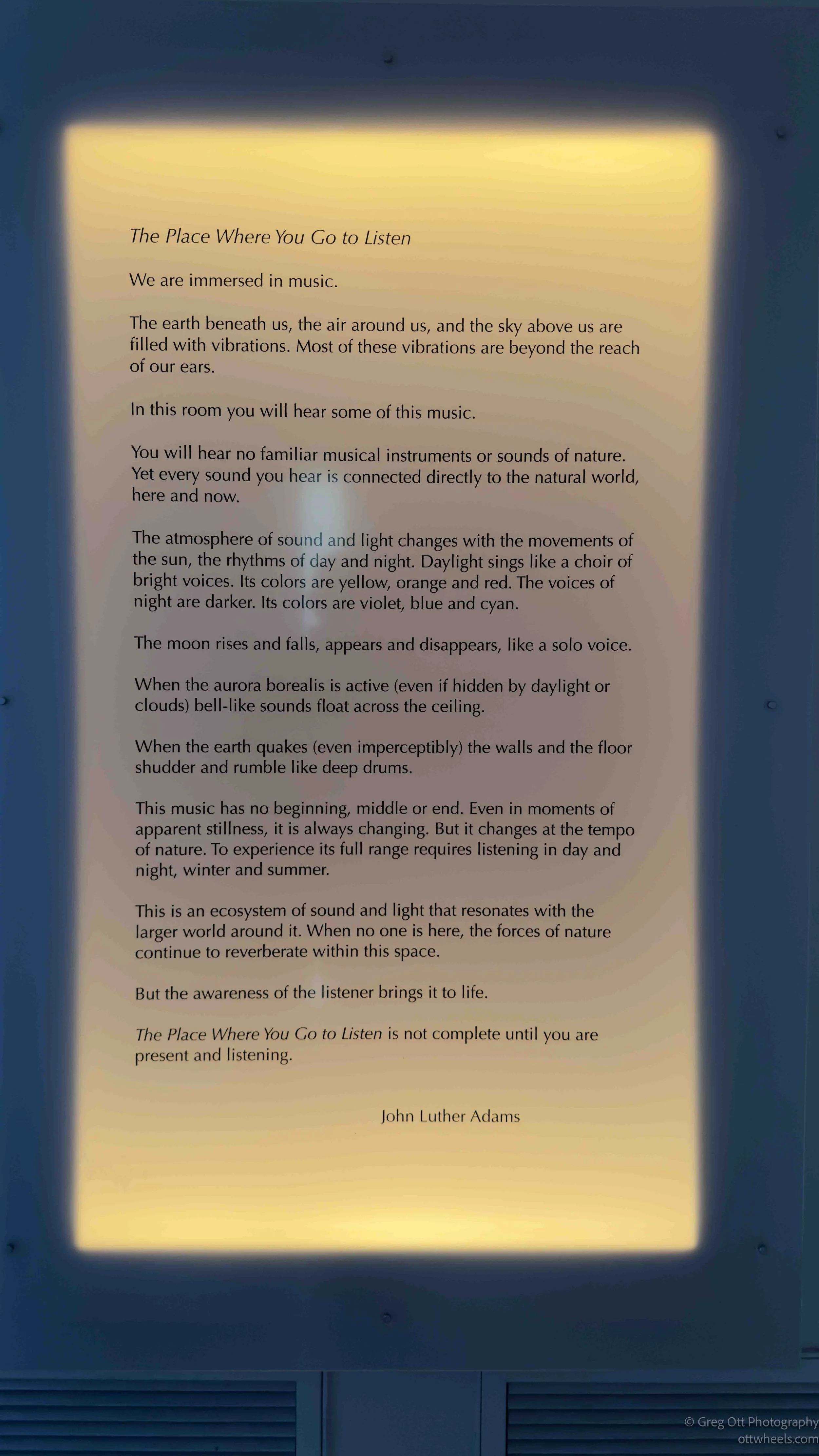
Near the top of my list for the museum was The Place Where You Go to Listen. I wasn't entirely sure what to expect. It isn't really an exhibit in the traditional sense. Created by composer John Luther Adams, who lived in Alaska for decades, it's a small, quiet room filled with continuously changing light and sound.
What makes it so unusual is that the music isn't prerecorded. Alaska itself is essentially playing the instrument. Real-time data from earthquakes, Earth's magnetic field, the aurora, daylight and the moon are translated into sound and light. Deep tones seem to come from the earth while other sounds slowly rise and fall around you. The composition never repeats because the natural forces creating it never repeat.
The name comes from Naalagiagvik, an Iñupiaq name for a place on Alaska's Arctic coast where, according to a traditional story, a woman went to sit quietly and listen—to birds, whales and things that couldn't ordinarily be heard. Adams was also influenced by composer John Cage and his idea that music could simply be the sounds already around us.
There isn't really anything to do once you're inside. That's the point. You sit on the bench, stop moving and listen. After a few minutes, you begin noticing subtle changes in the sounds and light. Somewhere beneath you the earth may be moving. The magnetic field above Alaska may be changing. These things are happening all the time, but normally we can't hear them.
Sitting there, I couldn't help thinking about the yogic Aum. In yoga, Aum isn't simply a sound we make when we chant. It represents an underlying vibration that is already present in the universe, something we become aware of by becoming still and listening. I don't know of any connection between that tradition and the Iñupiaq idea of Naalagiagvik, but that's what made it so interesting to me. Two cultures, separated by thousands of miles, seem to have independently arrived at a similar thought: the world is never really silent. We just have to become quiet enough to listen.
I spent the last hour in the Rose Berry Alaska Art Gallery on the top floor. I recognized several artists I'd seen in other museums around the state, but many were new to me. There was also a collection of black-and-white photographs documenting life in Alaska decades ago.
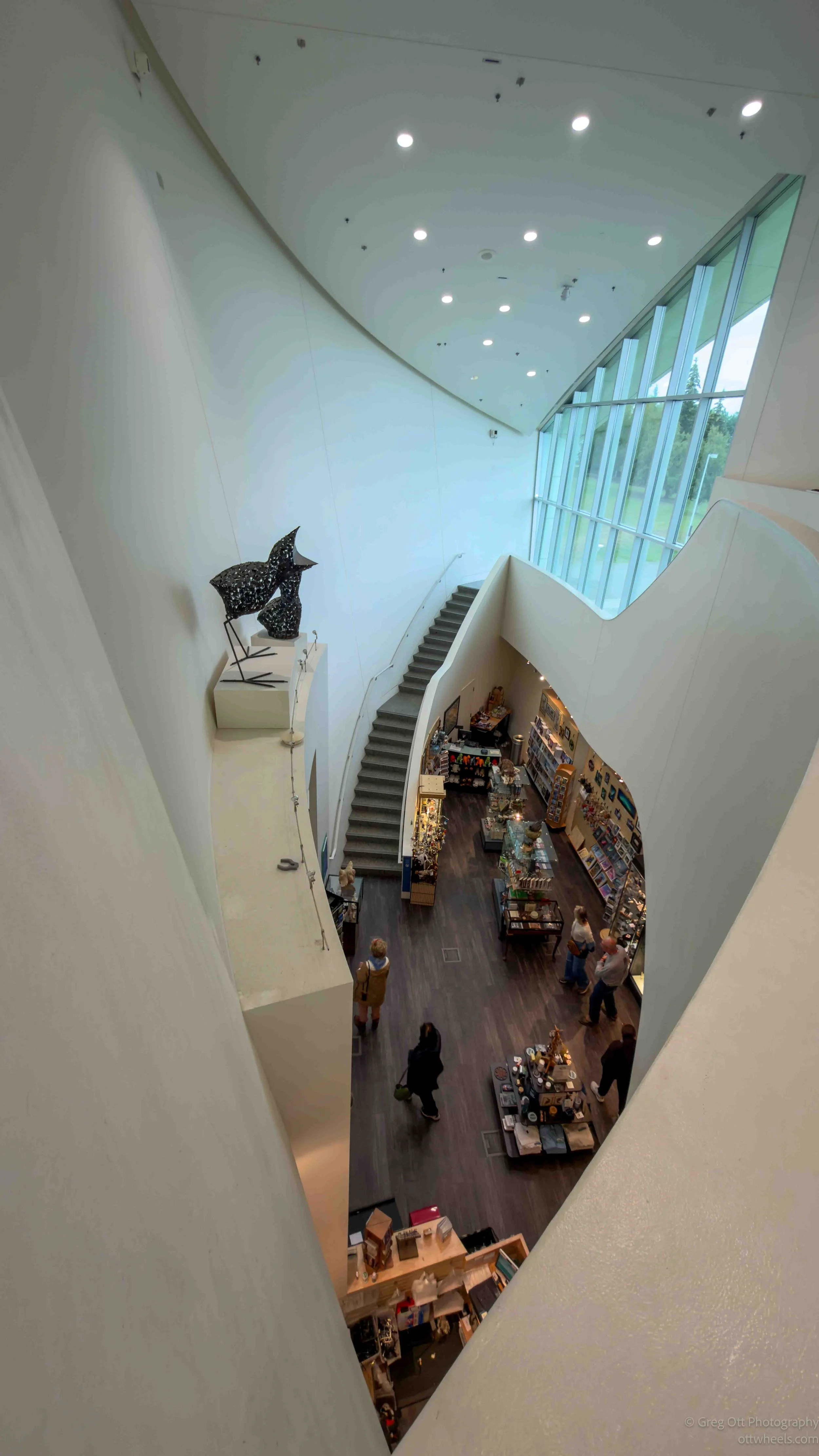
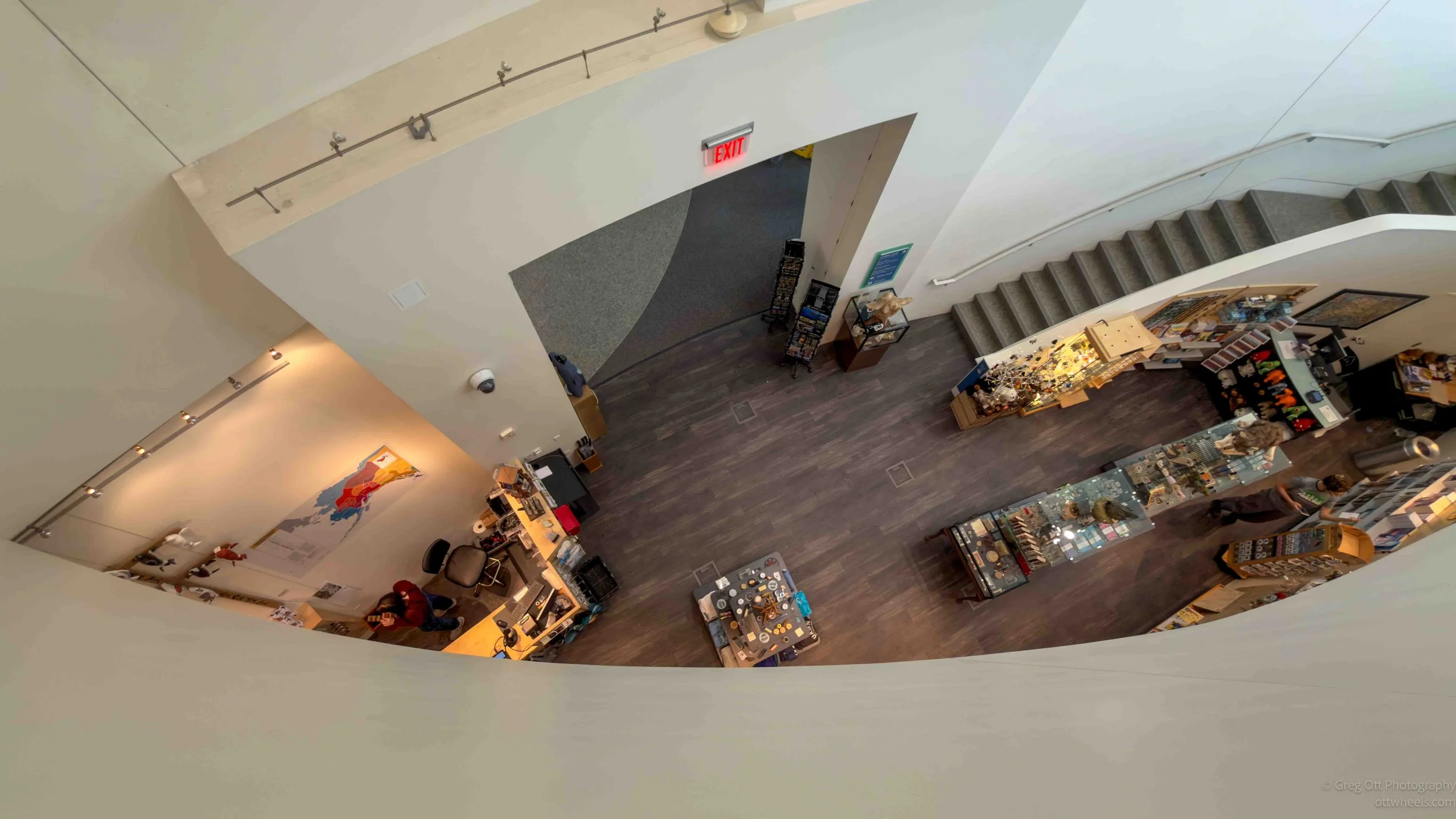
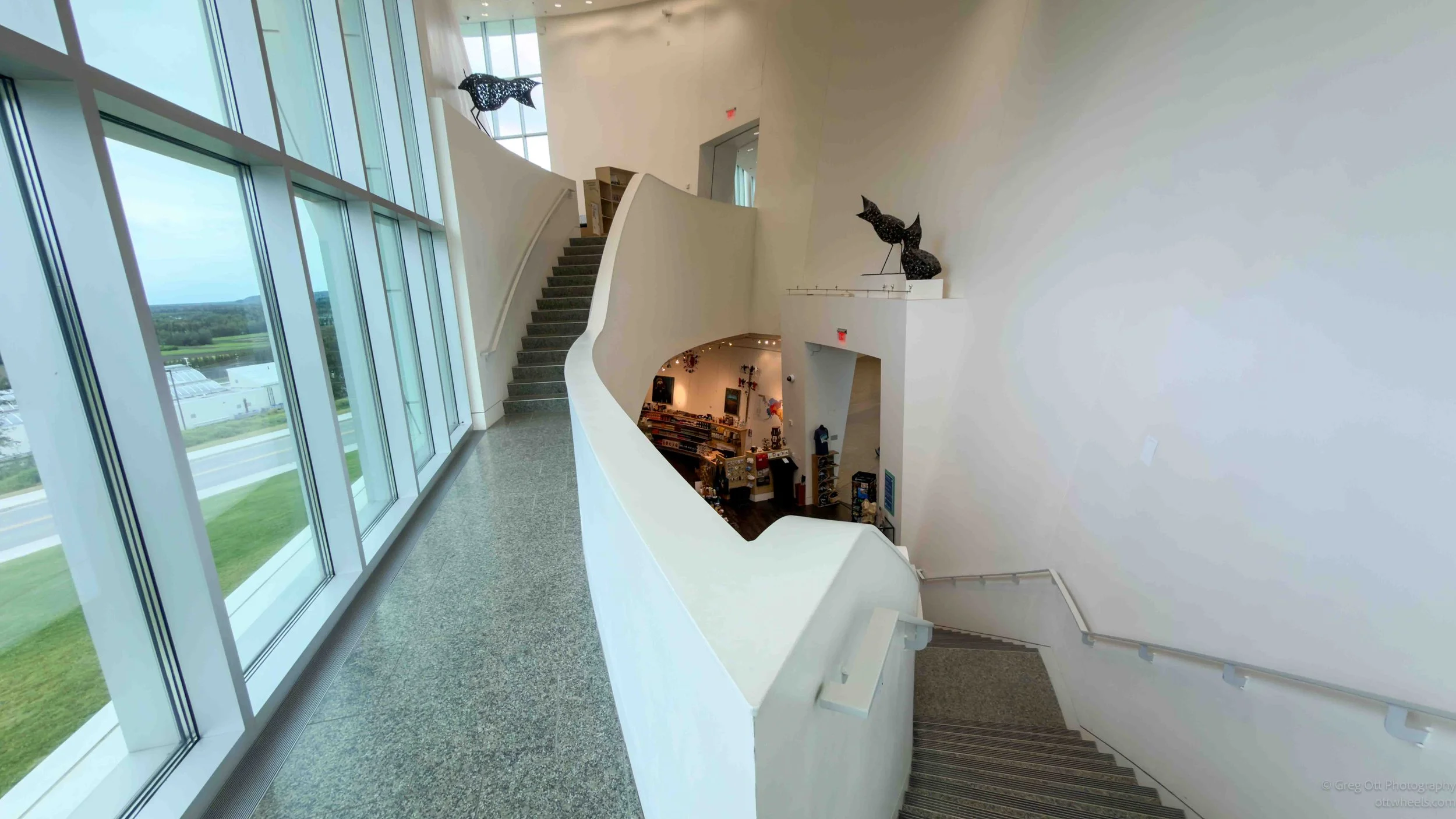
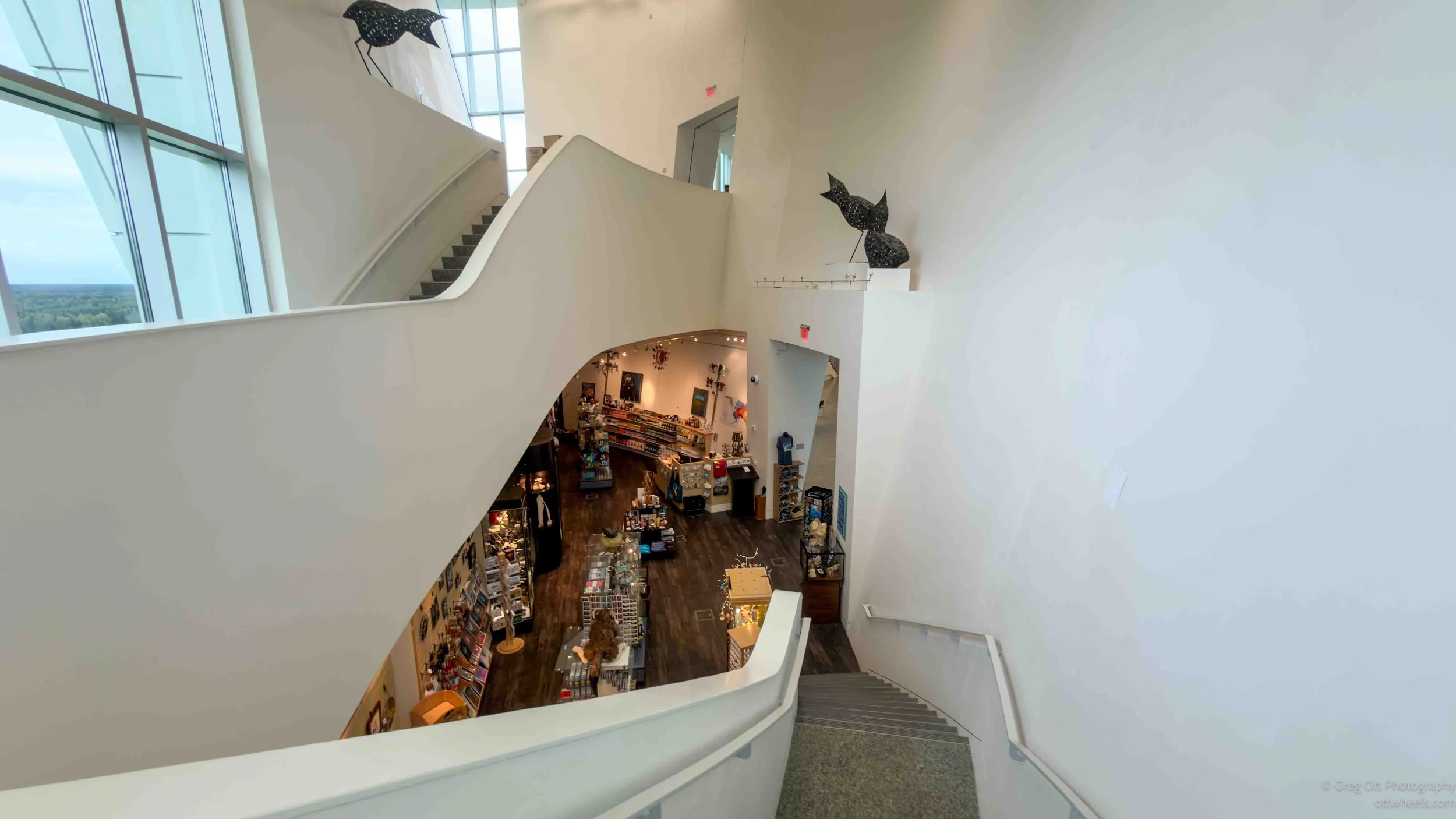
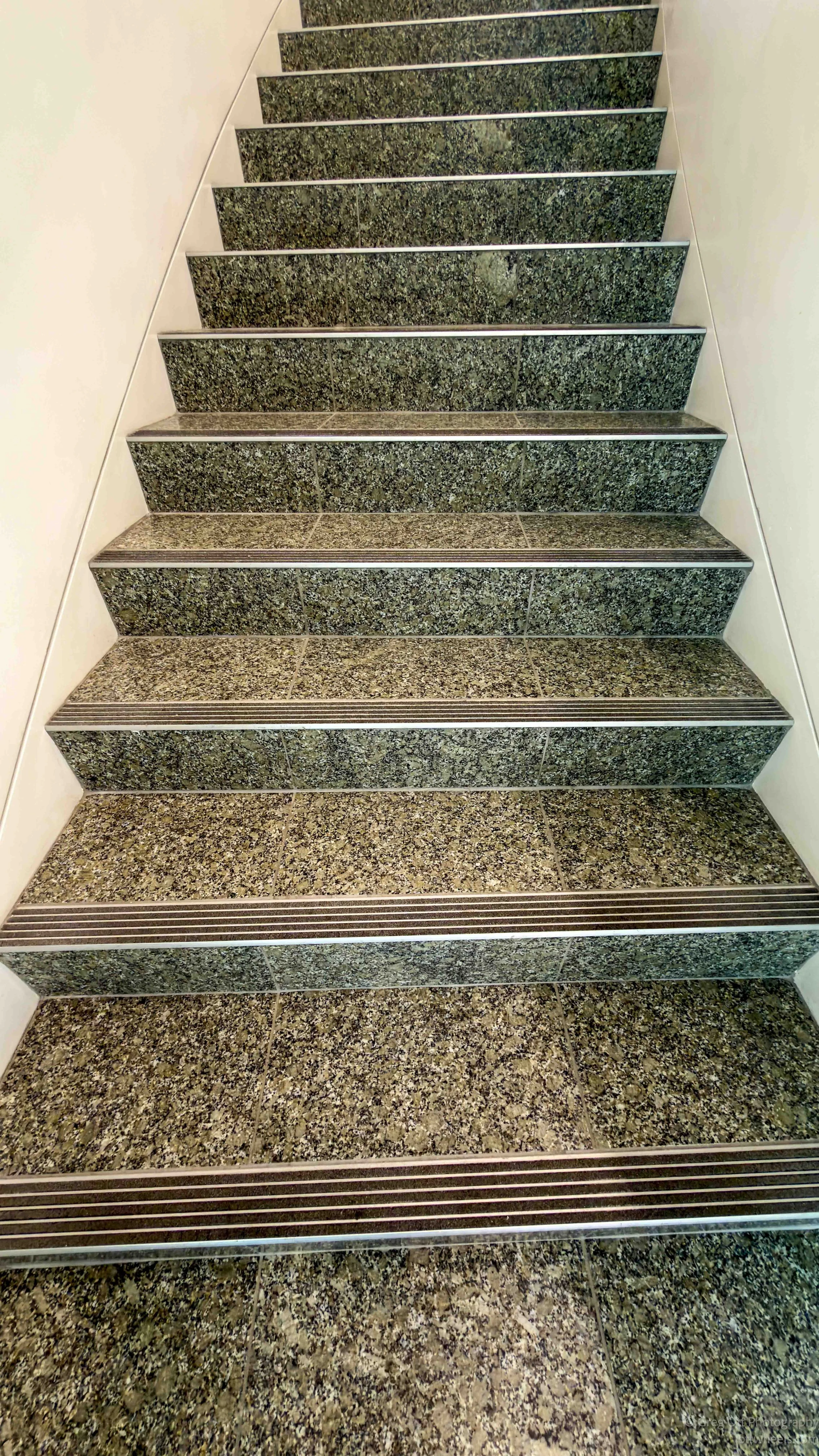
Close to 7 p.m., I took a few photographs of the museum's interior and bought a book before leaving. I particularly liked the sweeping curves of the stairway above the bookstore. In the late afternoon, indirect light filled the space, catching the curved white walls and making the architecture itself worth photographing.
I walked around the build for about 20 minutes and then went to the van in the parking lot. Parking after 5 is free. So, conceivably, you could arrive and see the museum for 2 hours and not pay for parking. As I was walking to the van, I noticed a sign, “RV Parking” pointing to where I was parked. There was no “No Overnight Parking” sign. I went online and found out the university has a policy where you can stay here three consecutive nights. So, I just stayed where I was parked. It was level and extremely quiet.