I worked on some blogs this morning before heading out around 11. On my way out of Madison Campground, I booked another night and asked to move to a different site. It’s the last week of camping in Yellowstone, and only about 40% of the sites are filled, so there was plenty of room to find somewhere quieter. At 8 this morning, four generators were running near me, and the different oscillating frequencies can be maddening.
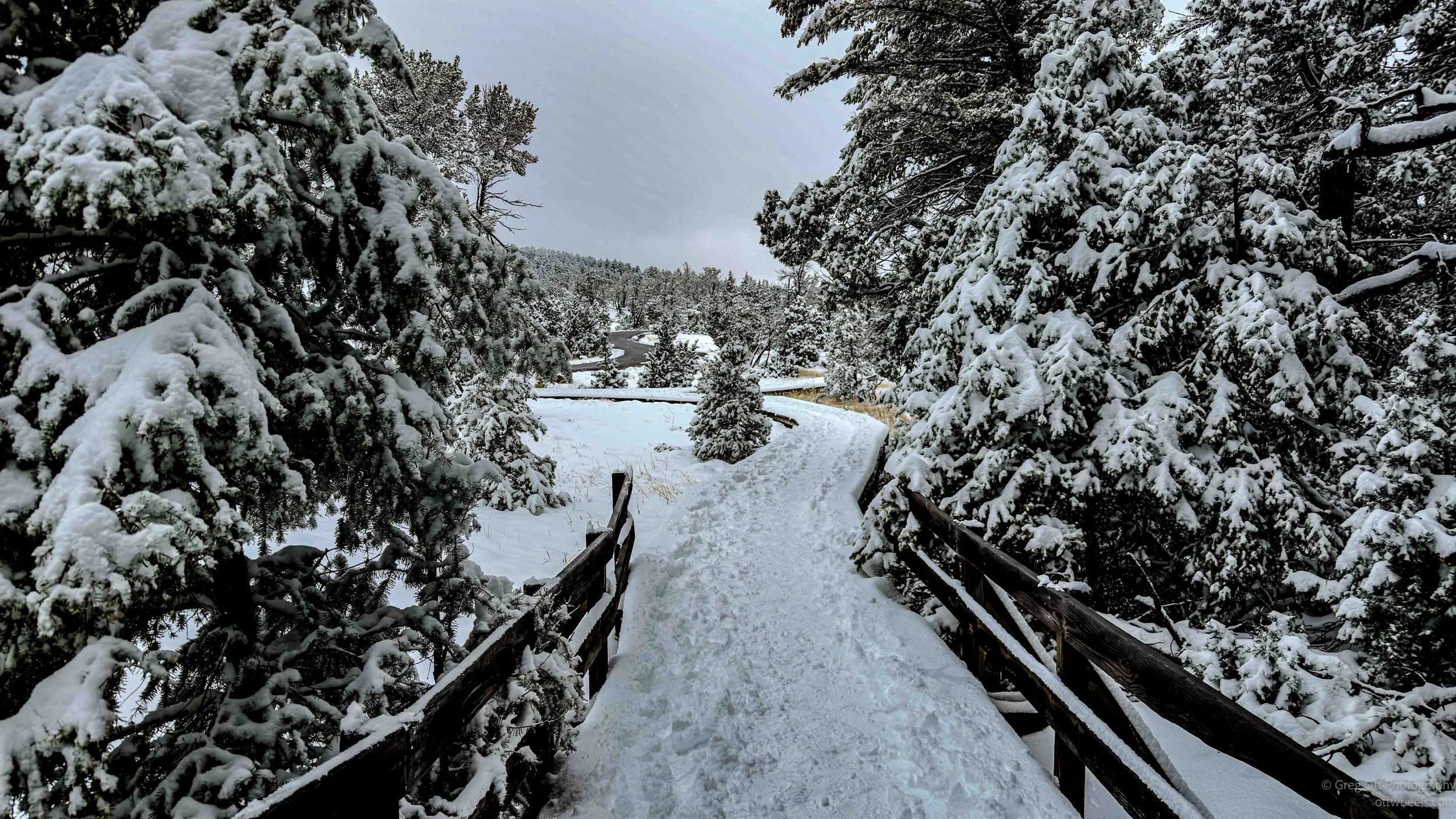
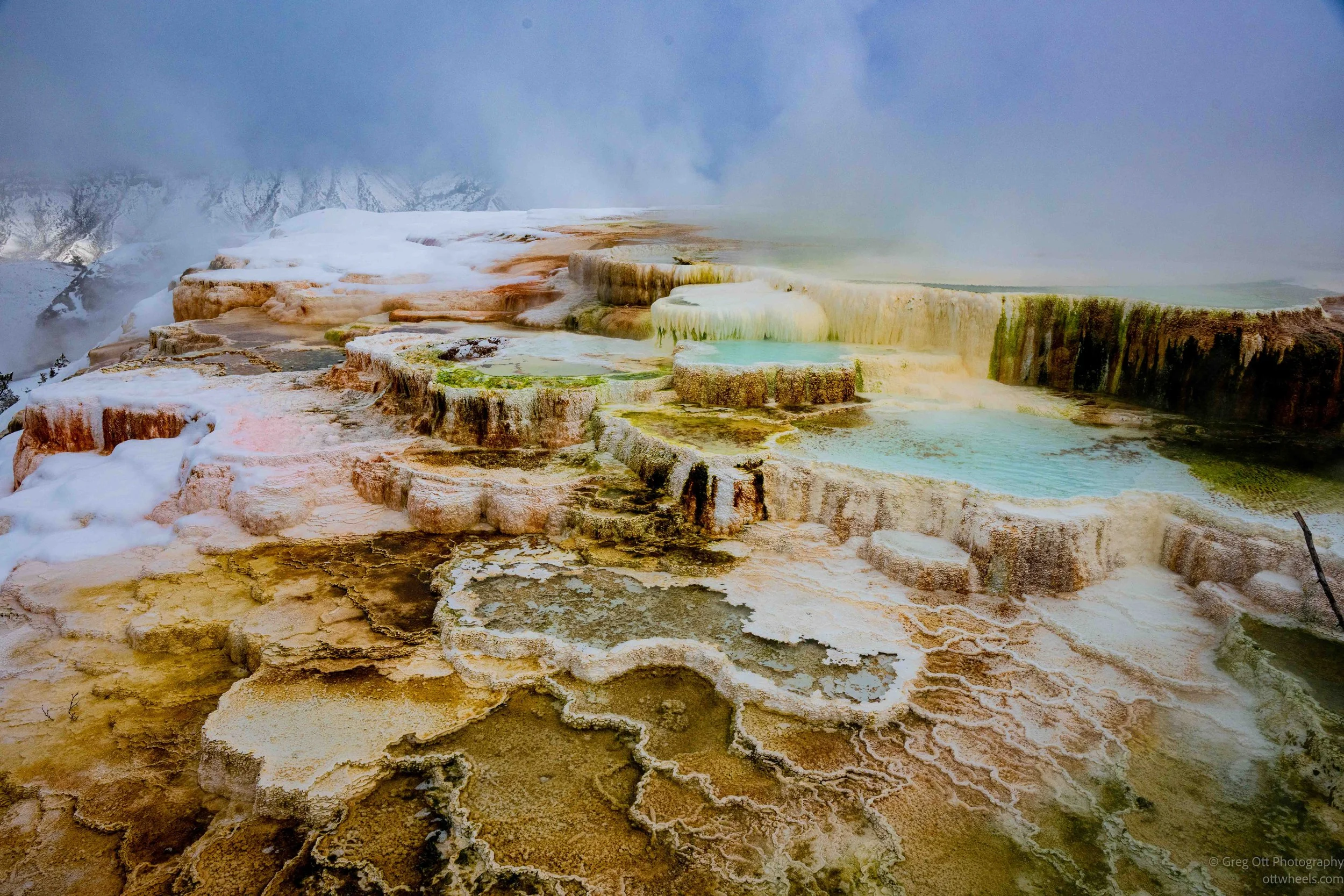
I also checked about the road conditions before driving north to Mammoth Hot Springs. They said Mammoth had received more snow last night, but the roads were totally clear. I parked near the Upper Terrace Scenic Loop, which was closed for the season and partially covered in snow, and started hiking around the Cupid Spring area. Fresh snow covered the trees and much of the terraces, while steam rose from the exposed spring water.
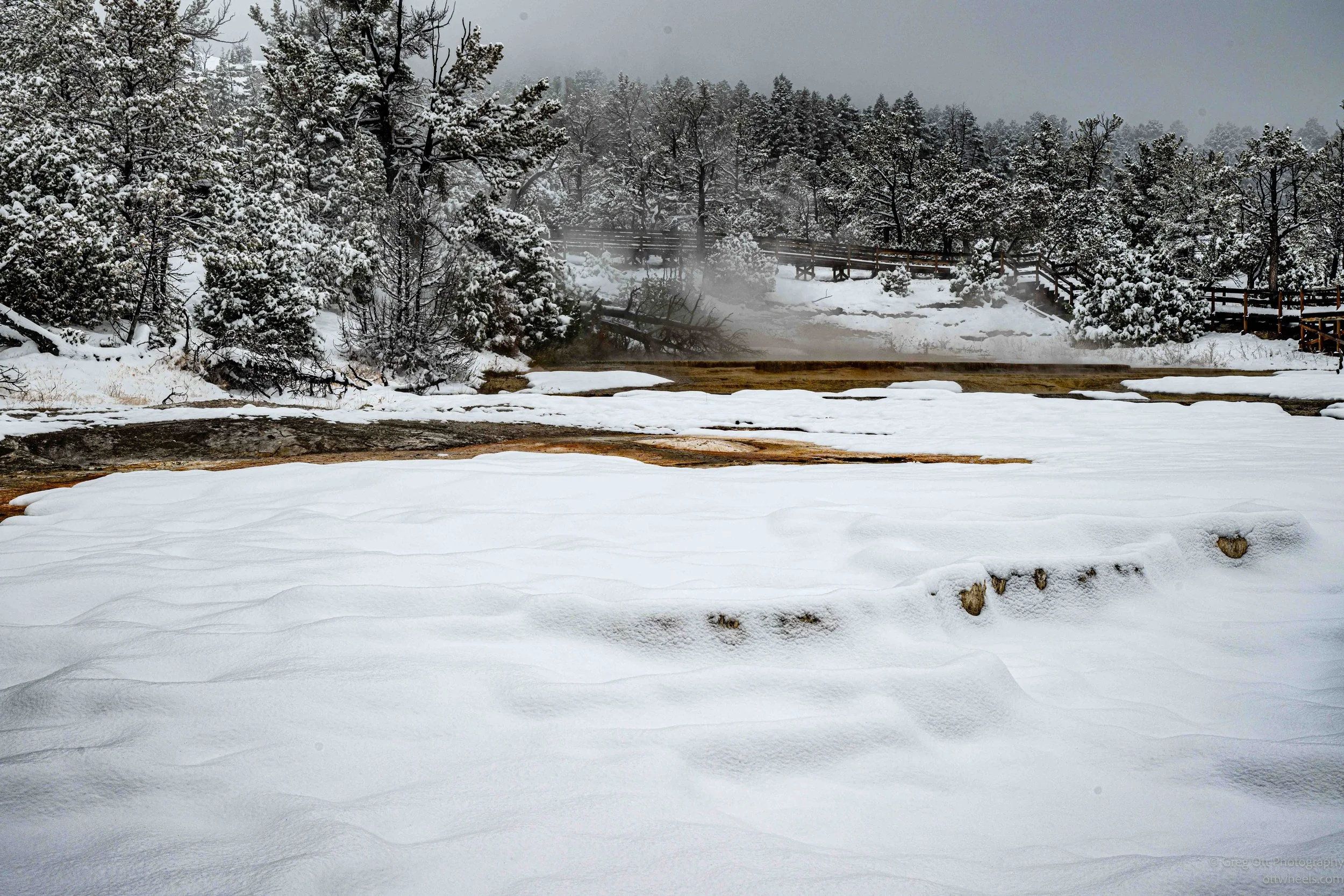
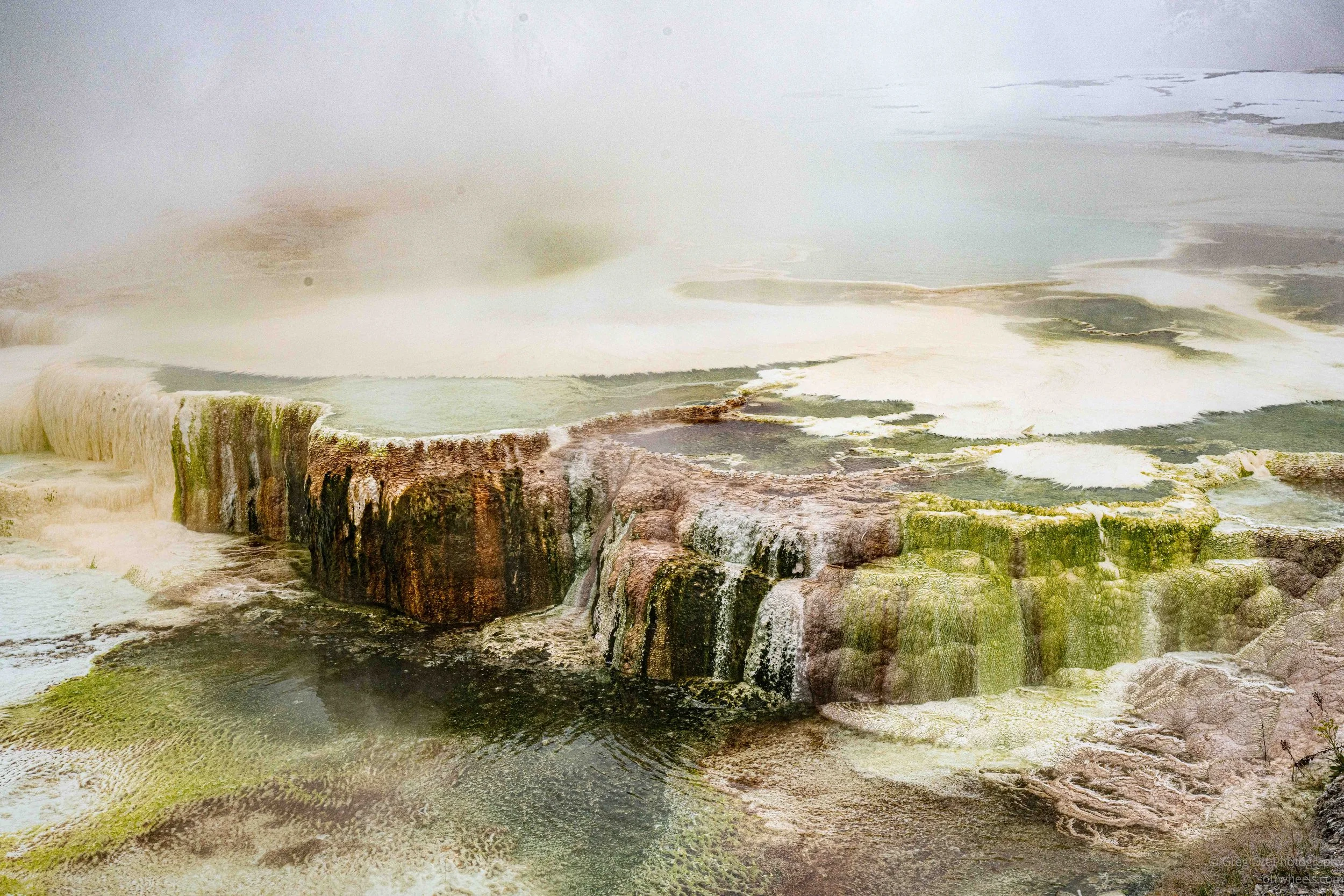
The hot water supports billions of heat-loving microorganisms called thermophiles. Some get their energy from chemicals coming up through the vents, while others use sunlight. As the springs deposit minerals, these tiny organisms become buried in the growing terraces, sometimes leaving impressions in the stone. The same process can gradually cover grasses, trees, and even sections of boardwalk.
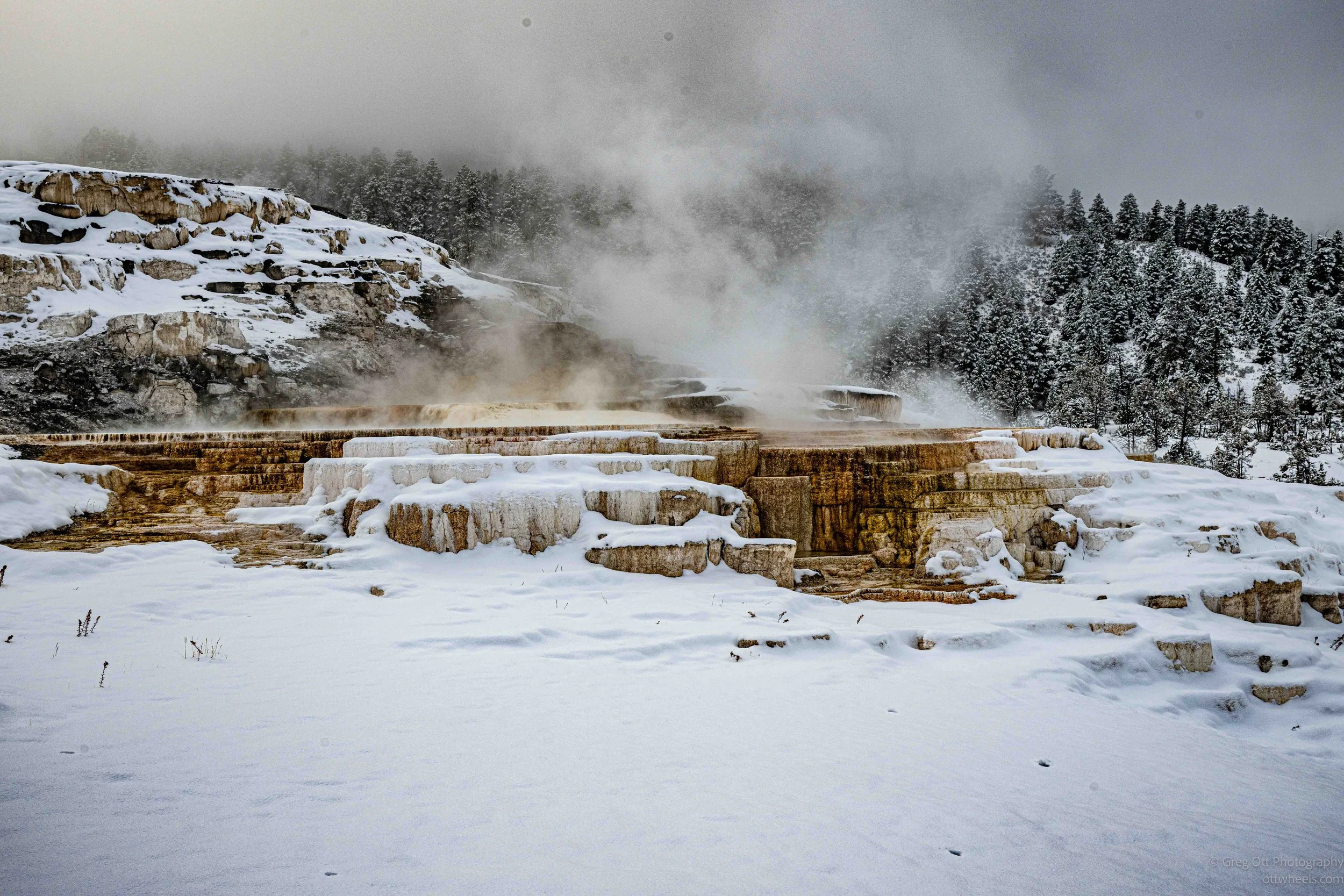
I continued along the boardwalk to Canary Spring, stopping to photograph the shelves through the steam. Snow rested on the rims of the pools and outlined the layers down the hillside. There was so much white between the snow and the steam that the exposed tan edges stood out, even when I couldn’t see much beyond them.
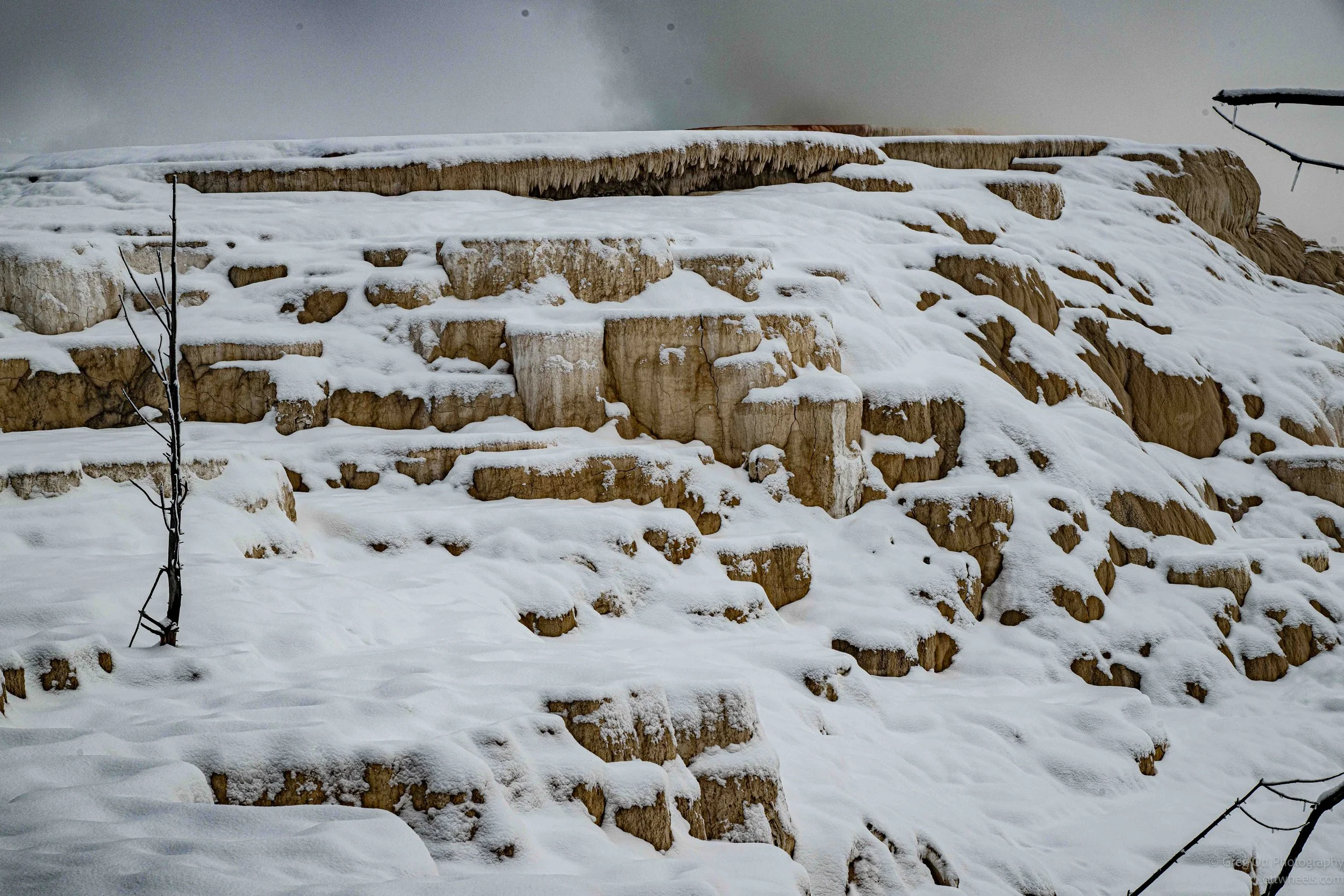
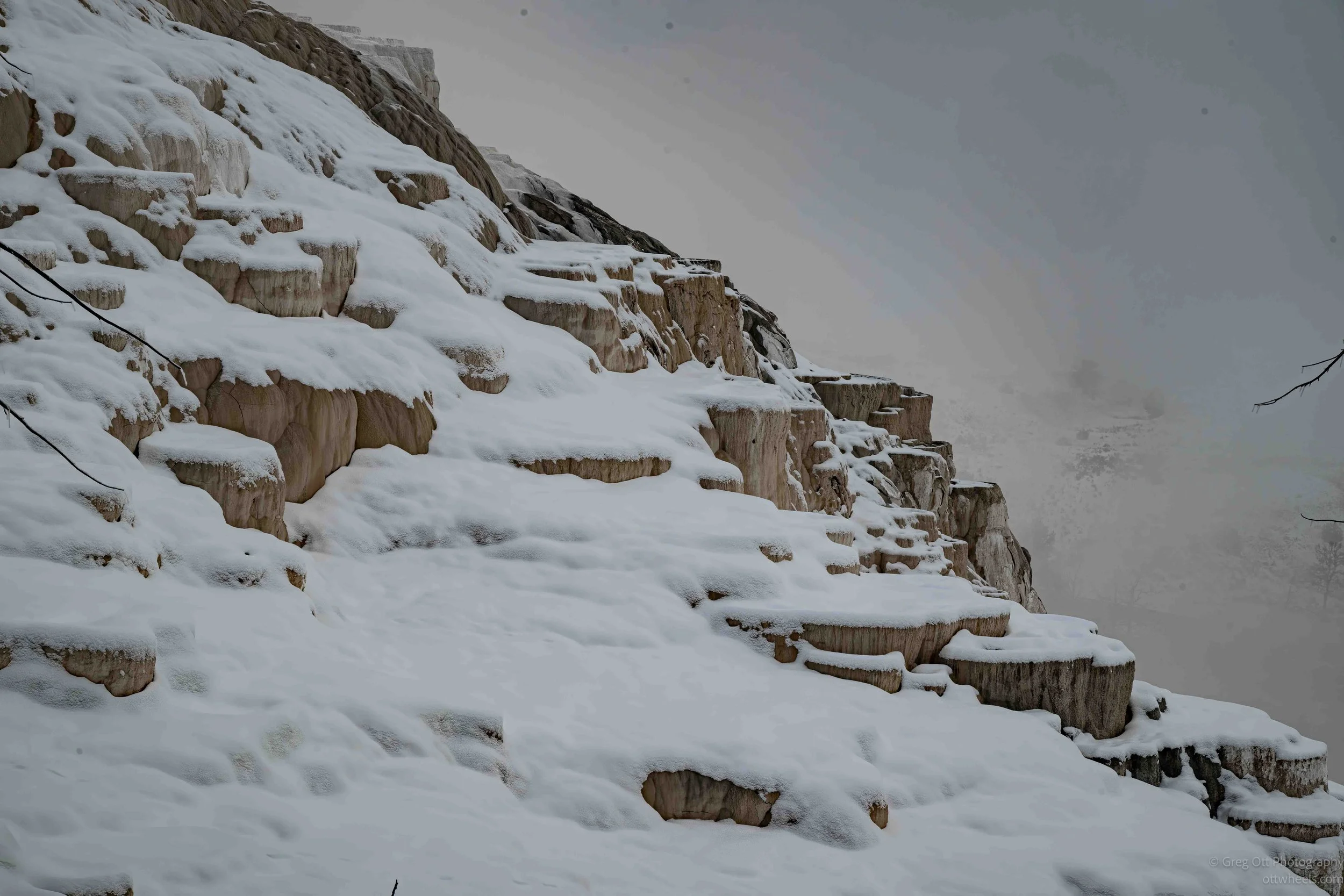
These terraces are built by water heated underground by Yellowstone’s volcanic system. As it travels through buried limestone, it dissolves minerals and carries them to the surface. There, it deposits calcite that hardens into travertine. Water flowing over the pool edges continues adding to them, gradually building the shelves and rounded formations. The boardwalks wind through the trees and follow the terraces down the hillside, so I could see both the broad formations and the smaller pools up close.
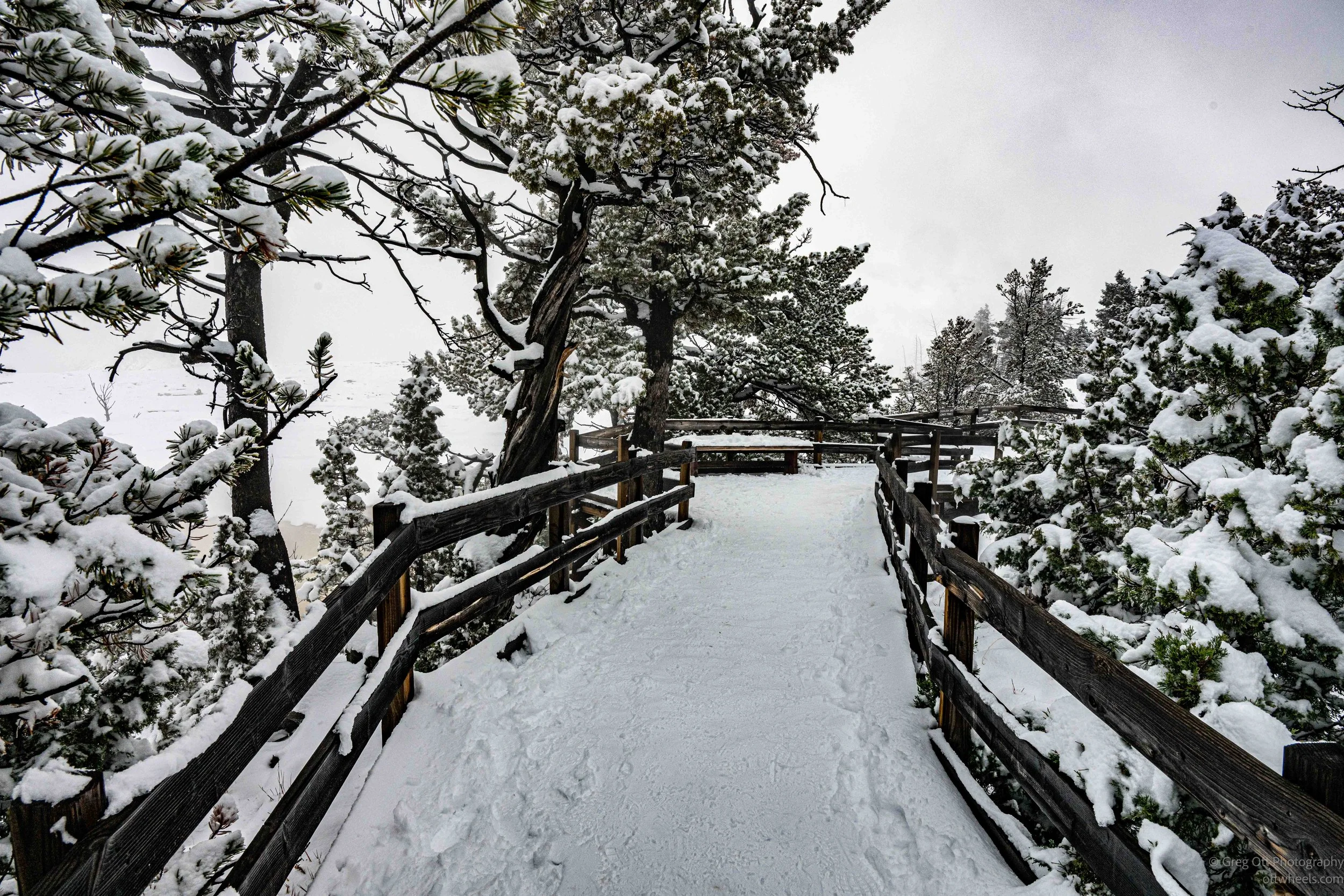
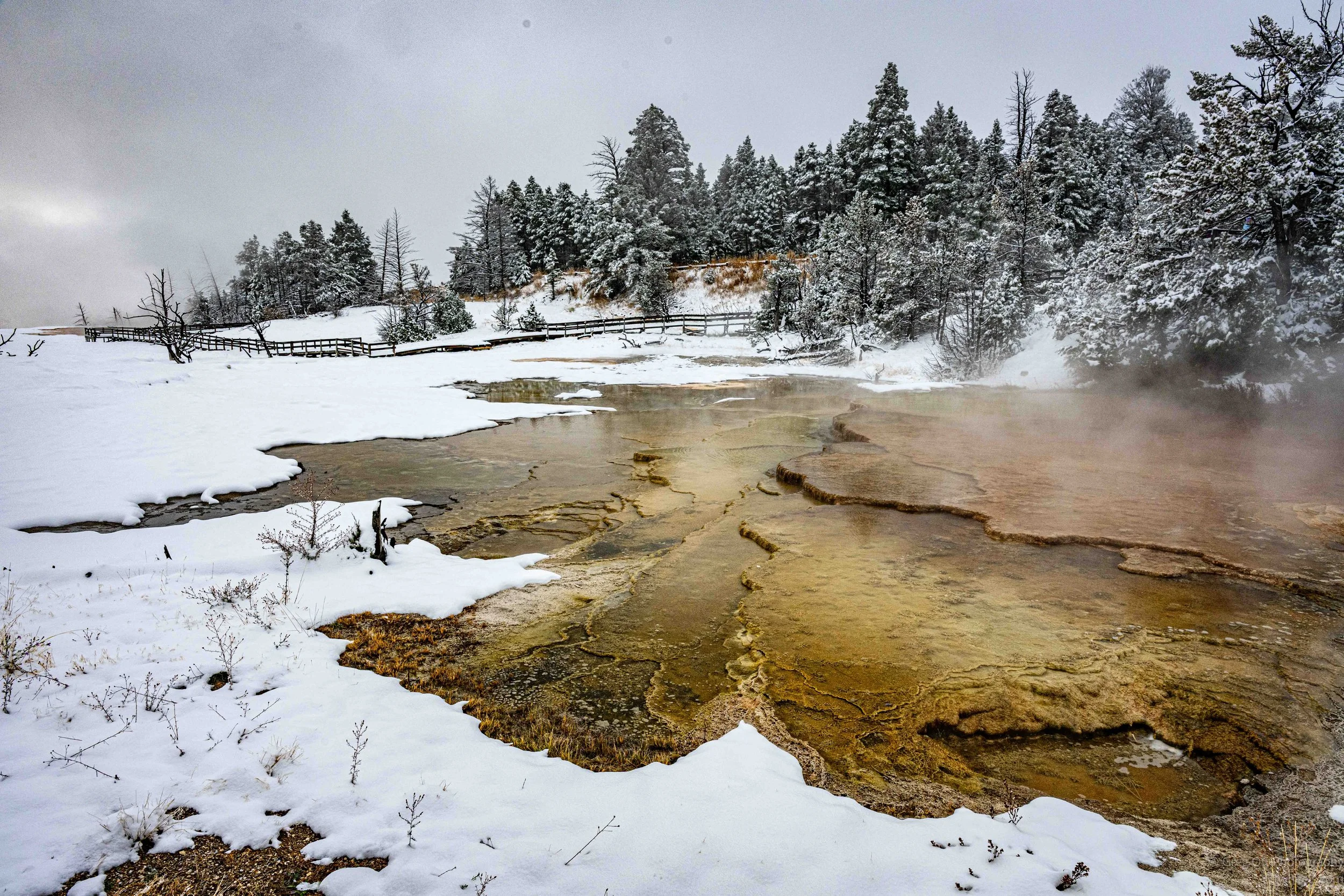
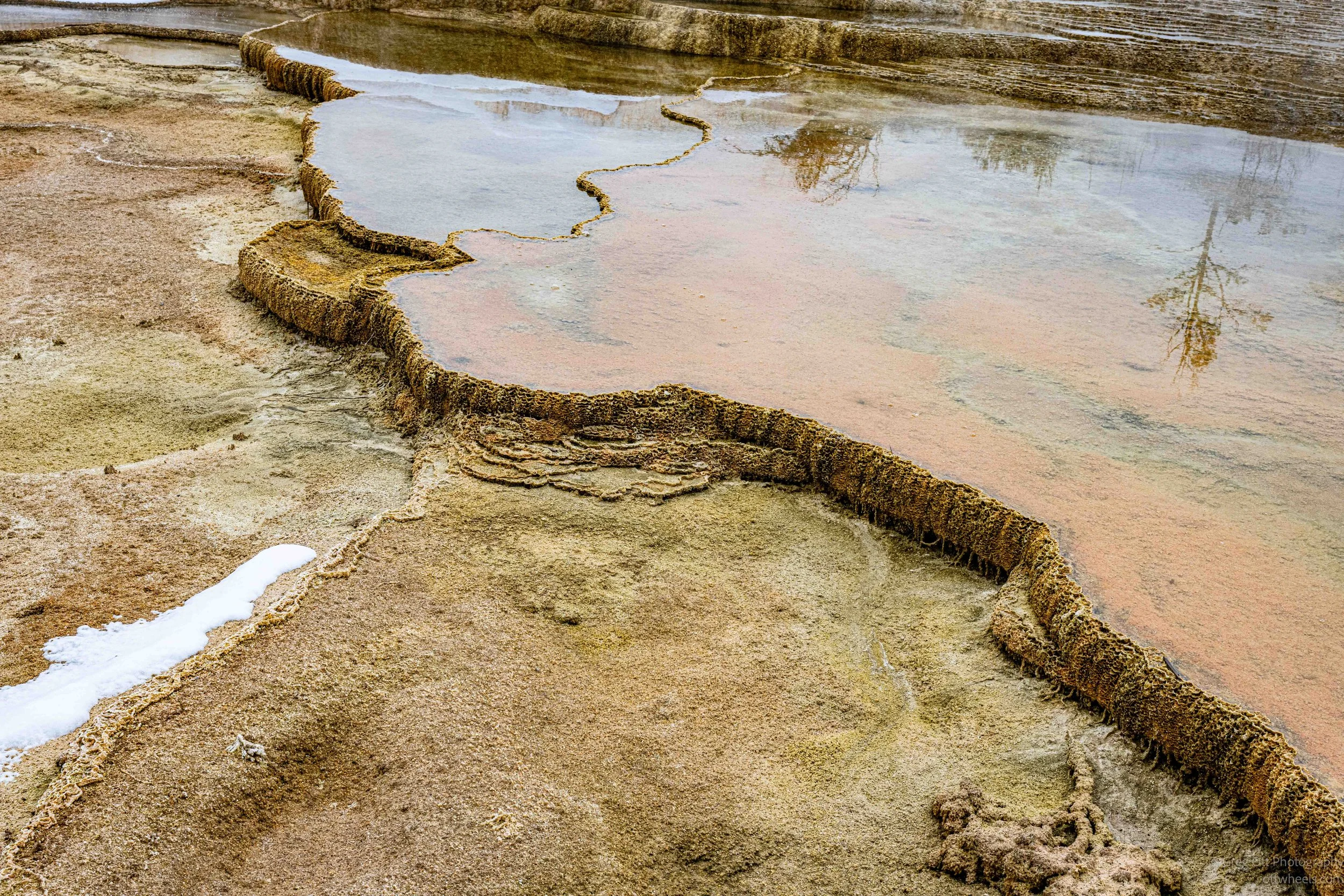
Where the hot water was flowing, the terraces were exposed, with yellows, browns, and bright greens against the snow. The plaque nearby explained that Some of those colors come from the microorganisms living in the water. Cyanobacteria use sunlight for energy, while other bacteria near the vents consume hydrogen sulfide. I spent some time photographing the colored edges where the water spilled from one shallow pool into the next.
For some reason, everyone was chatting today. Easily a third of the people were tourists from outside the country, including England, Italy, Spain, Colombia, Mexico, and Taiwan. Between the conversations and stopping for photographs, I was making my way down slowly. The boardwalks continued through snow-covered trees before opening onto views of Mammoth and the surrounding hills, with clouds hanging along the slopes beyond the buildings.
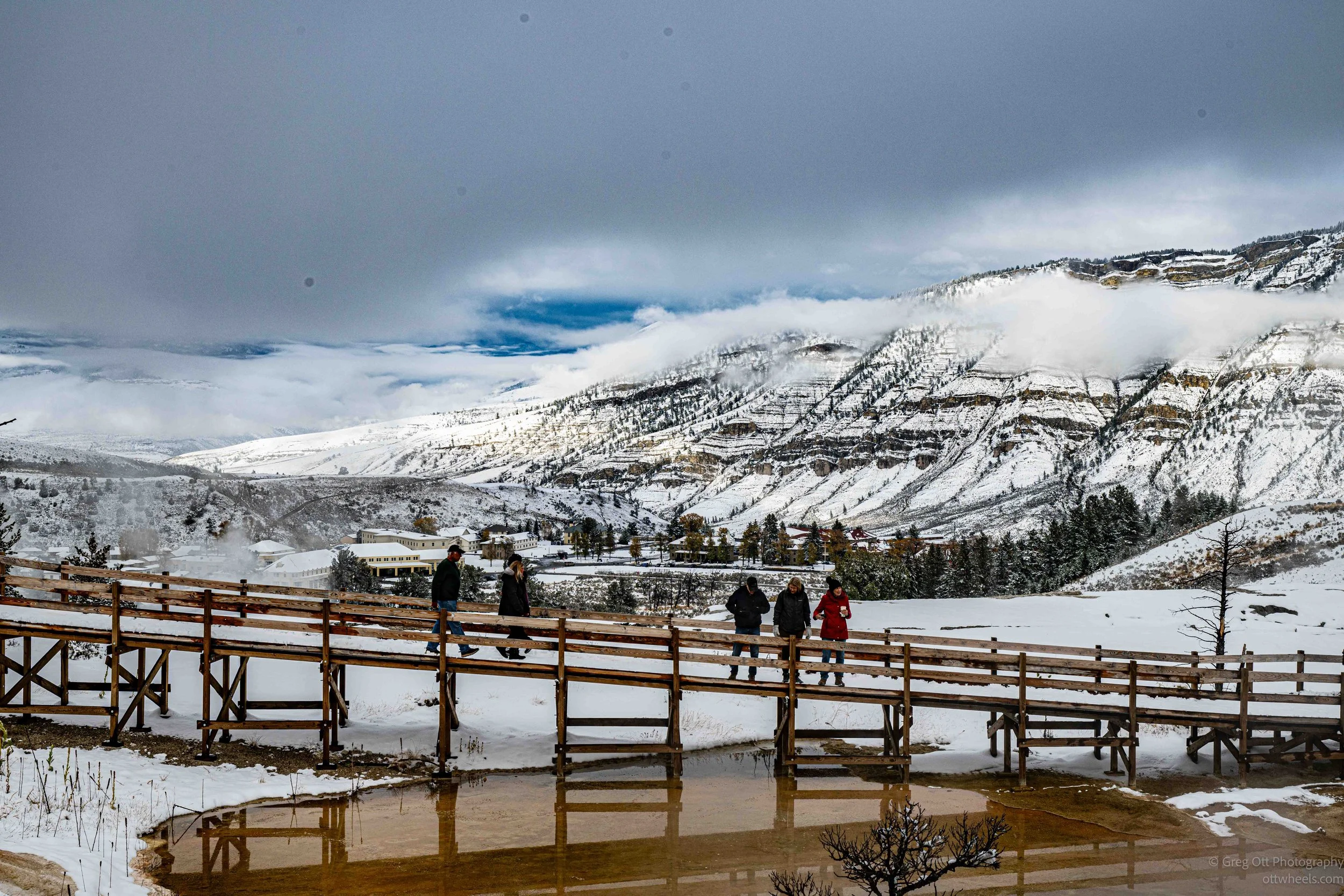
Farther down, shallow pools spread across wider shelves, with bare trees standing among the mineral deposits. The flowing water was gradually coating what lay in its path, adding new layers around the trees and across the ground. I photographed the wider terraces before concentrating on the winding pool rims. Up close, the edges had smaller shelves beneath them, repeating the shapes of the larger formations farther up the hill.
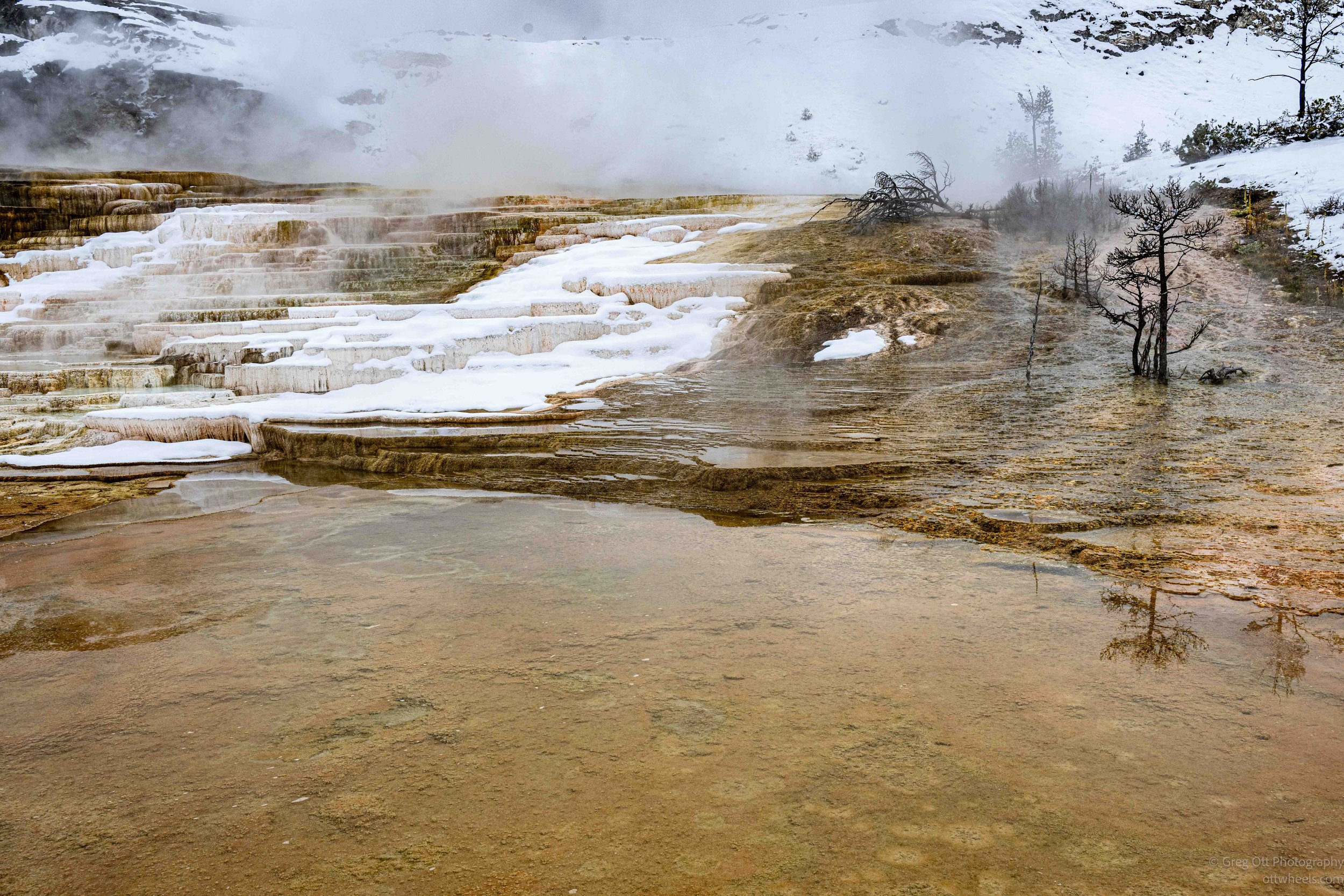
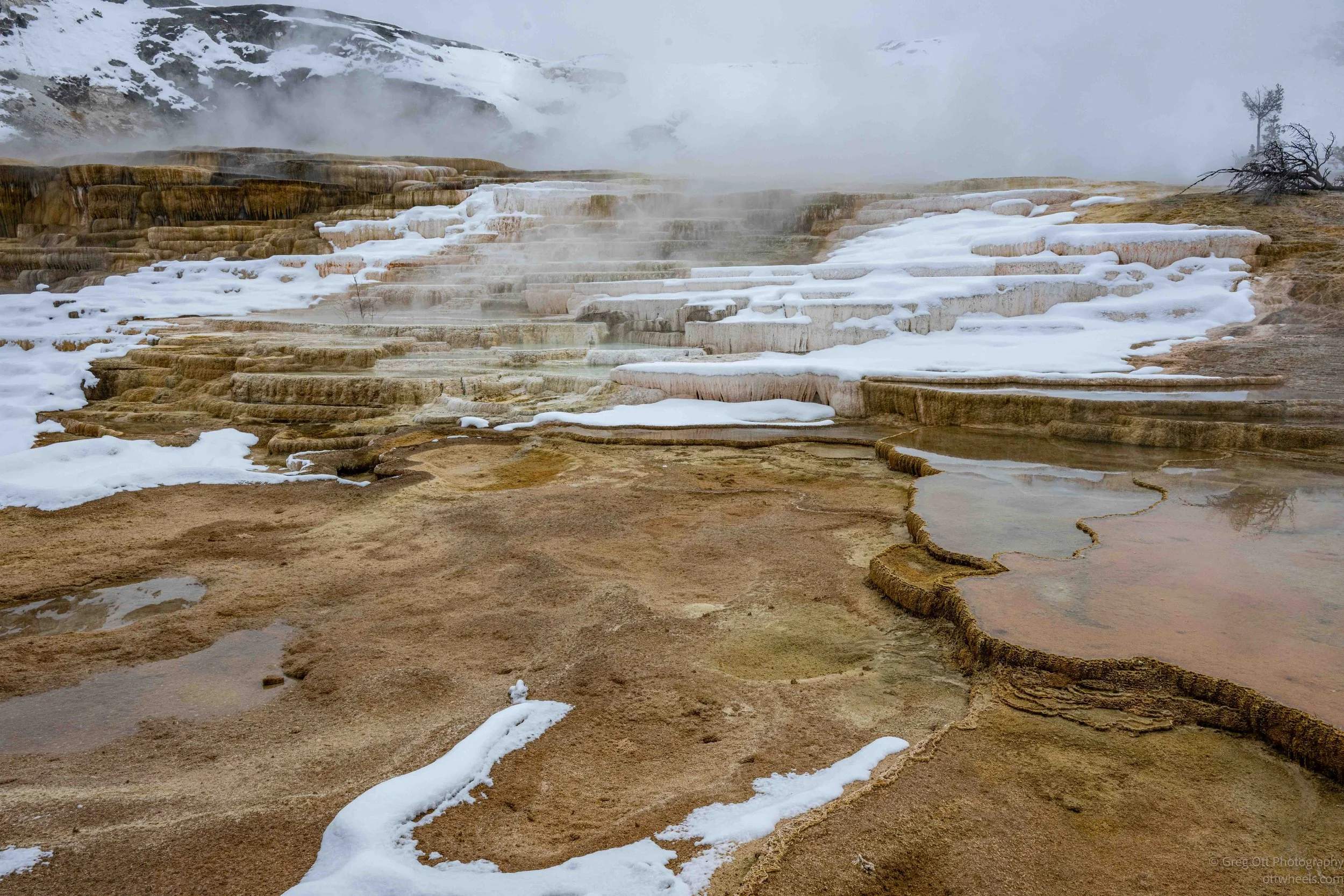
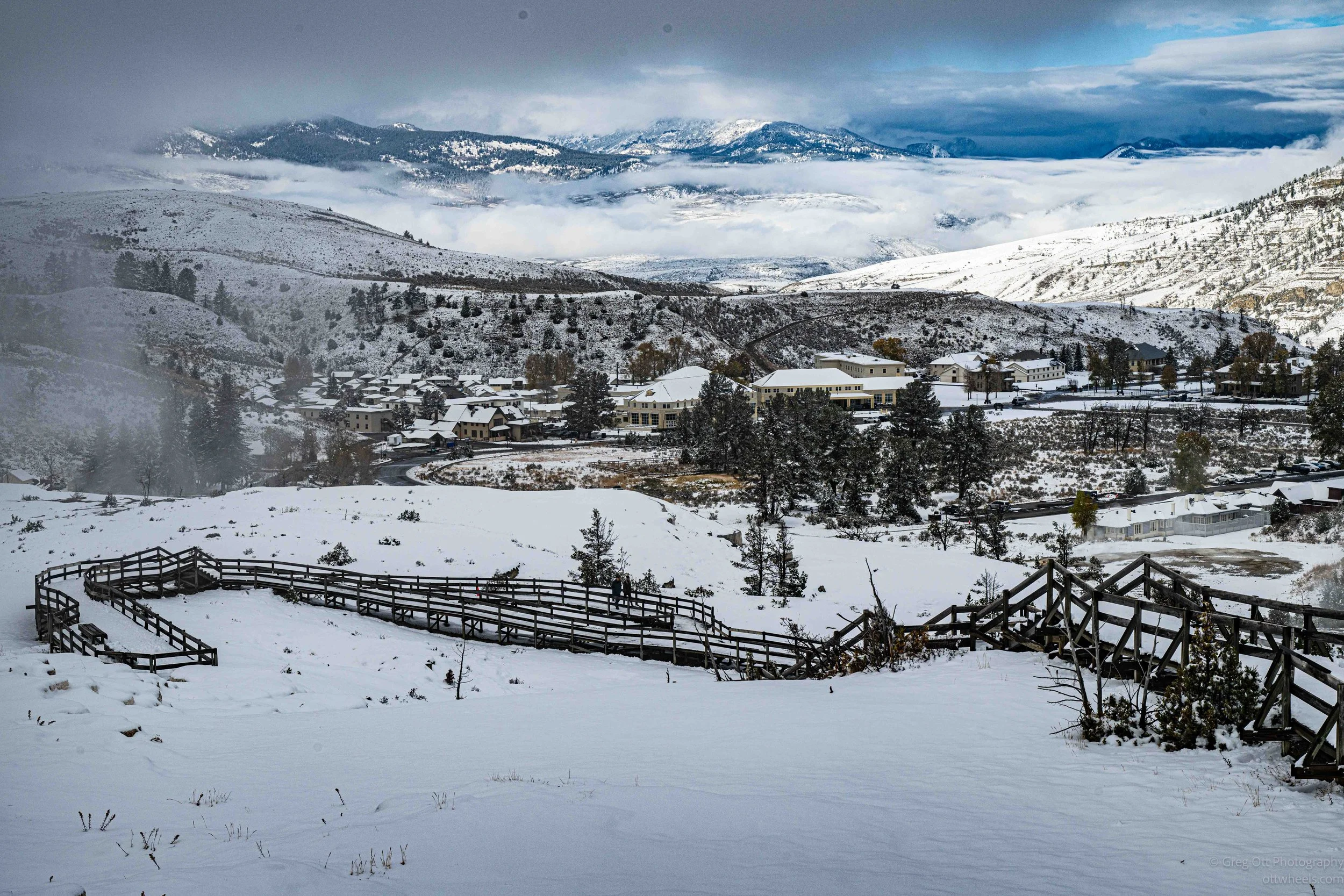
I had hiked most of the way down when I realized the boardwalks led to another parking lot. I didn’t want to hike all the way back up, but the van was near the upper terraces, so I turned around. On the climb, I stopped to photograph the view over Mammoth, with the boardwalks stretching down toward the buildings and the snowy hills beyond.
Around Minerva Terrace, another plaque discusses the history of the springs. This helped explain the mix of dry formations and flowing water. Minerva Spring was named in the late 1800s for the Roman goddess of art. It has flowed abundantly at times and been completely dry at others, as the water finds different routes through the underground channels. Mineral buildup can block a passage, dissolving minerals can open another, and earthquakes can change the cracks through which the water travels. Nearby Terrace Mountain has more than 100 feet of travertine left by ancient springs. The water has been moving around and rebuilding this landscape for a long time.
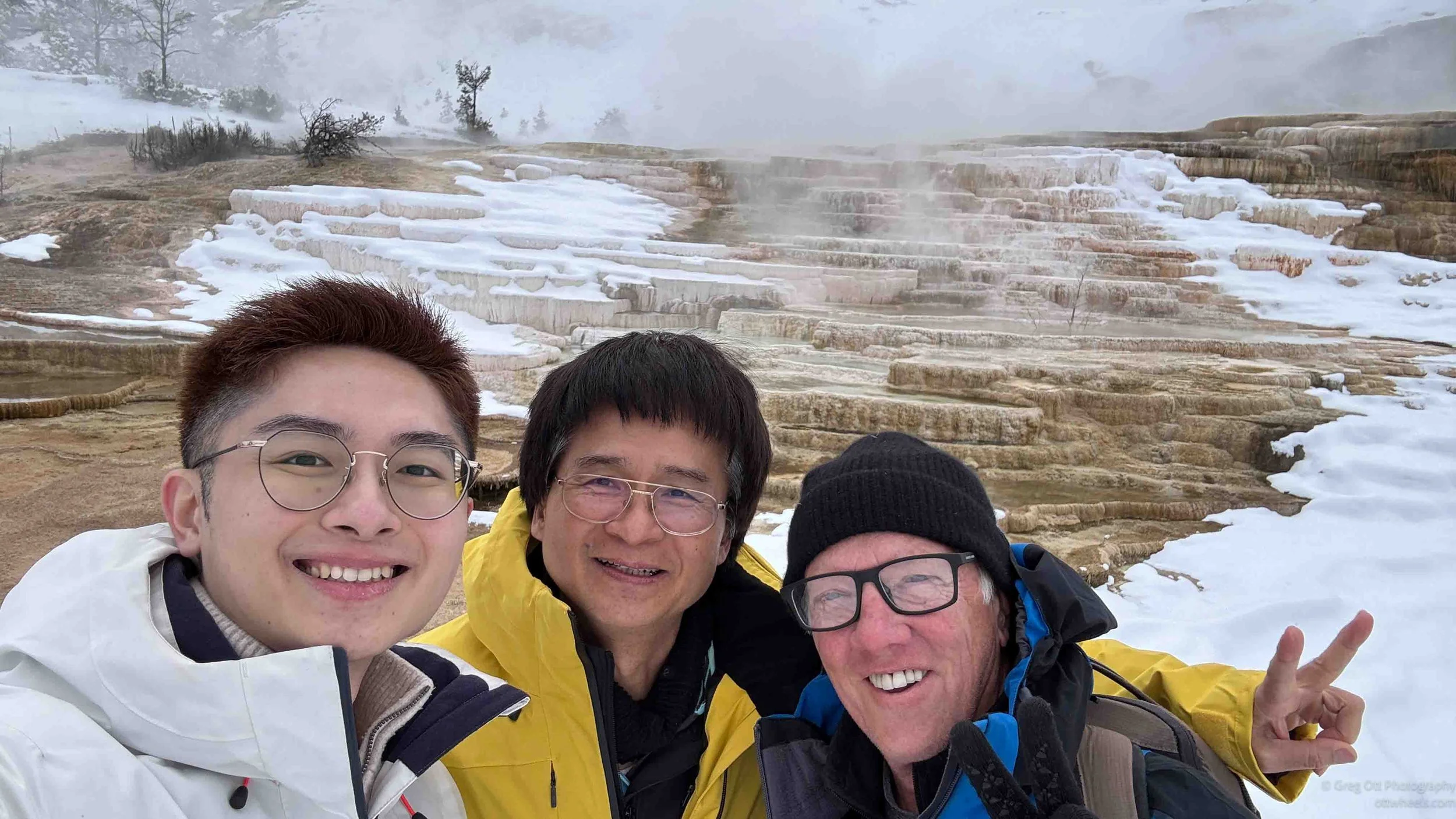
On the way back up, I stopped to photograph some bright green colors, and a woman nearby said, “My husband also has a Nikon. He’s up the hill taking photos of something.” I told her, “You have to be very patient to be traveling with a photographer.” She laughed and said he had to be equally patient with the things she liked to do. Then she reached out her hand and said, “My name is Kim.” I told her my name, and she said, “OMG, that’s my husband’s name!”
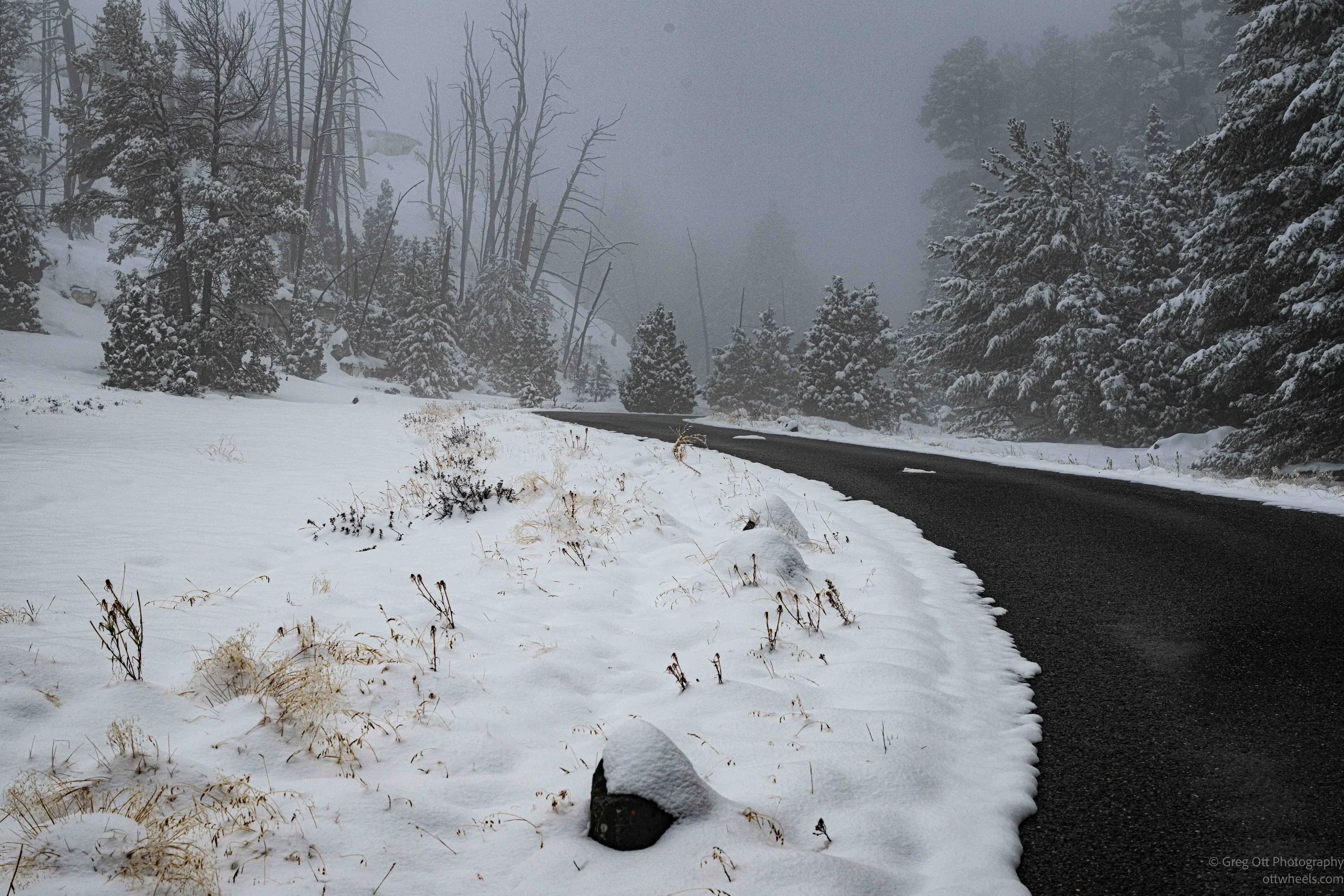
I made it back to the Upper Terrace Scenic Loop and was still feeling good, so I decided to hike the loop. There was no one on the road, and some of the hills were pretty steep. Every few hundred feet, I shouted out the name of a state: “Pennsylvania! Alabama! Hawaii!” A park ranger in Denali had suggested doing that this summer to let bears know someone was in the area. I don’t know if it worked, but I didn’t see any bears.
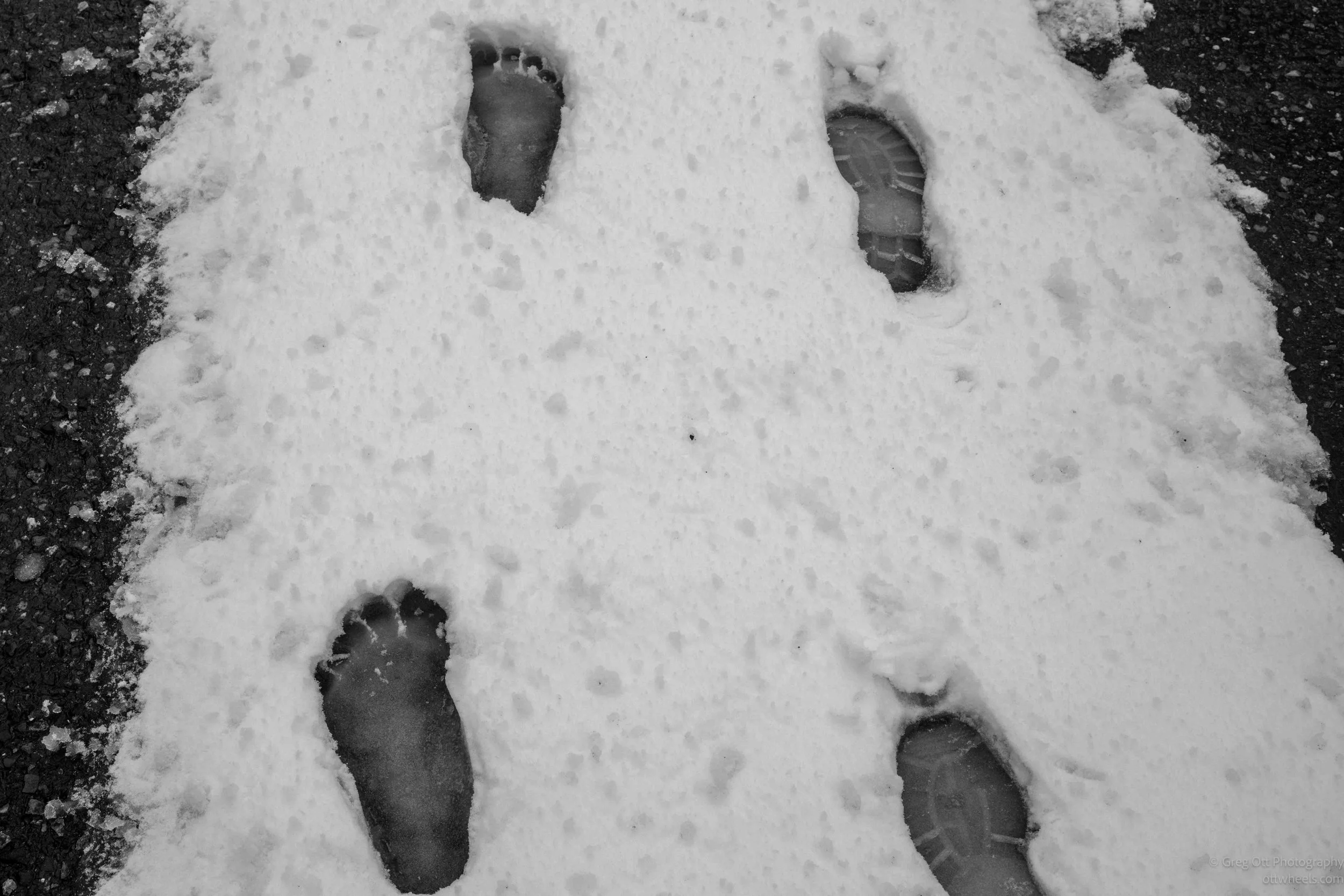
At one point, bare footprints suddenly appeared in the snow. Someone had taken off their shoes and walked, or occasionally jogged, along the road. I found this funny because I recently met a woman who told me she likes to walk a mile barefoot in the snow. She said it really wakes you up. Whoever left these tracks lasted less than a quarter of a mile.
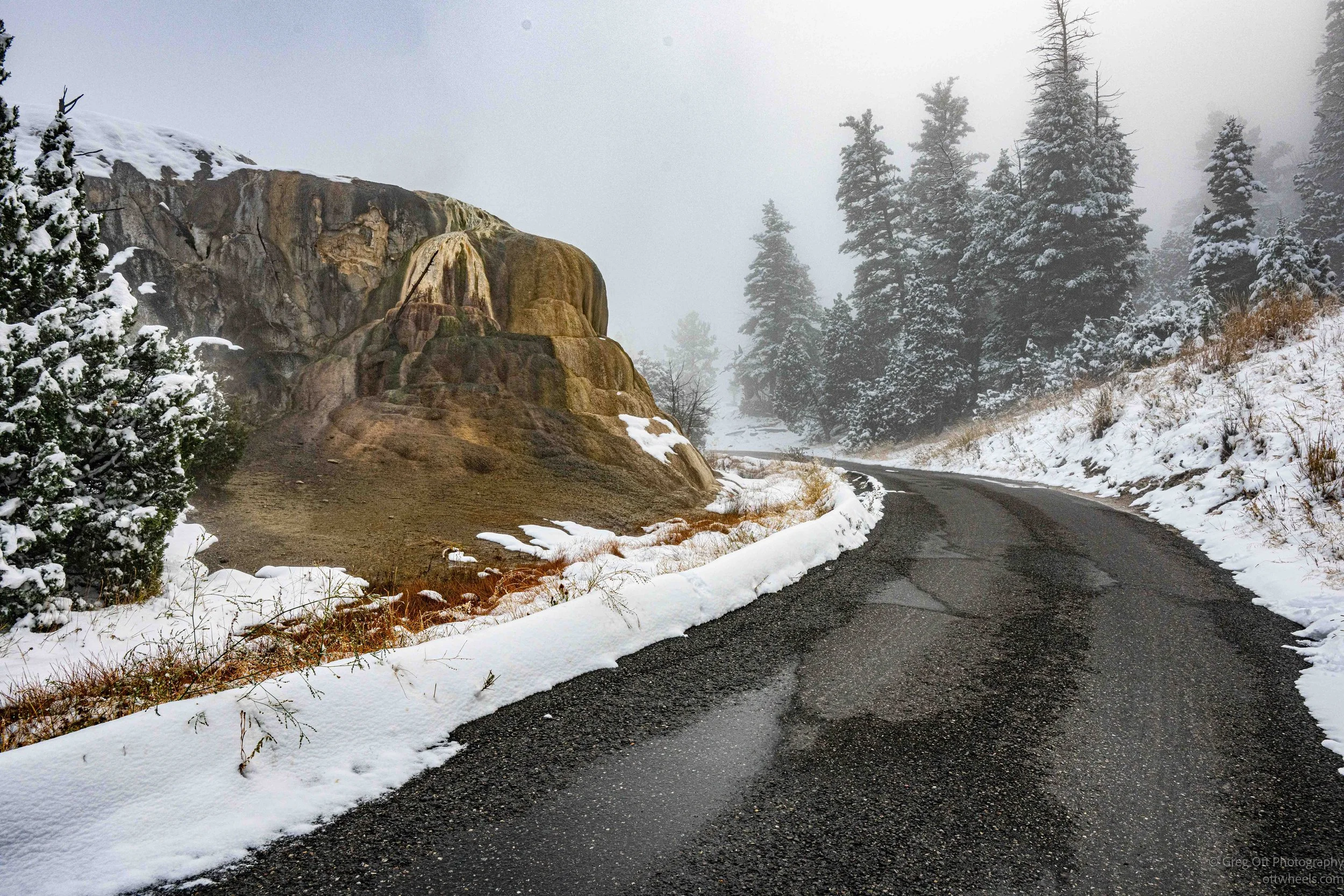
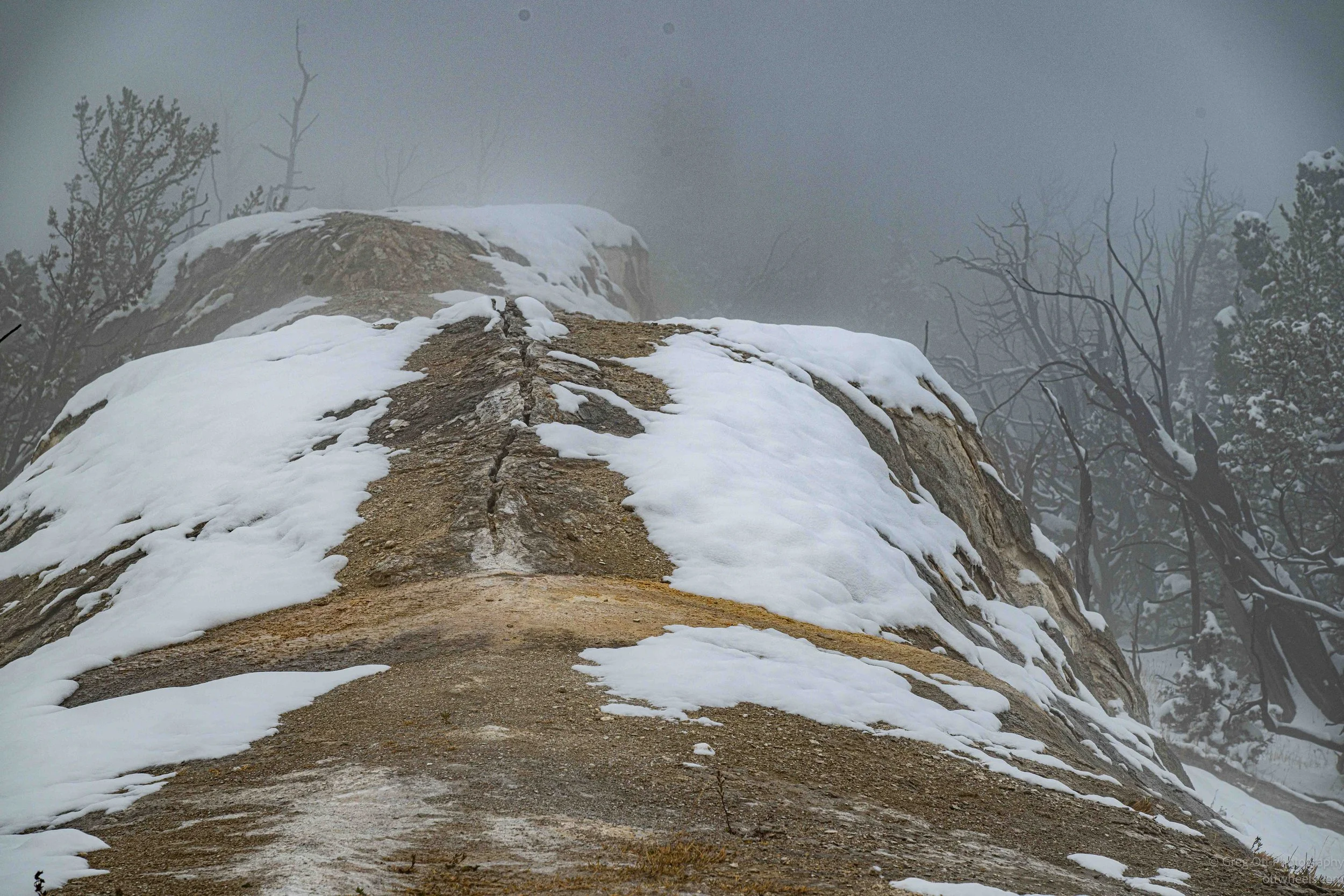
The road curved around Orange Spring Mound, a large formation rising right beside the pavement. Hot water bubbles up through several vents along the top and flows over its sides, depositing travertine as it cools and releases gases. Over time, those deposits have built the mound, while heat-loving bacteria and algae growing in the water give the surface much of its color. With snow around its base and trees fading into the mist behind it, the exposed rock stood out along the otherwise gray and white road.
Farther along, water flowed over a series of rounded shelves, with yellow, orange, and green running down the slope. I stopped to photograph the patterns and the contrast between the wet formations and the snow. From one angle, I could concentrate on the texture of the surface; from another, the bare branches and snowy trees framed the spring.
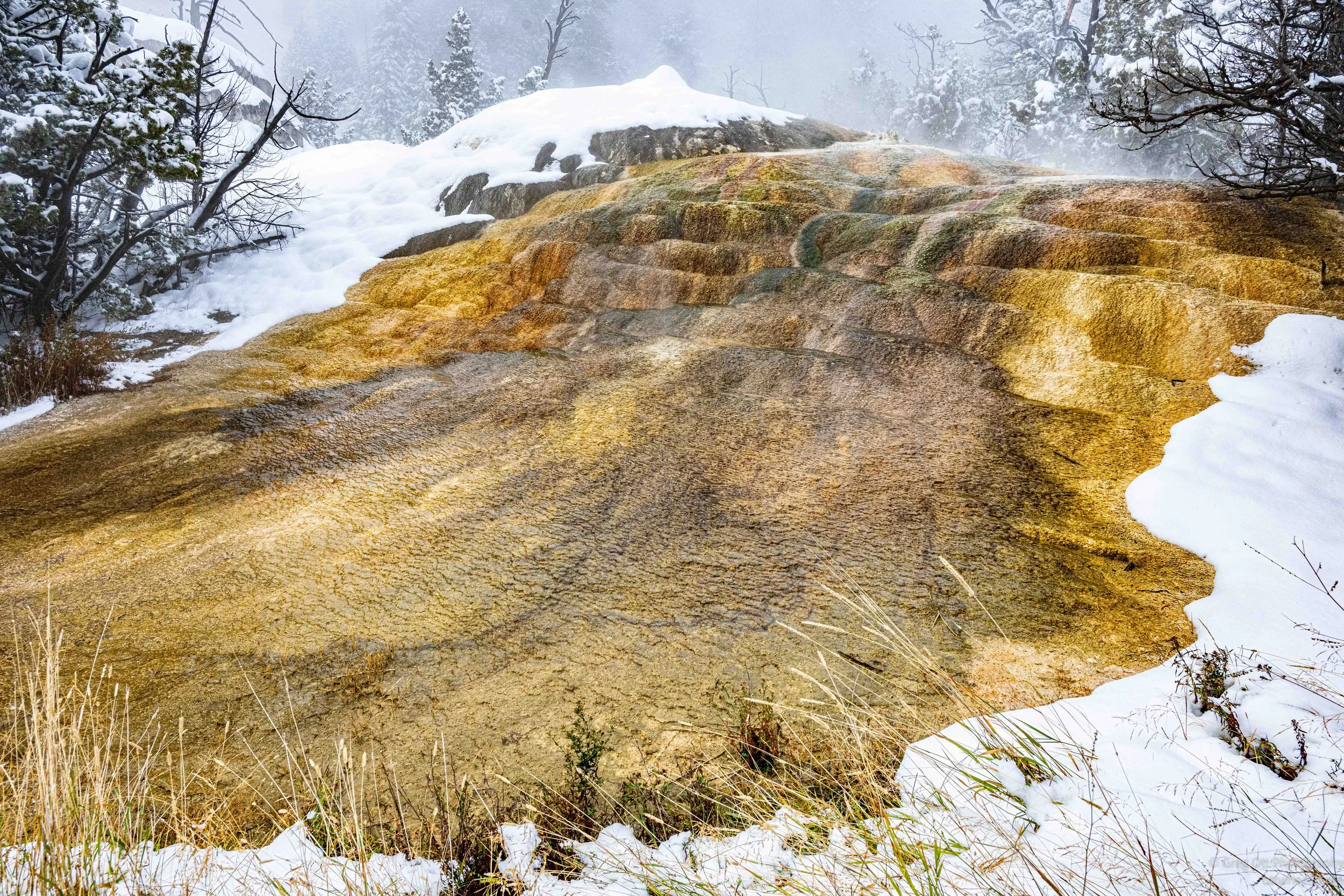
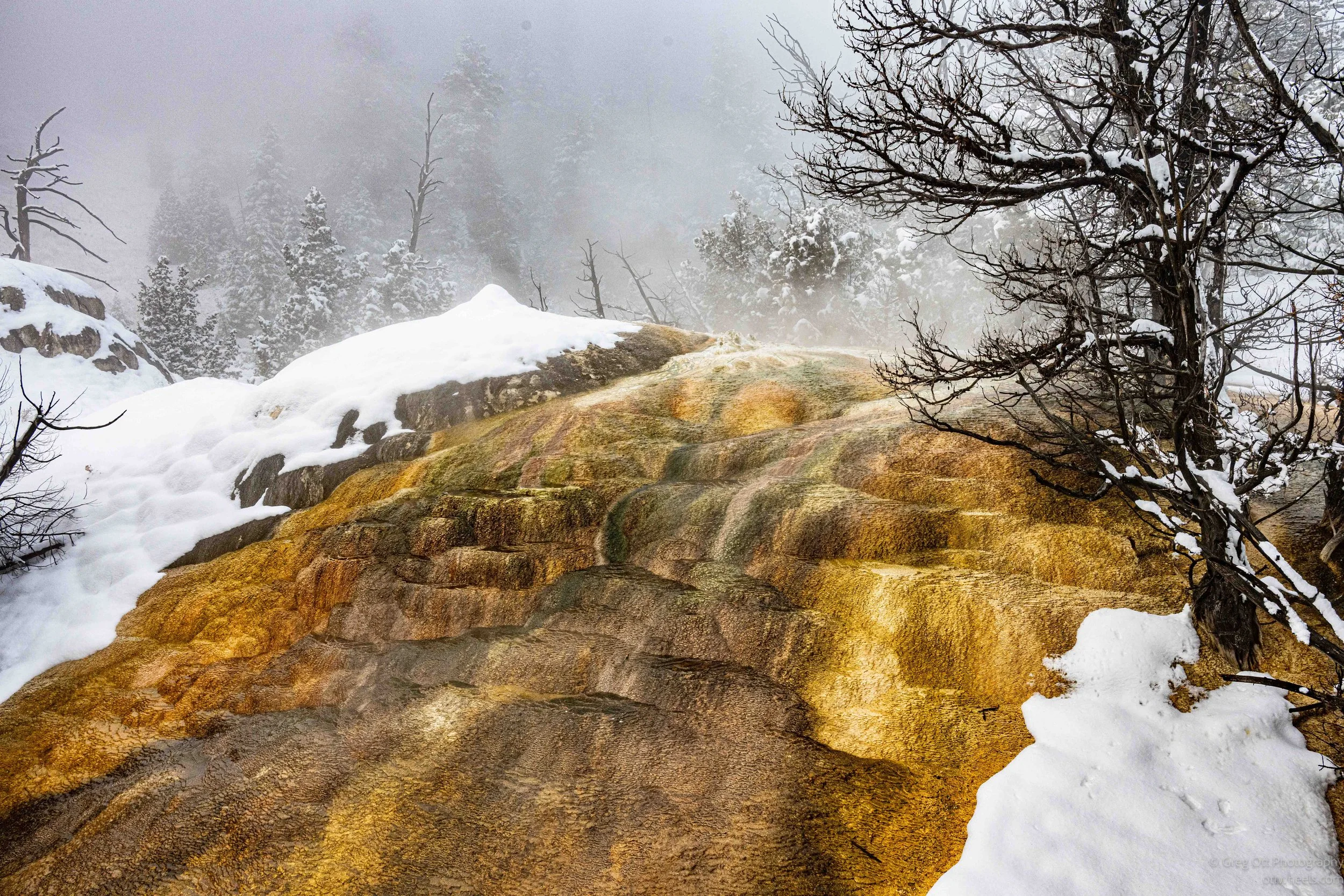
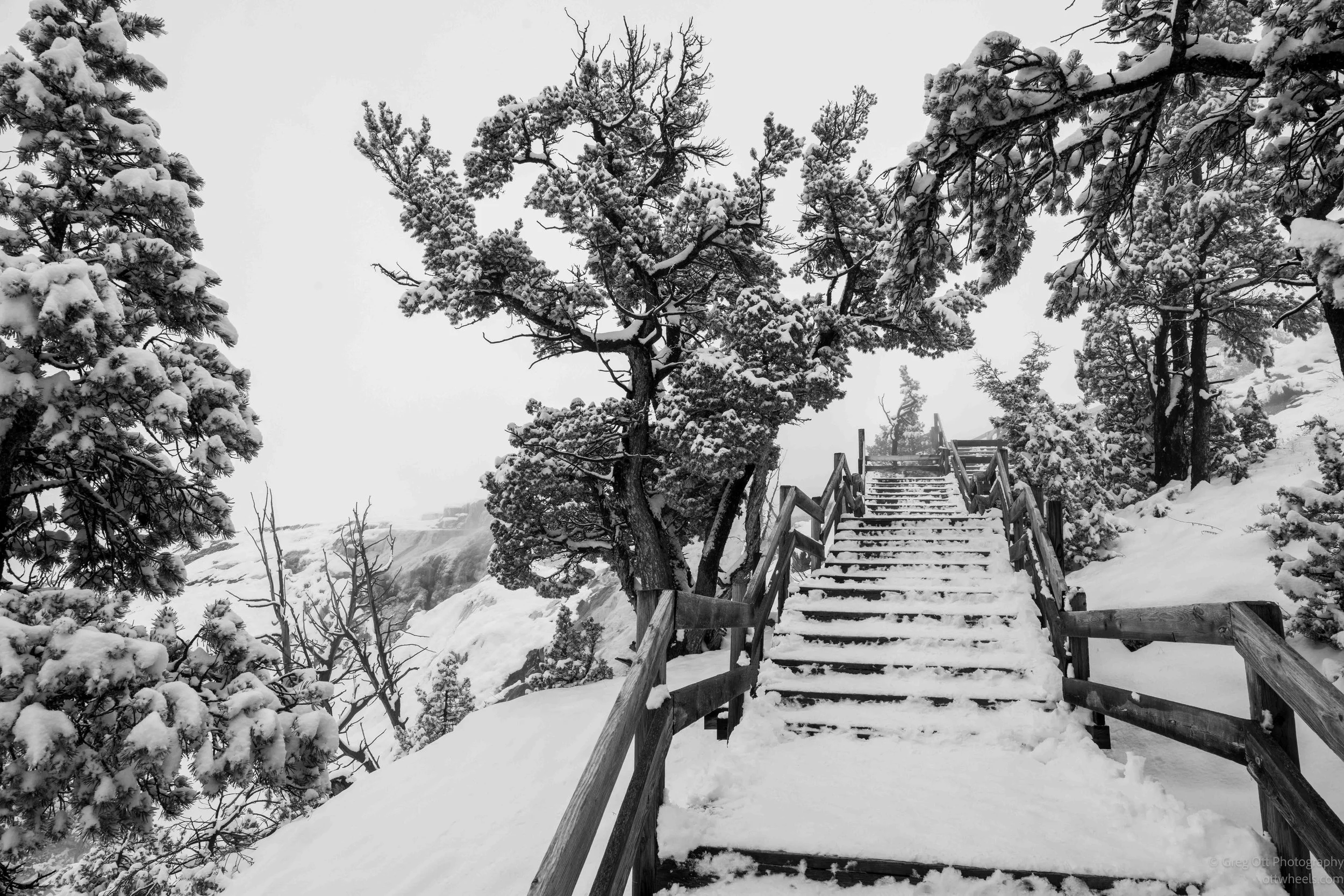
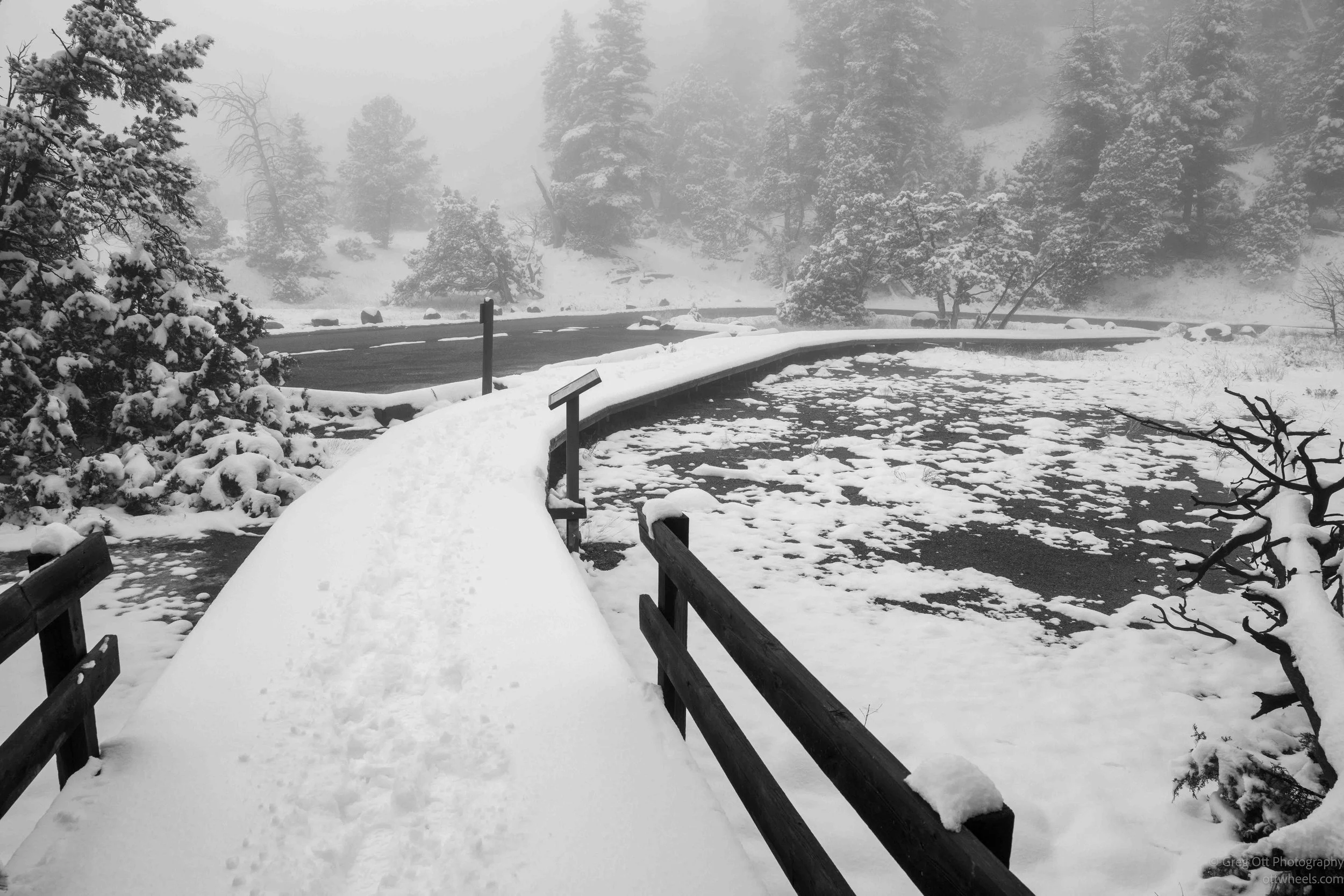
Away from the colorful water, the forest had an almost black-and-white feel. Dark trunks and branches stood against the snow, while the more distant trees faded into gray. Even the snow-covered boardwalk and the exposed ground around it seemed to fit into the same limited range of tones.
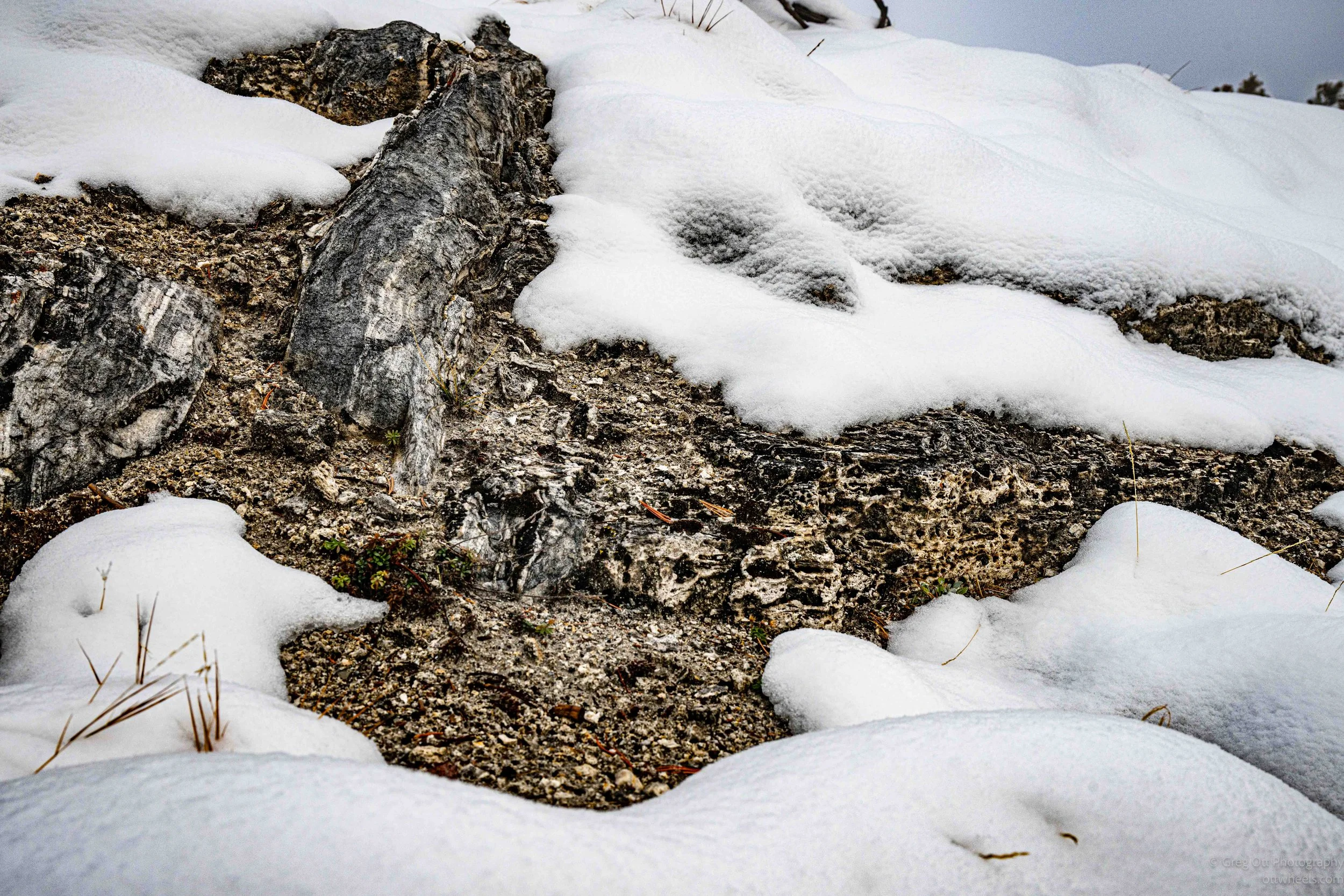
I particularly liked the exposed rock formations and stopped to look at them closely. Some of the textures looked like impressions of trees and other forms caught in the stone. After learning how the spring water coats and eventually buries things in travertine, I found myself looking for those shapes in the rough surfaces. I couldn’t tell exactly what I was seeing, but the details were as interesting to photograph as the larger formations.
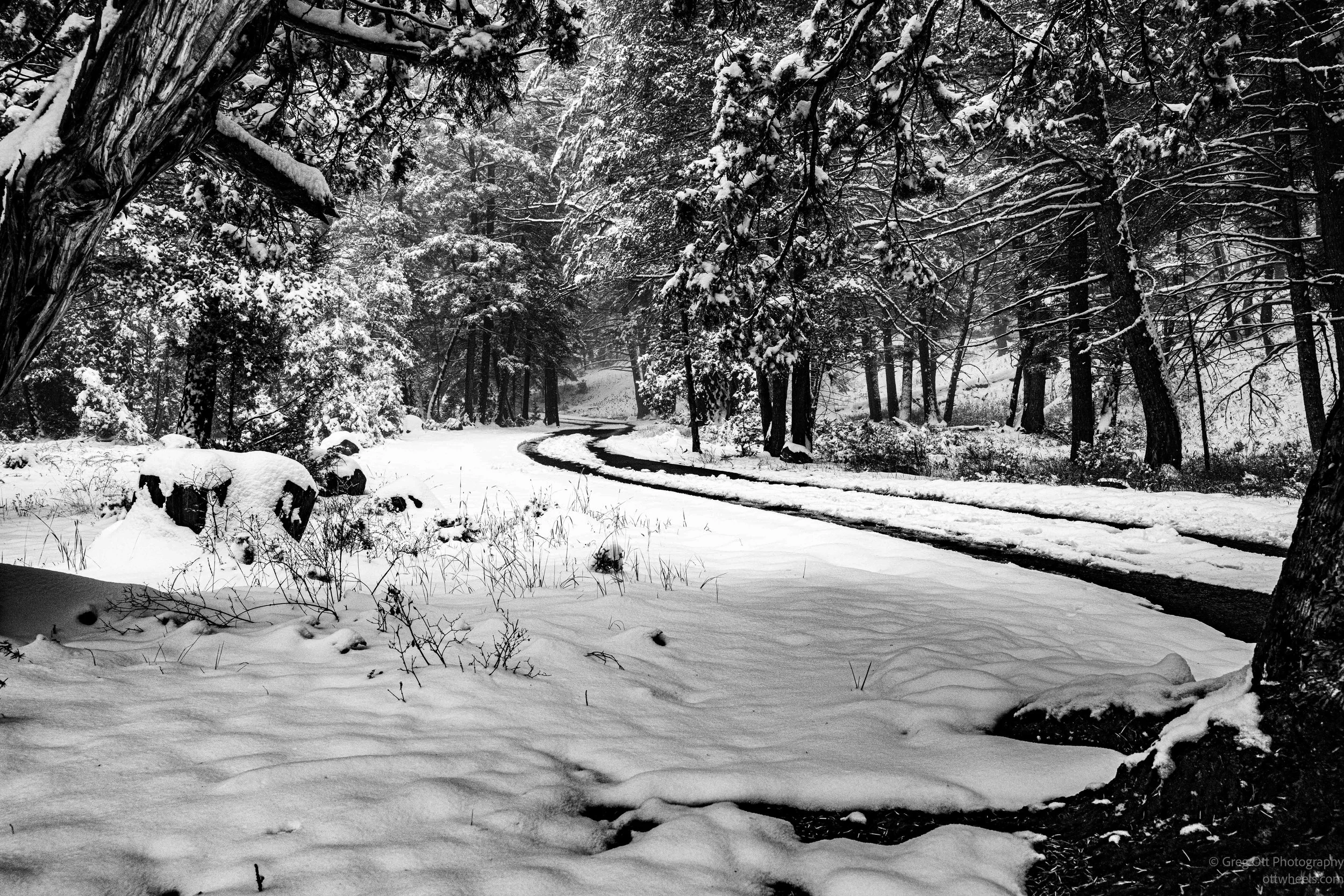
As I continued around the loop, the road wound back through the forest. Snow traced the branches and covered the ground between the dark trees, giving this stretch the black-and-white feel I had noticed earlier. I stopped for another photograph of the road curving through them before continuing the hike.
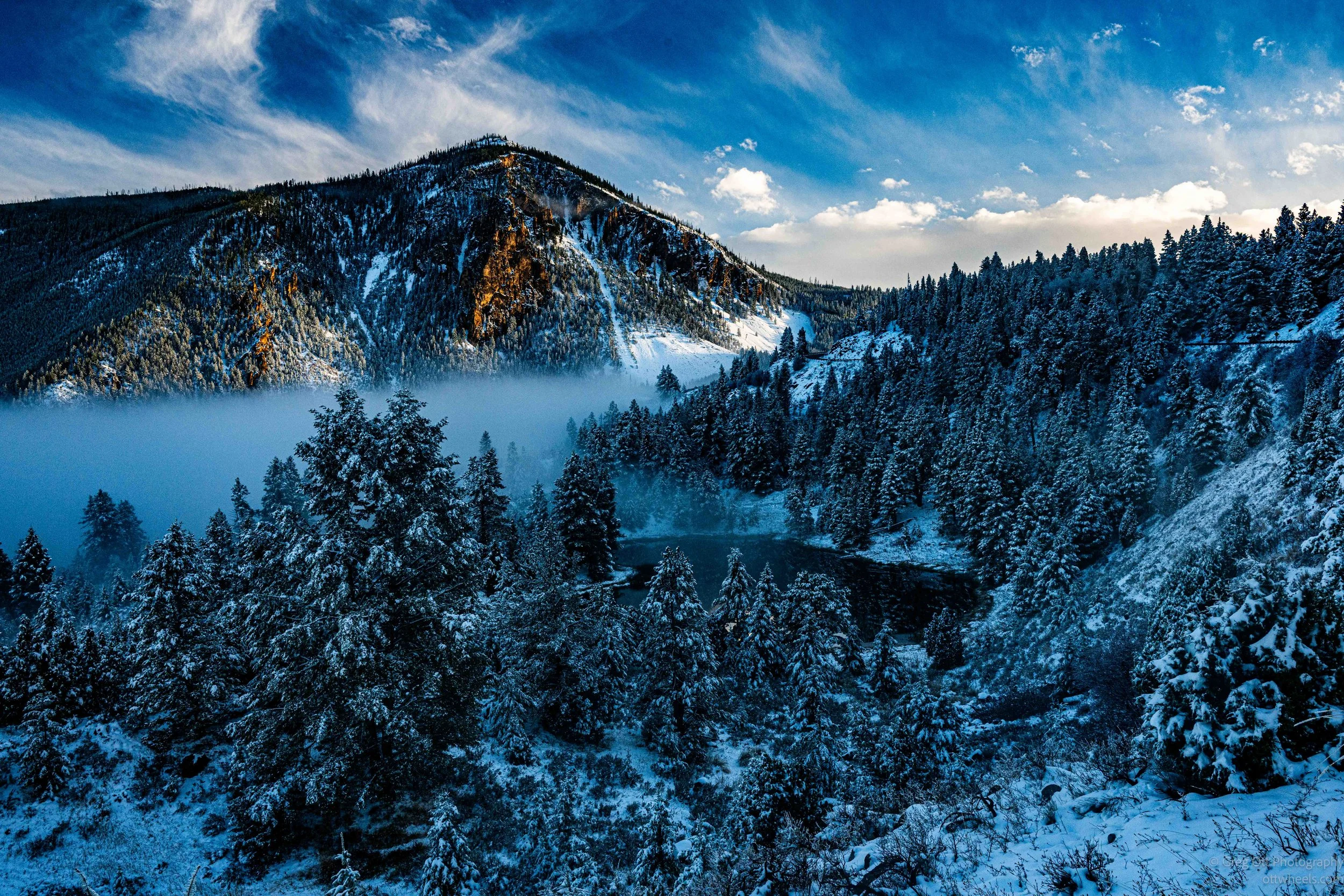
Back at the van, I spent some time cleaning off the snow and putting away my hiking and camera gear, then took a rest while I copied the images onto a drive. I was excited about some of the photographs, but when I headed out, the parking lots were empty and the sun was beginning to set. Driving back toward Madison, I stopped for a view of Bunsen Peak, where patches of younger forest among the older trees still show the pattern left by the fires of 1988. The snow and low clouds made the different sections of forest stand out across the mountainside.
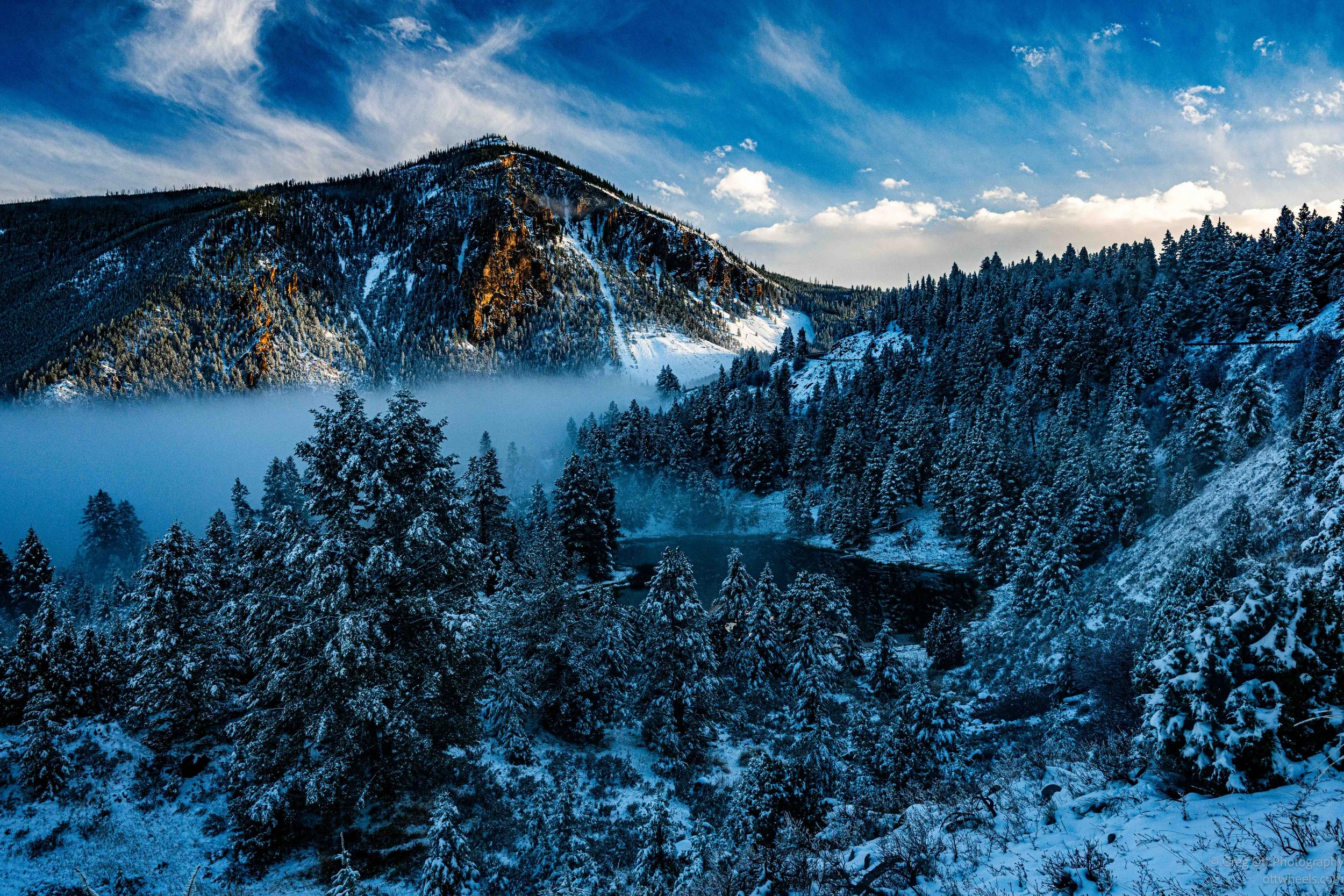
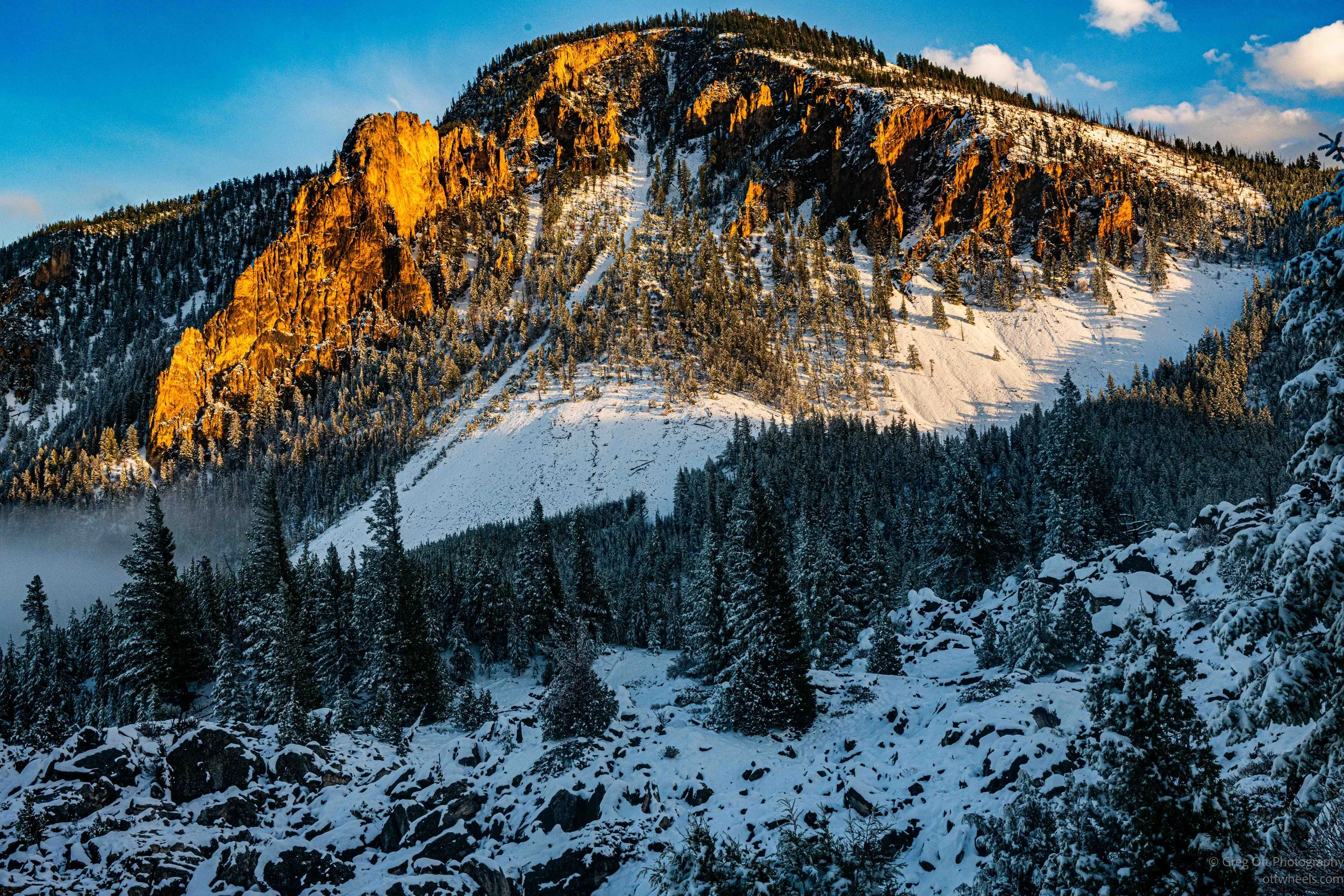
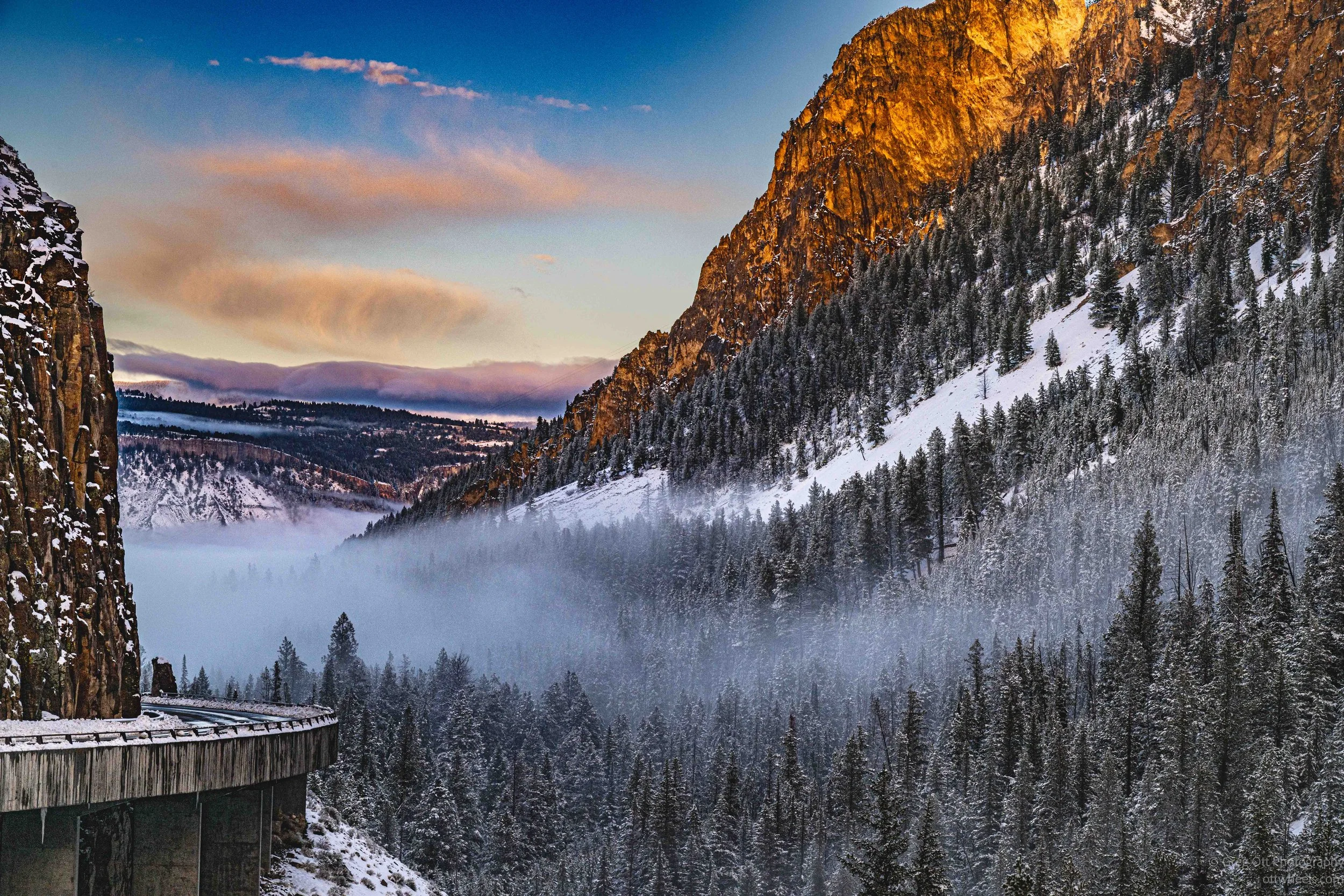
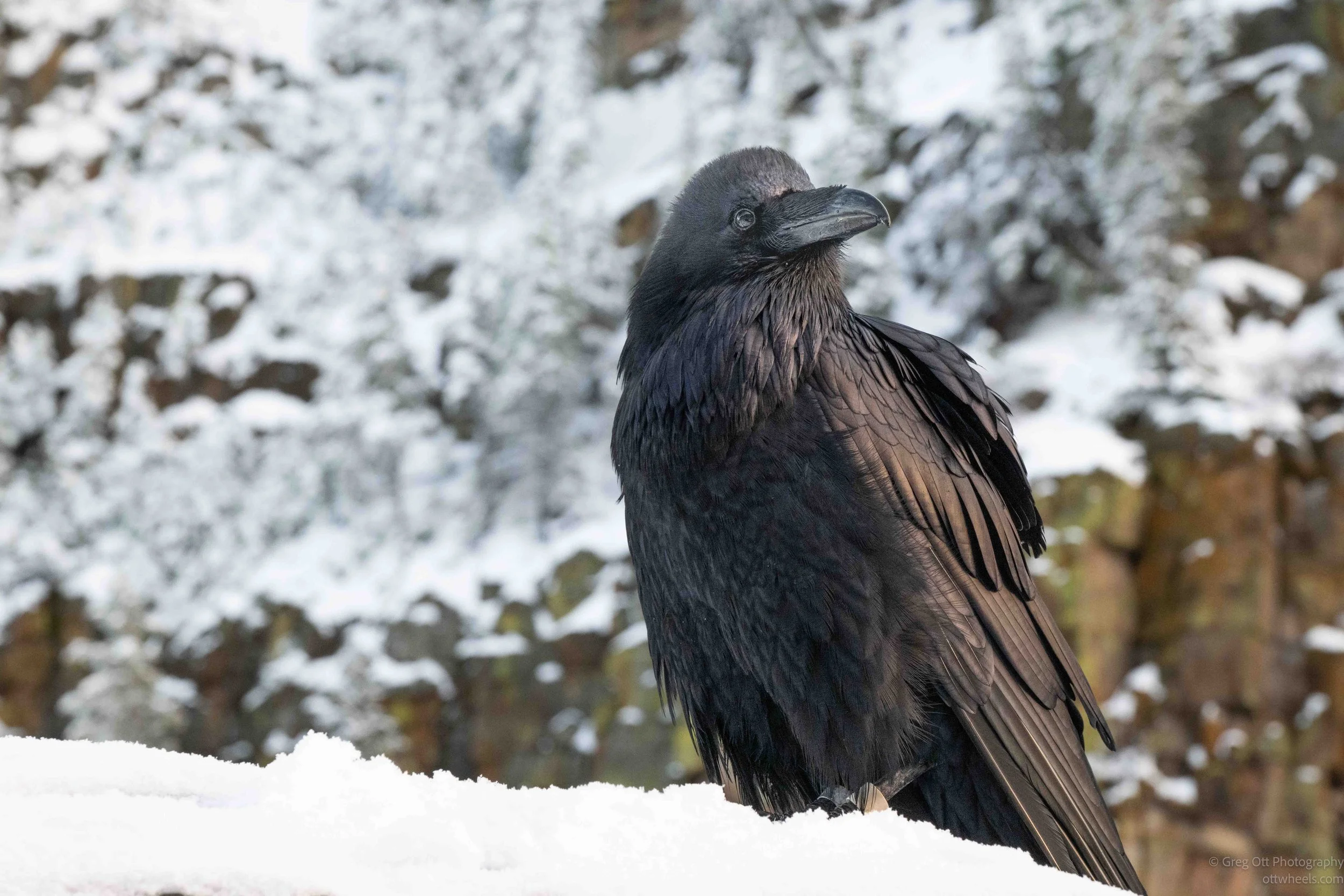
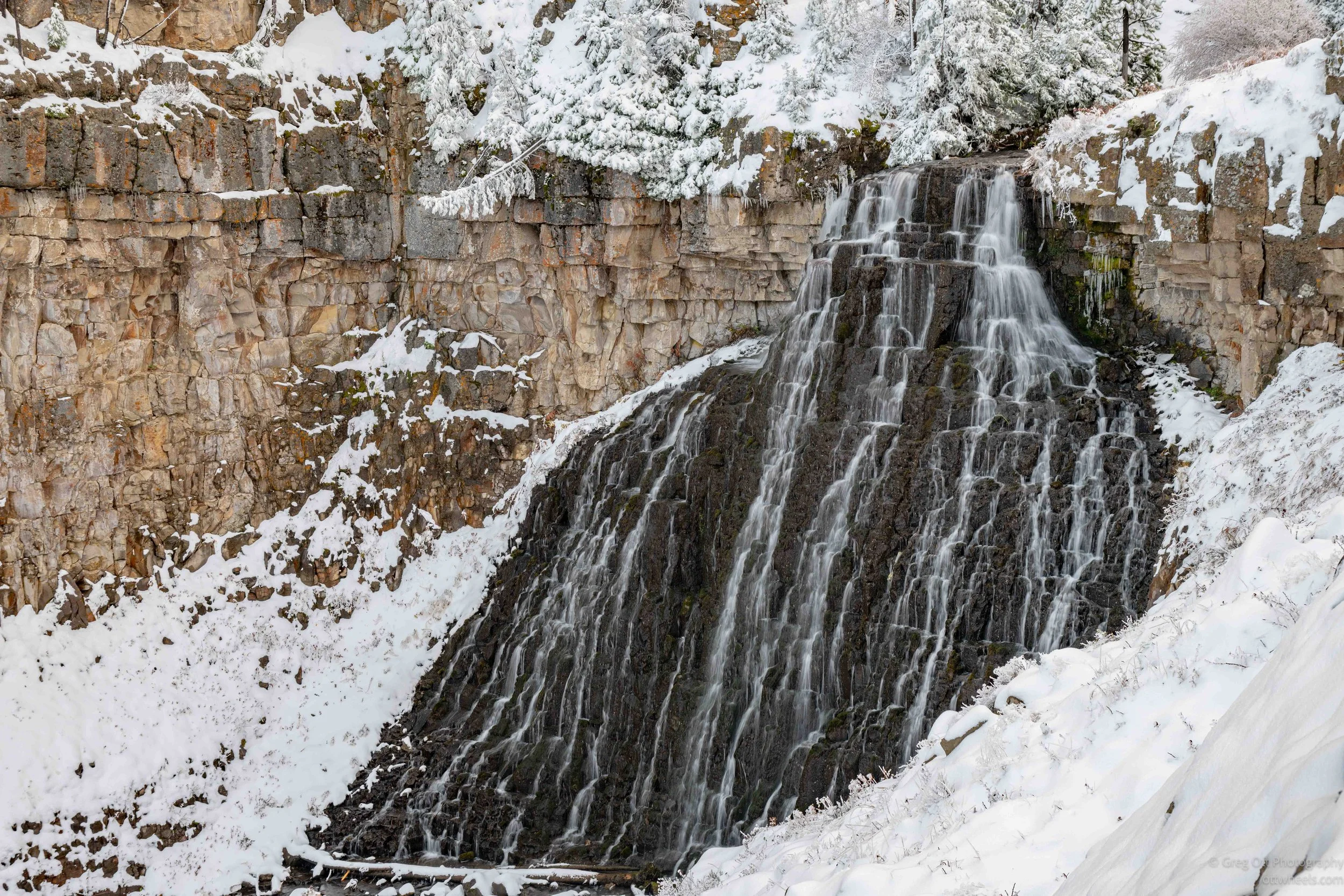
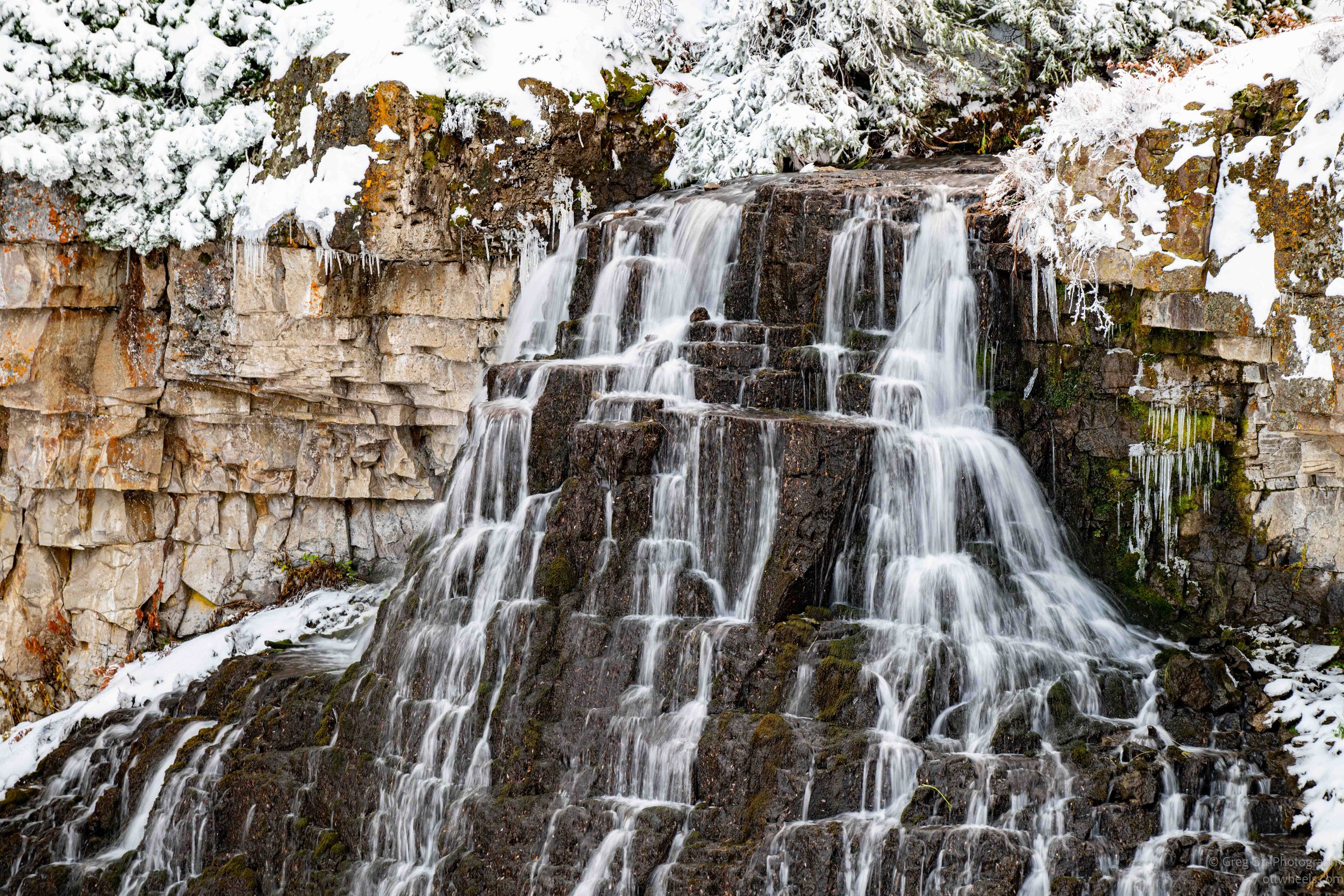
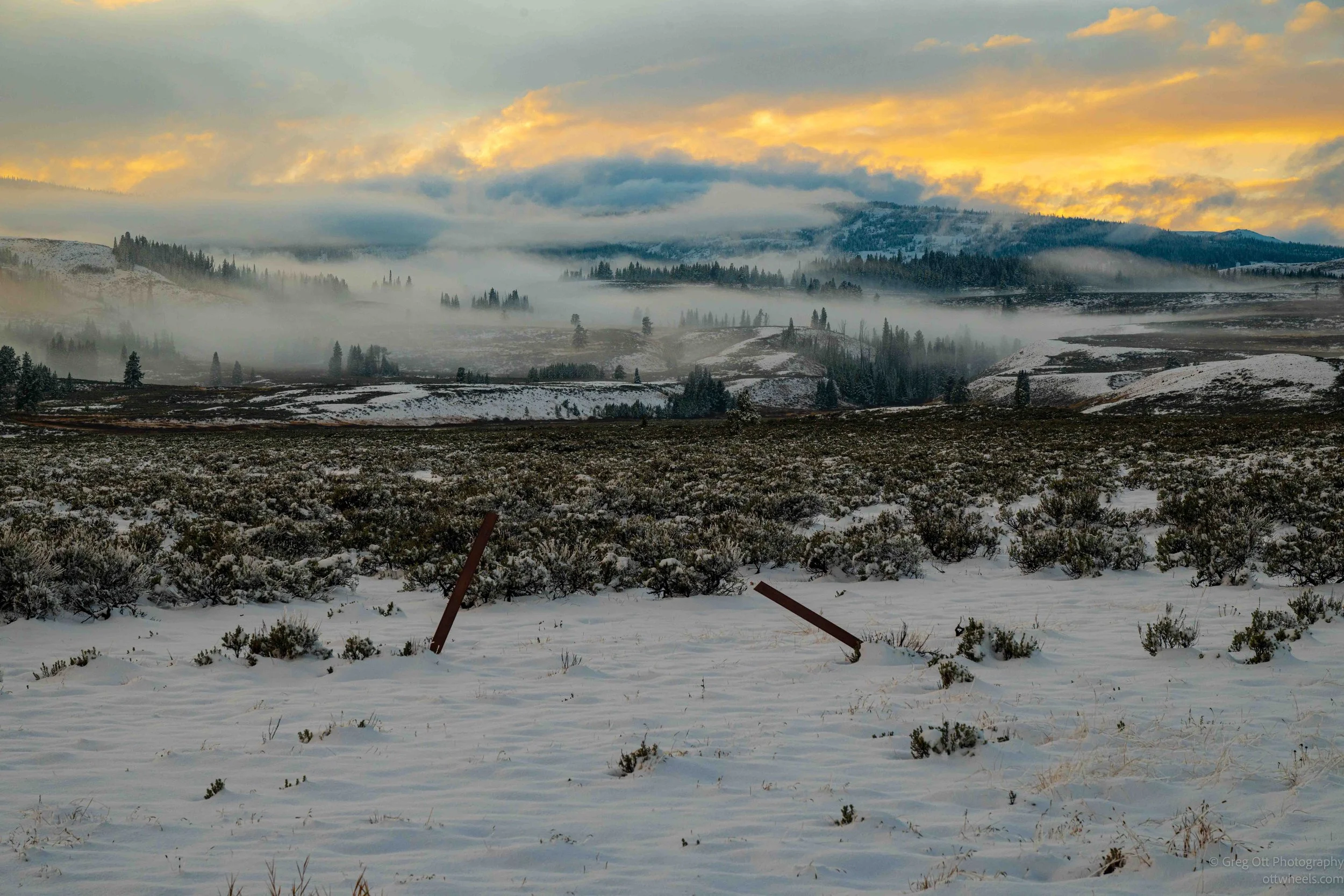
As I continued, the setting sun painted the exposed cliffs gold and orange above the snowy forest. There were plenty of cameras out along the way, including mine, and I probably stopped ten times to take more photographs. Along with the mountain views, I photographed a raven and a waterfall surrounded by snow and icicles. By the time I reached the more open country, low clouds were drifting between the hills beneath a yellow sky. I had already put the camera away once, but the views kept giving me reasons to get it back out.
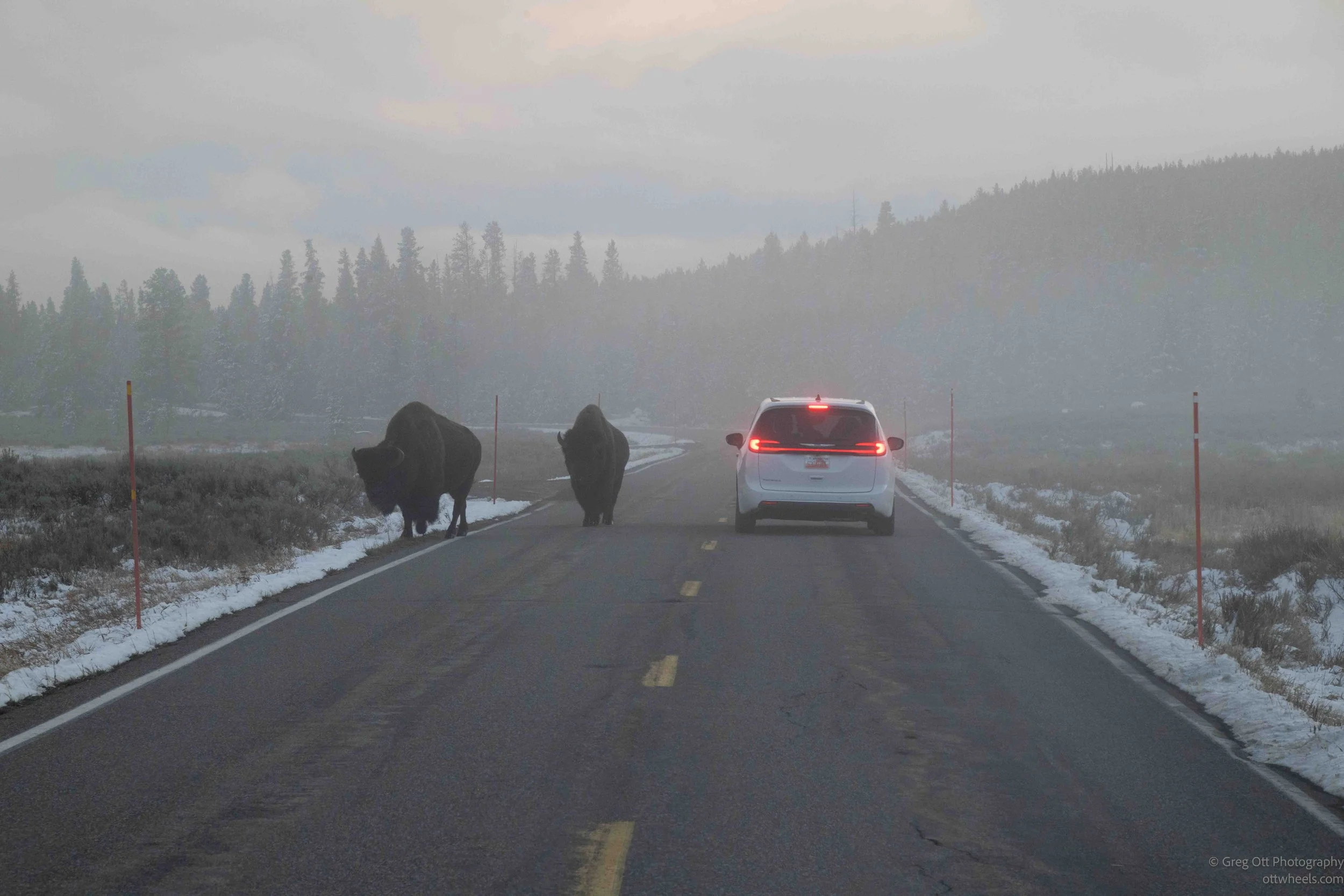
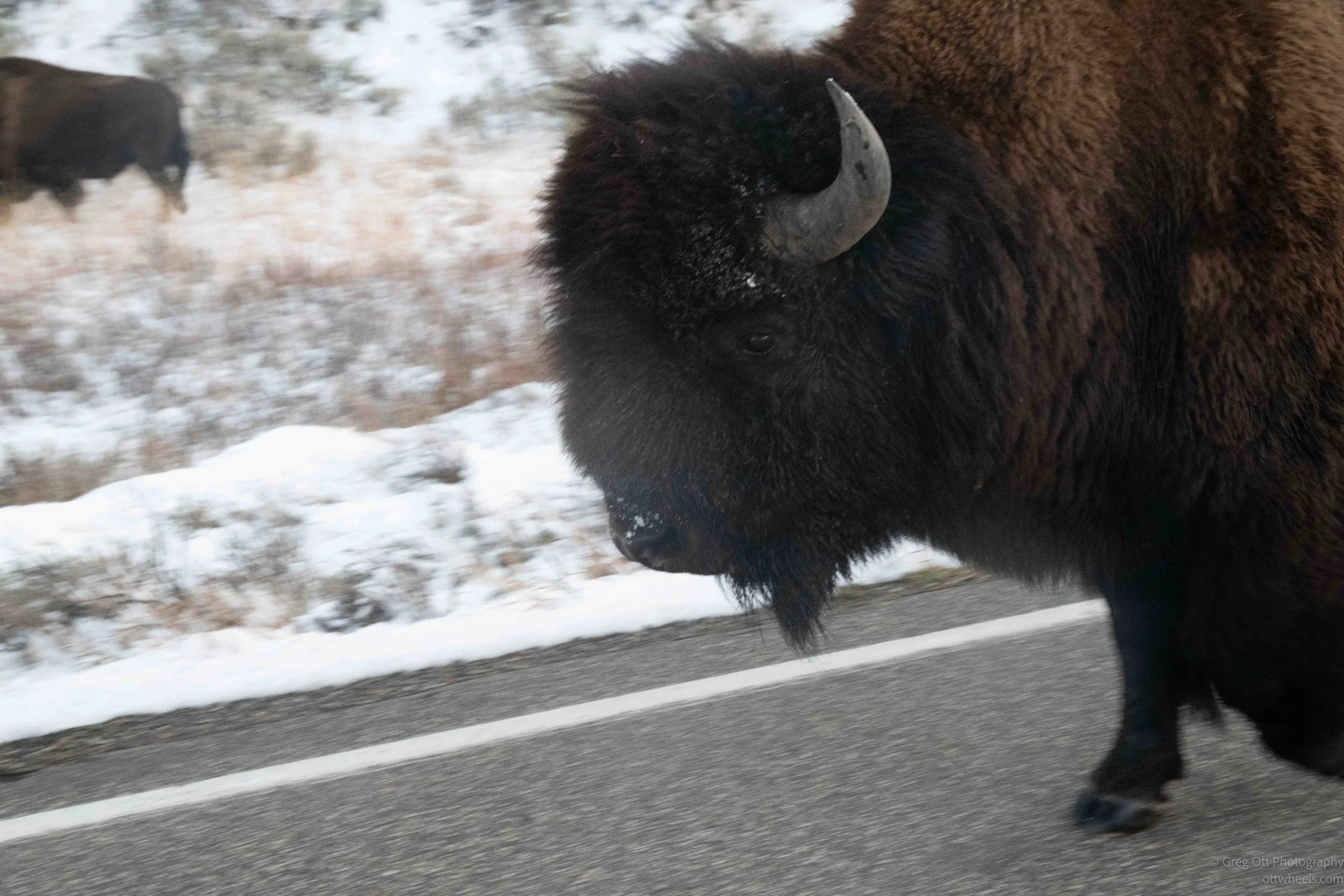
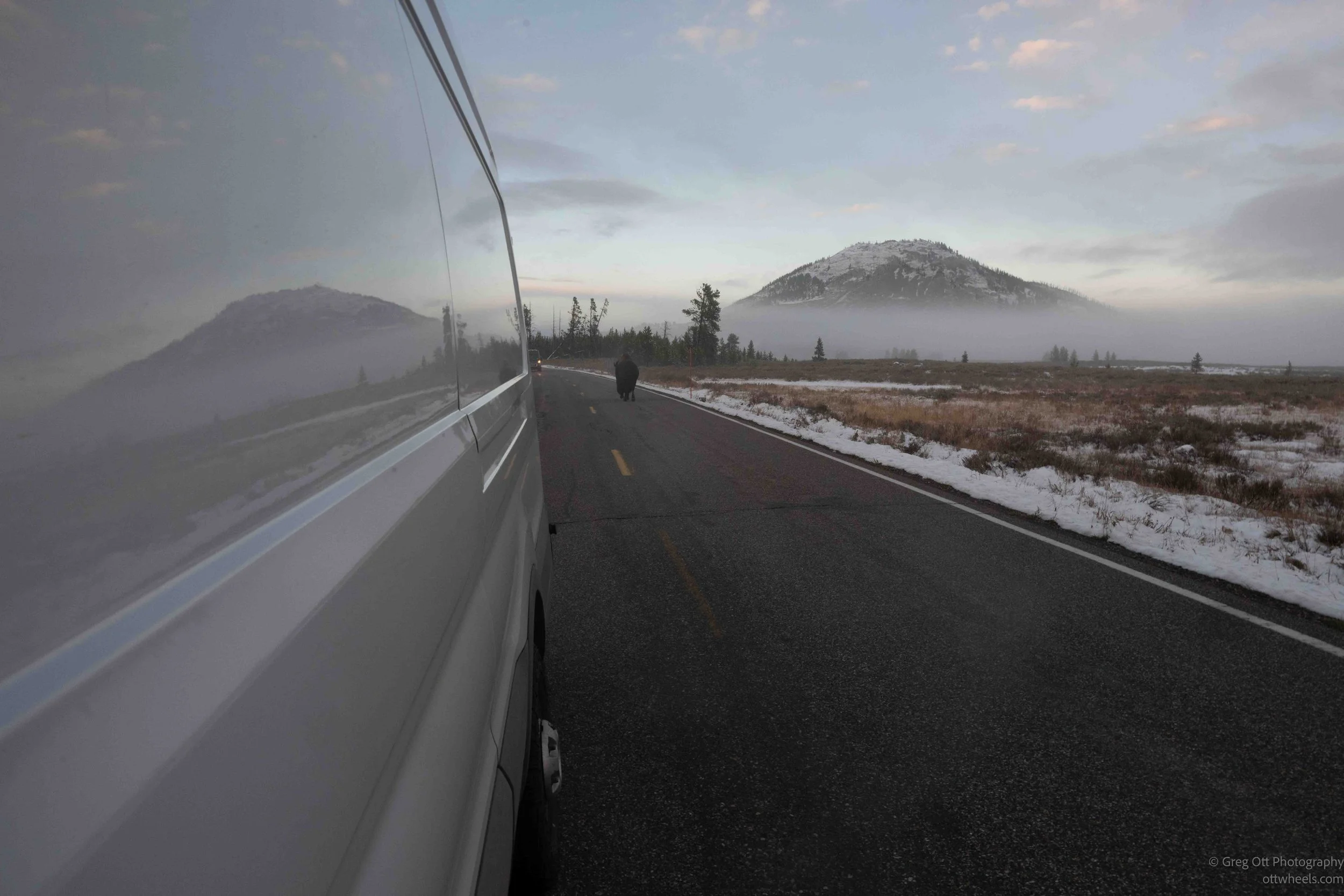
The fun continued as the golden hour slipped away. A car ahead of me slowed as several bison decided to walk down the middle of the road. I slowed down, grabbed my camera and started taking photos. One particularly large bull approached the van and stopped beside me, looking directly at me as though he was trying to decide whether to ram the van or simply continue on his way. He stood there for about 30 seconds, close enough that I could see every detail of his enormous head, before finally deciding to move on. I watched him walk past and continue down the other side of the road without the slightest concern for the traffic he was holding up. He behaved as though he owned the road, and I suppose he probably did.
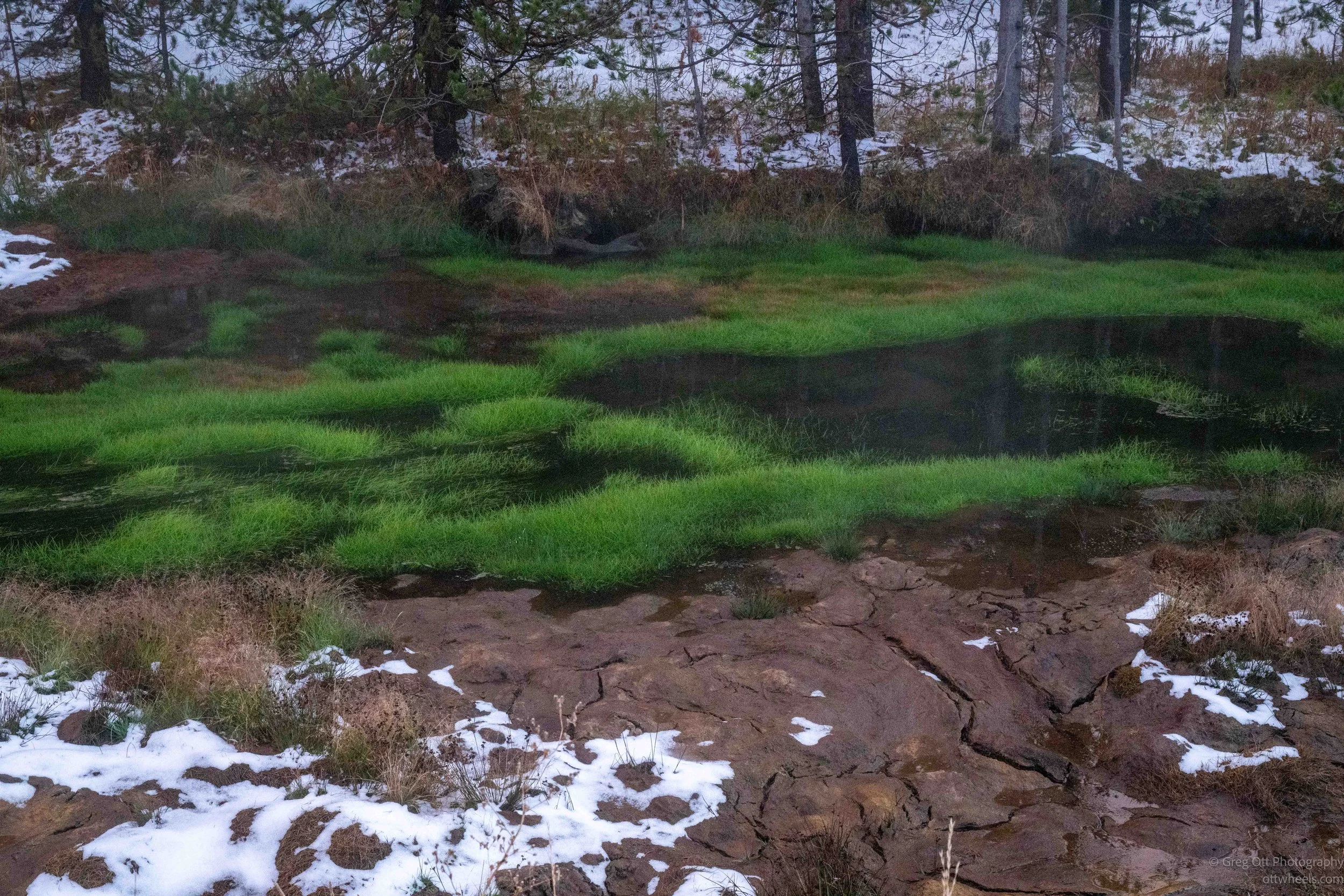
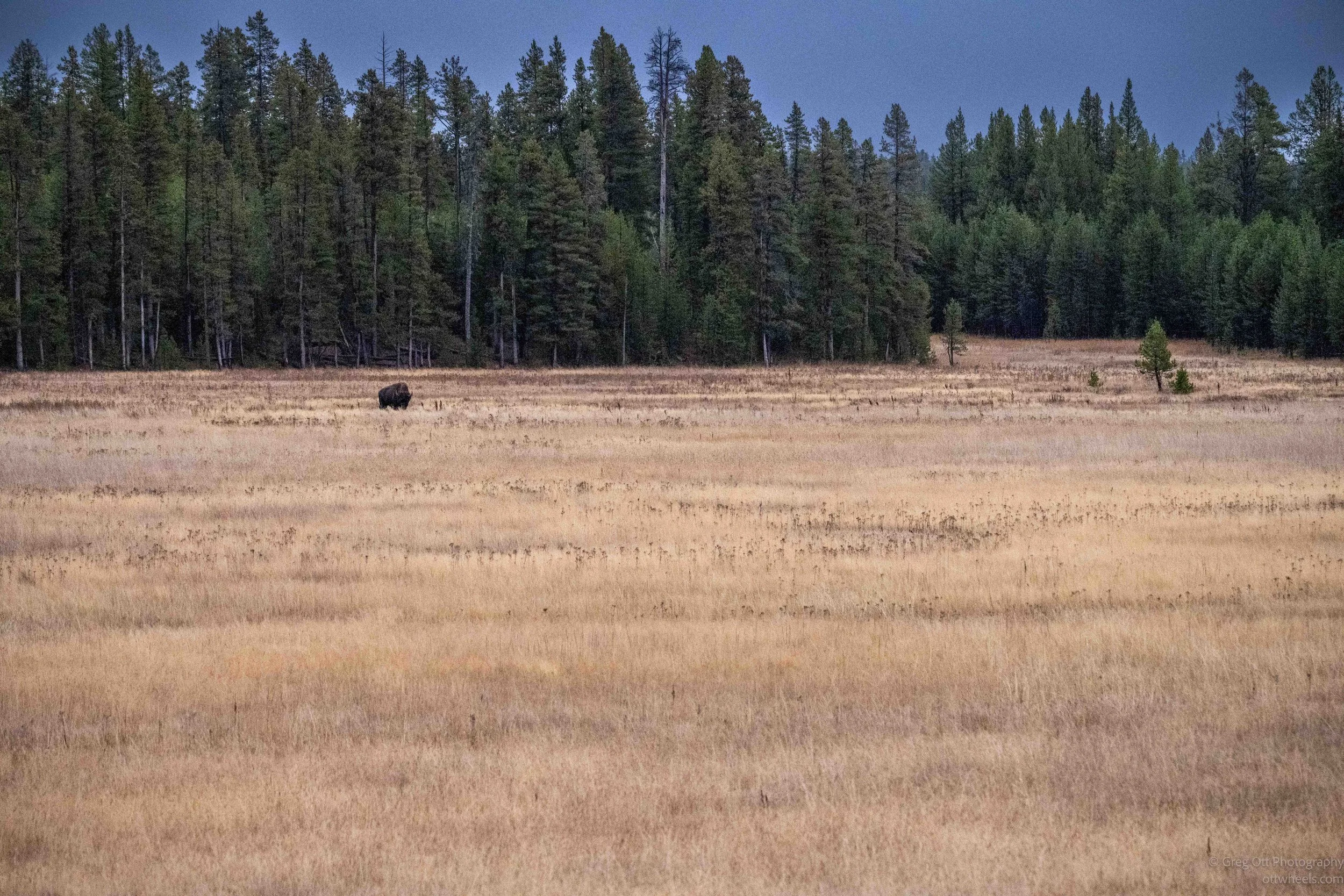
I stopped a few more times before heading back to the campground. Earlier, I had noticed some unusually bright green grass growing in the middle of a stream, surrounded by patches of snow. I suspect the water was being warmed by geothermal activity, allowing the grass to remain green despite the cold weather. The contrast between the vivid green vegetation, dark water and snow was striking. I also stopped to photograph a lone bison grazing in a large meadow bordered by pine trees. By then, the light was fading and the sky was growing darker, so I decided it was time to return to Madison Campground.
It was after 8 p.m. when I returned to the campground, and it was already dark. My neighbors had a campfire going, but I was too tired to join them. After a long day of hiking, photographing and exploring Yellowstone, I was ready to call it a night. I made a quick dinner, crawled into bed and just relaxed.