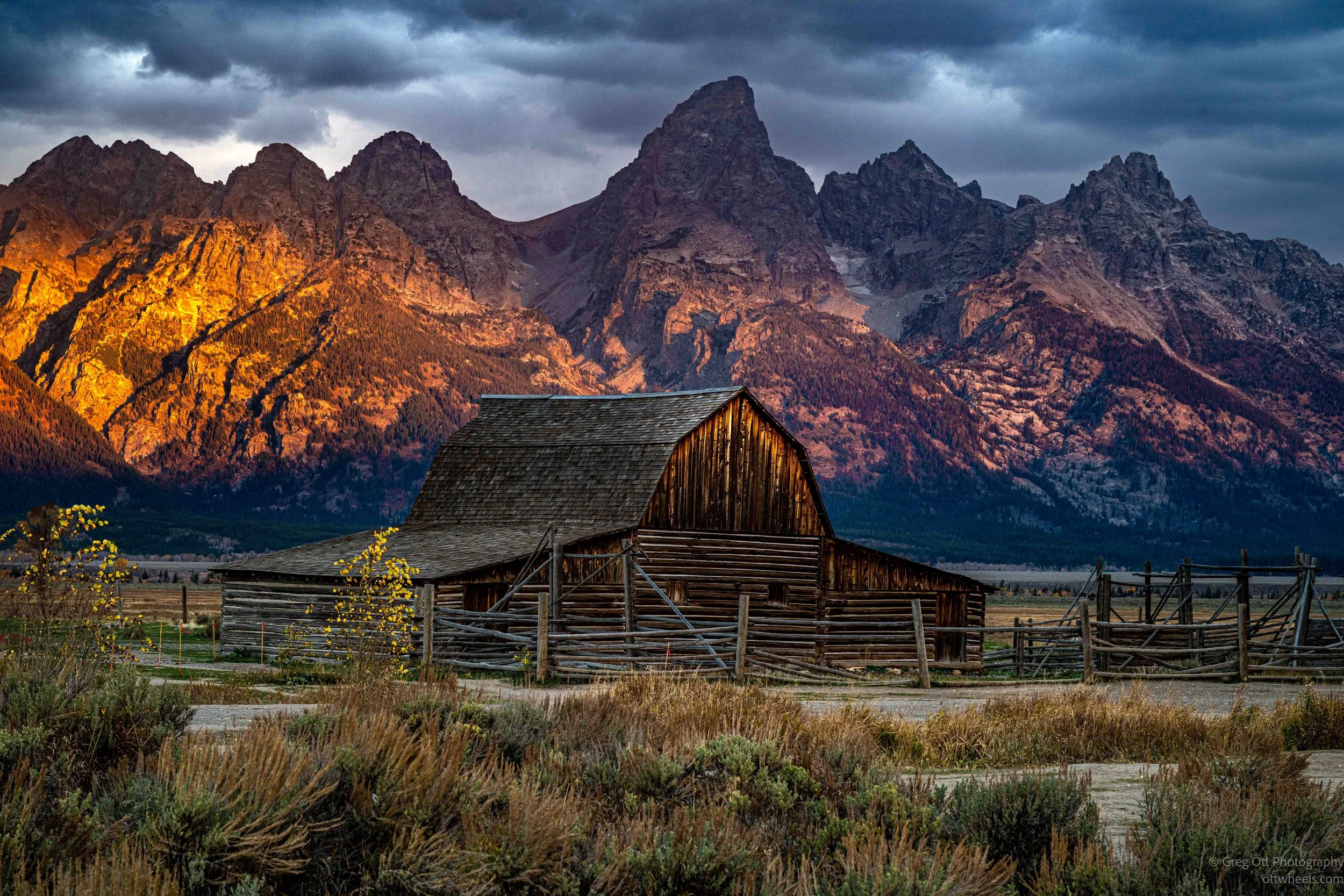
I was out of Gros Ventre Campground by 6:30 a.m., heading toward the historic barns at Mormon Row. I wanted to photograph them at sunrise, something I had been planning to do before leaving Grand Teton National Park.
When I arrived about 20 minutes later, cars were already lined up along the side of the dirt road. There must have been 70 photographers standing in a row, their cameras and tripods all pointed toward the same barn and the Tetons behind it. Other visitors were scattered among them.
I tried to find a place where I wouldn't block anyone's camera. Almost immediately, a man called out, "You're blocking our view." He was standing with his family of four, and none of them had a camera. I moved over beside them anyway. "Good morning. Sorry," I said. He didn't answer, although his wife said good morning.
The yelling continued during the 30 minutes or so that I stood near the group. Someone would be walking along a path a hundred yards away, and a photographer would start shouting for them to get out of the picture. With that distance and a little wind, I doubt the person could even hear them.
At one point I said to a photographer, "There's always Lightroom." He rather smugly replied, "I don't retouch my images." I thought that was an interesting statement. If you're photographing in RAW format, you're making decisions about how that image is processed one way or another.
Mostly, though, I didn't understand the attitude. Owning a camera doesn't give anyone the right to yell at people for walking along a public path. I also found the whole scene a little strange photographically. Everyone was trying to make essentially the same image—an image that has already been photographed tens of thousands of times and published around the world. Seventy cameras were pointed toward one barn while beautiful photographs were happening everywhere around them.
Then the sun reached the Tetons and painted the mountains in pink and gold. Within five minutes, some of the photographers were already folding their tripods and walking back to their cars. They had apparently gotten the photograph they came for. I stayed. For another 45 minutes, I wandered around Mormon Row, looking in different directions and trying to find my own photographs in the changing morning light.
I left Mormon Row thinking there ought to be a code of conduct for photographers. I later disco vered thatthere is. The North American Nature Photography Association has published ethical guidelines that include treating other people with courtesy and respect. There's also an organization called Nature First that promotes responsible behavior among nature photographers.
I don't think any photographer has the right to claim a piece of public land simply because they've set up a tripod. Everyone has an equal right to enjoy these places, whether they're carrying a camera, walking with their family or simply enjoying the scenery. A little patience and consideration shouldn't be too much to expect.
What bothered me almost as much as the shouting was the lack of curiosity. Everyone seemed so determined to capture that one familiar photograph that they were missing much of what was happening around them. I enjoy photographing well-known landmarks as much as anyone, but I also enjoy looking for something different. Sometimes the most interesting photograph is the one you weren't expecting to take.
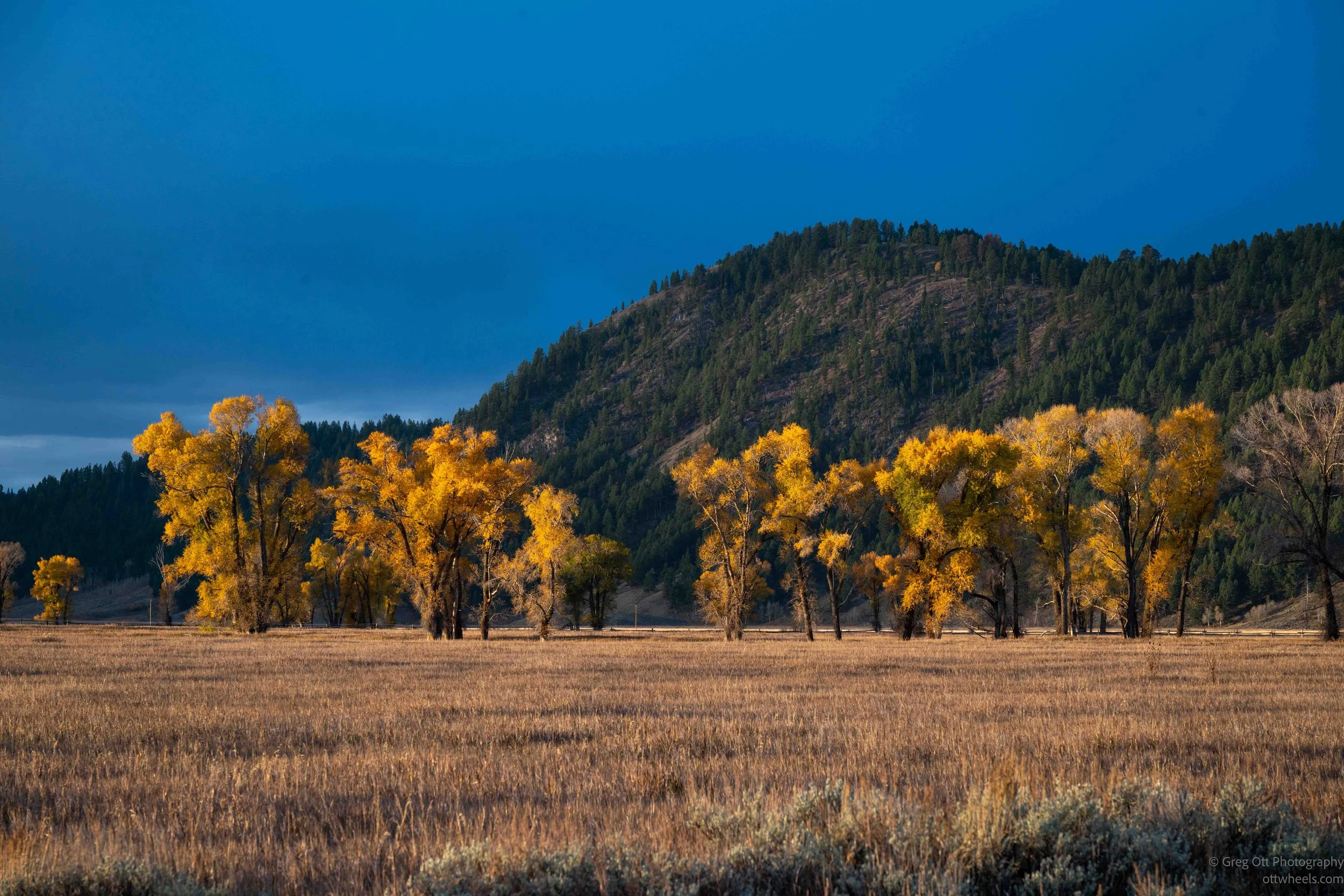
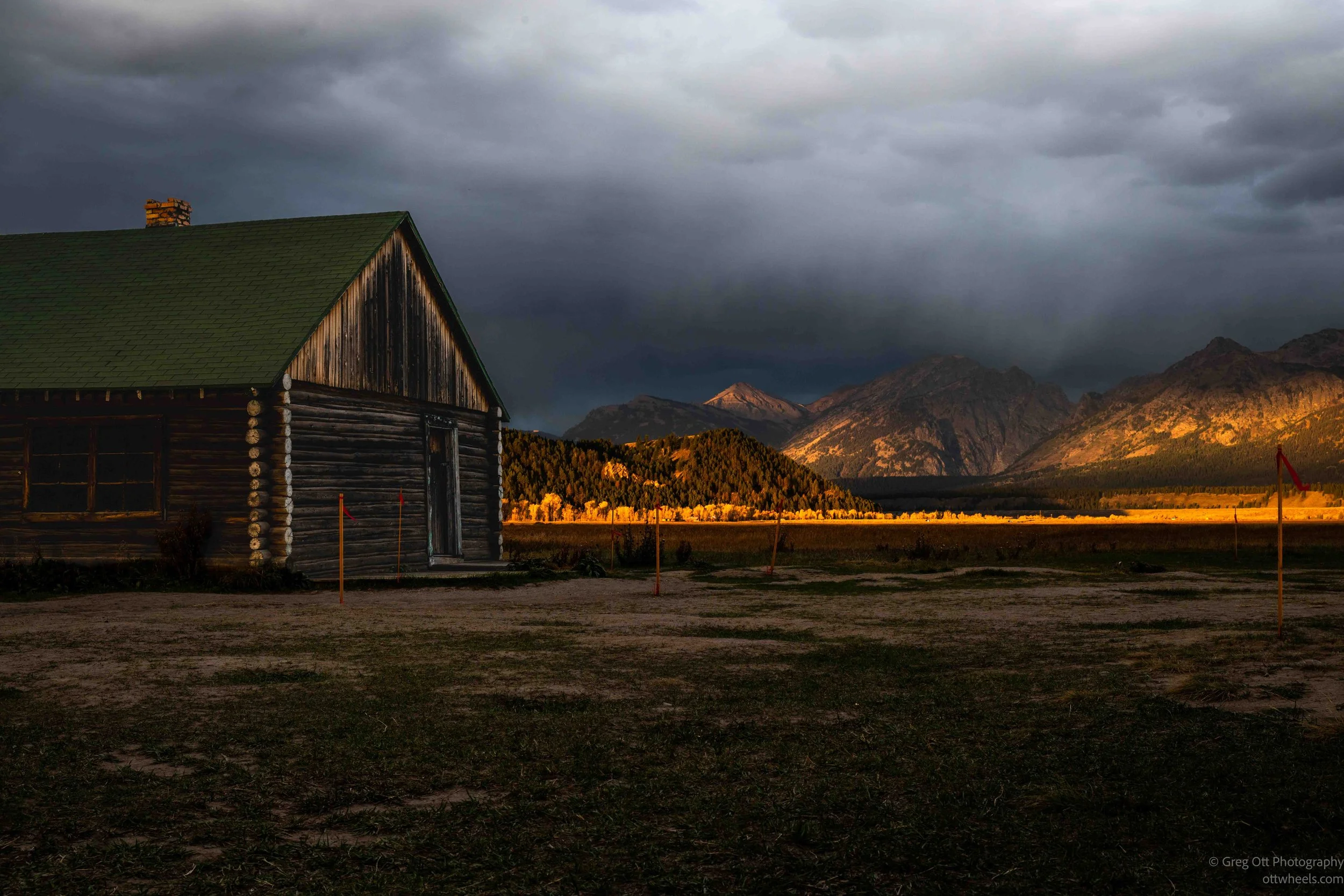
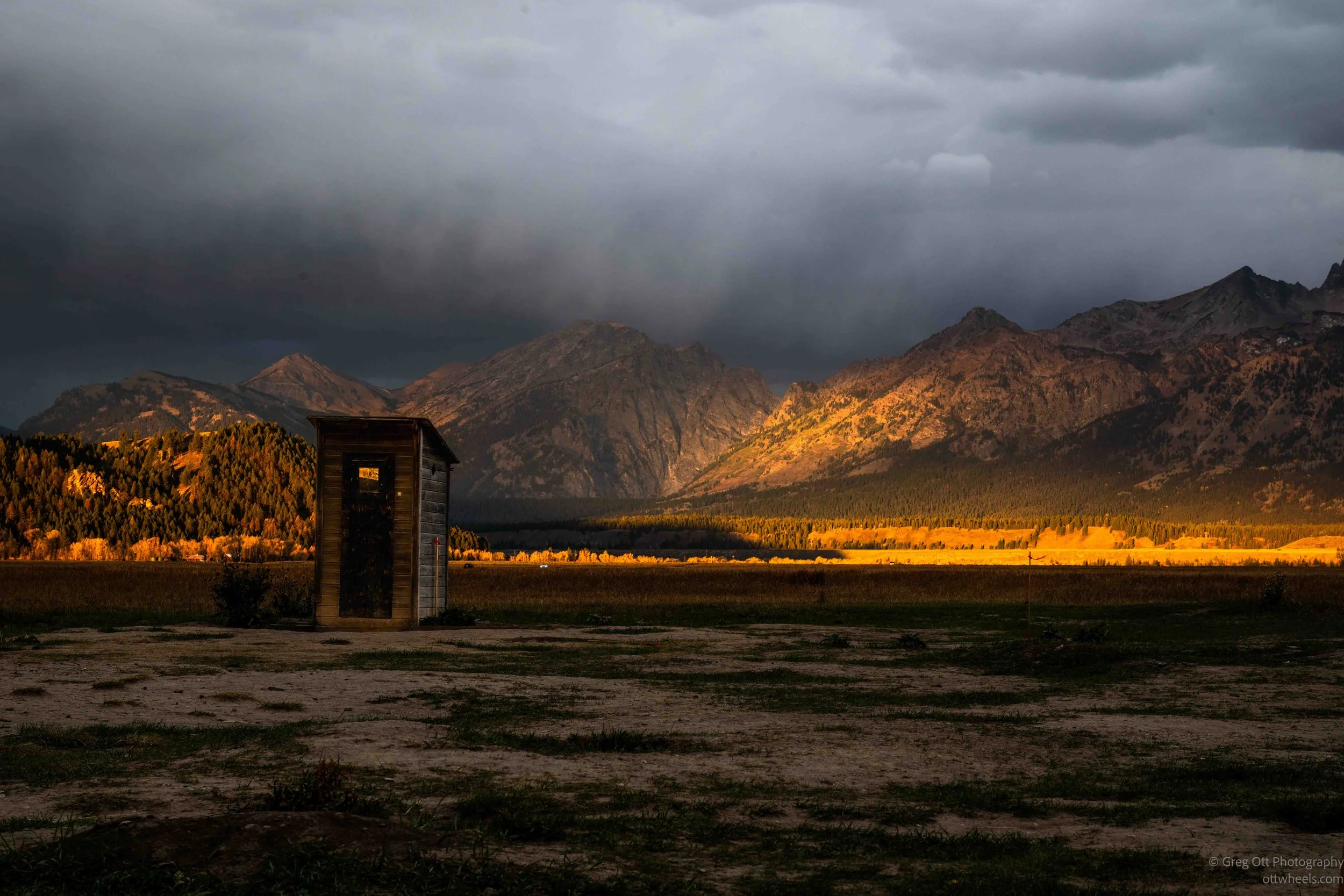
I wondered how many of those photographers had actually looked behind them when the sun came up.
Continental Divide
Not far north of Jackson it began to rain. I was on RT-191 and stopped to photograph some bodies of water. Im not even sure what area it was. I came to a sign marking the continental divide and stopped for even more photos. There were small bodies of water. places where the water couldn’t decide to go to the Pacific or Altlantic oceans.
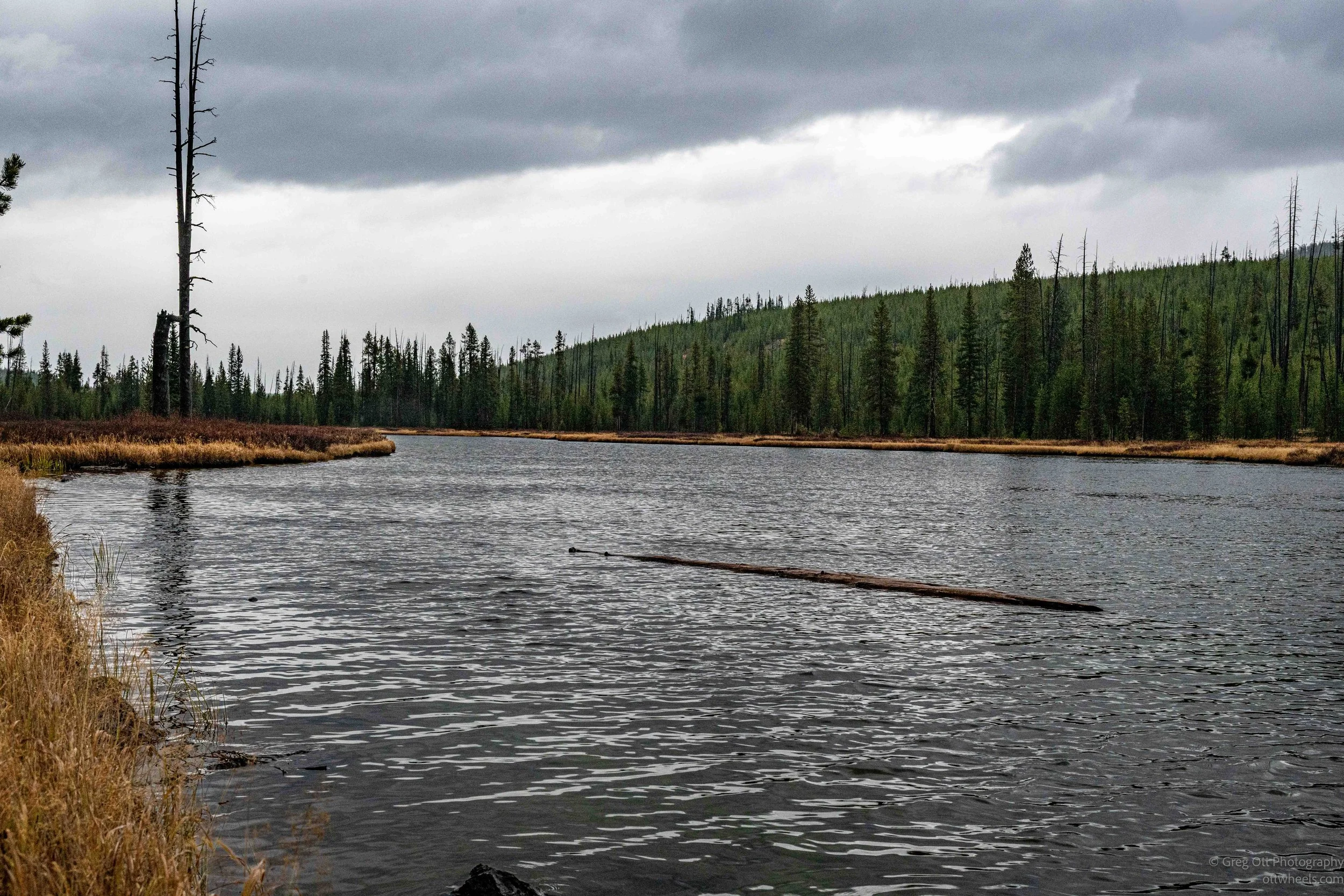
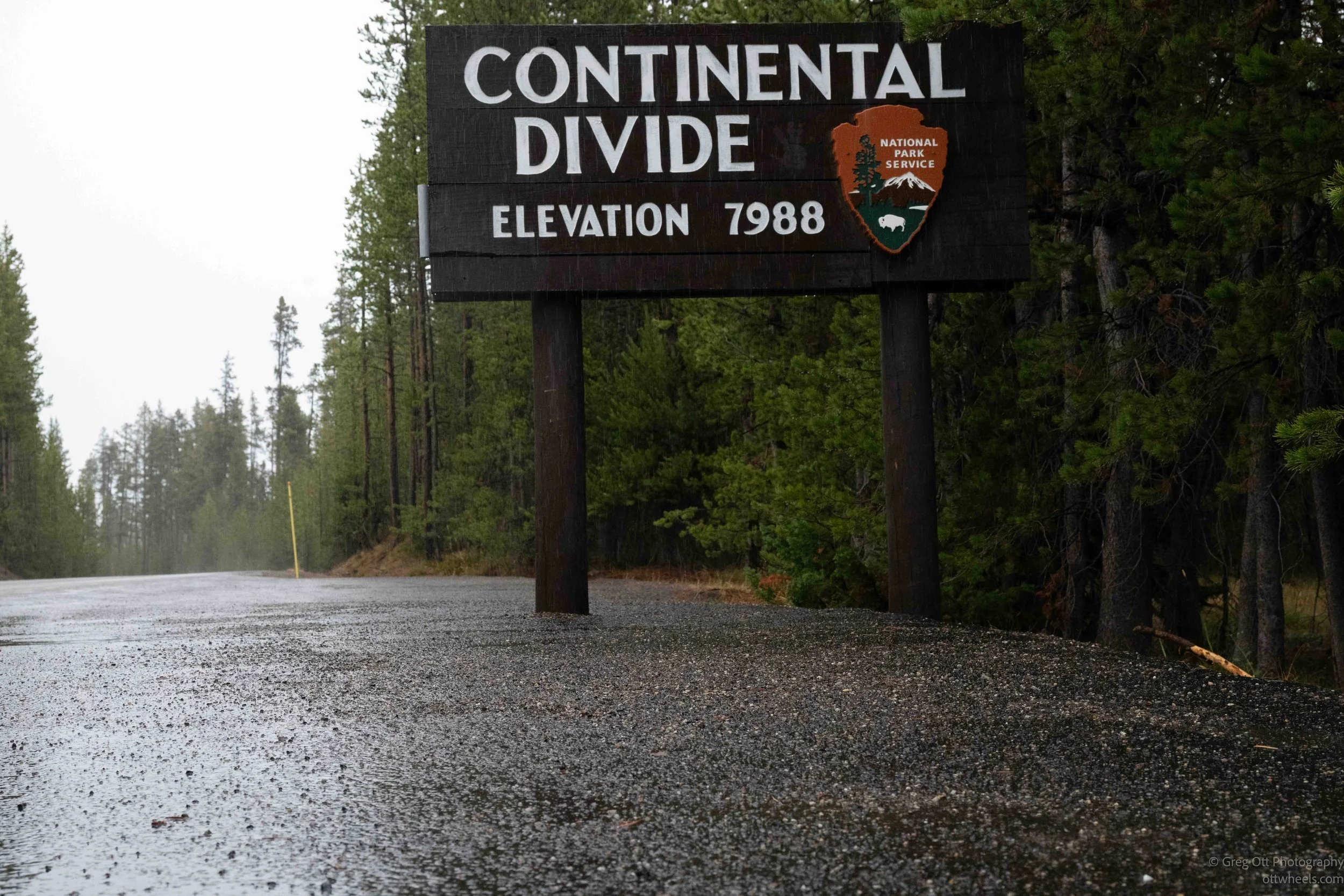
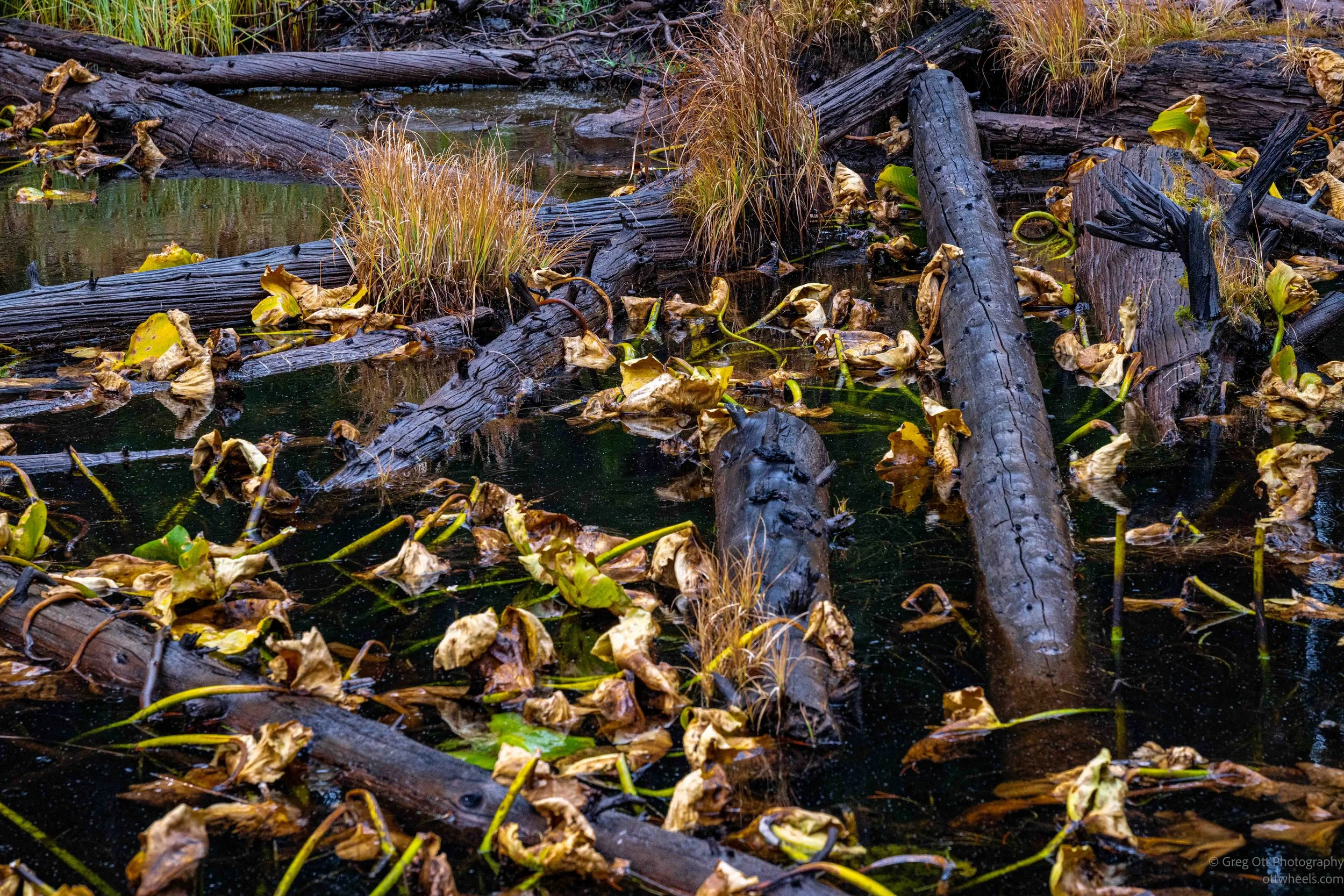
It was that time of year when there were fewer vehicles on the roads. The Grand Teton campgrounds had begun closing for the season, and Yellowstone would soon follow. I pulled over to photograph a pond where the lily pads were turning yellow, creating interesting patterns on the water as raindrops fell around them. At one end of the pond, a pile of charred logs lay soaked from the rain. I later realized that I'd crossed the Continental Divide twice along the way.
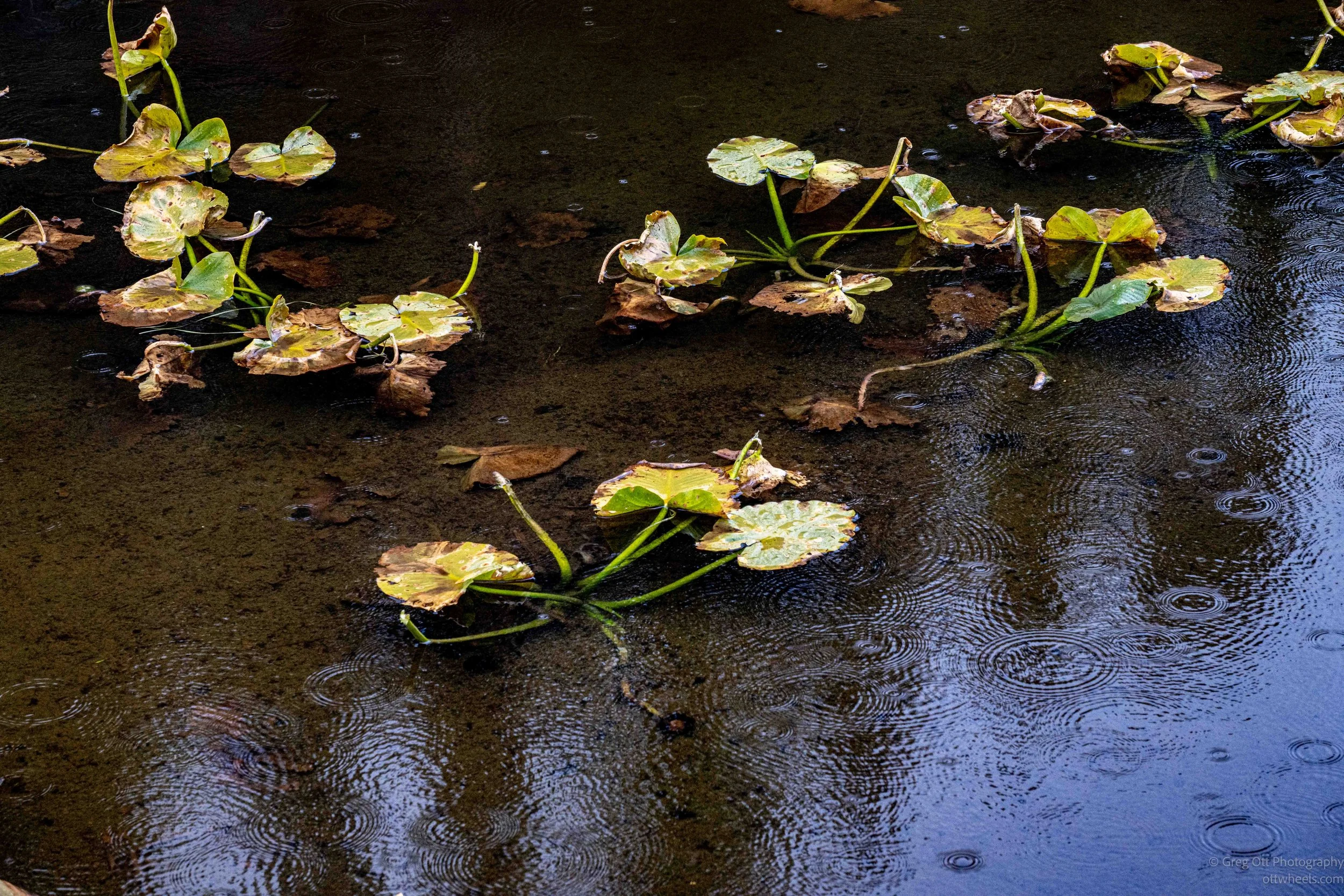
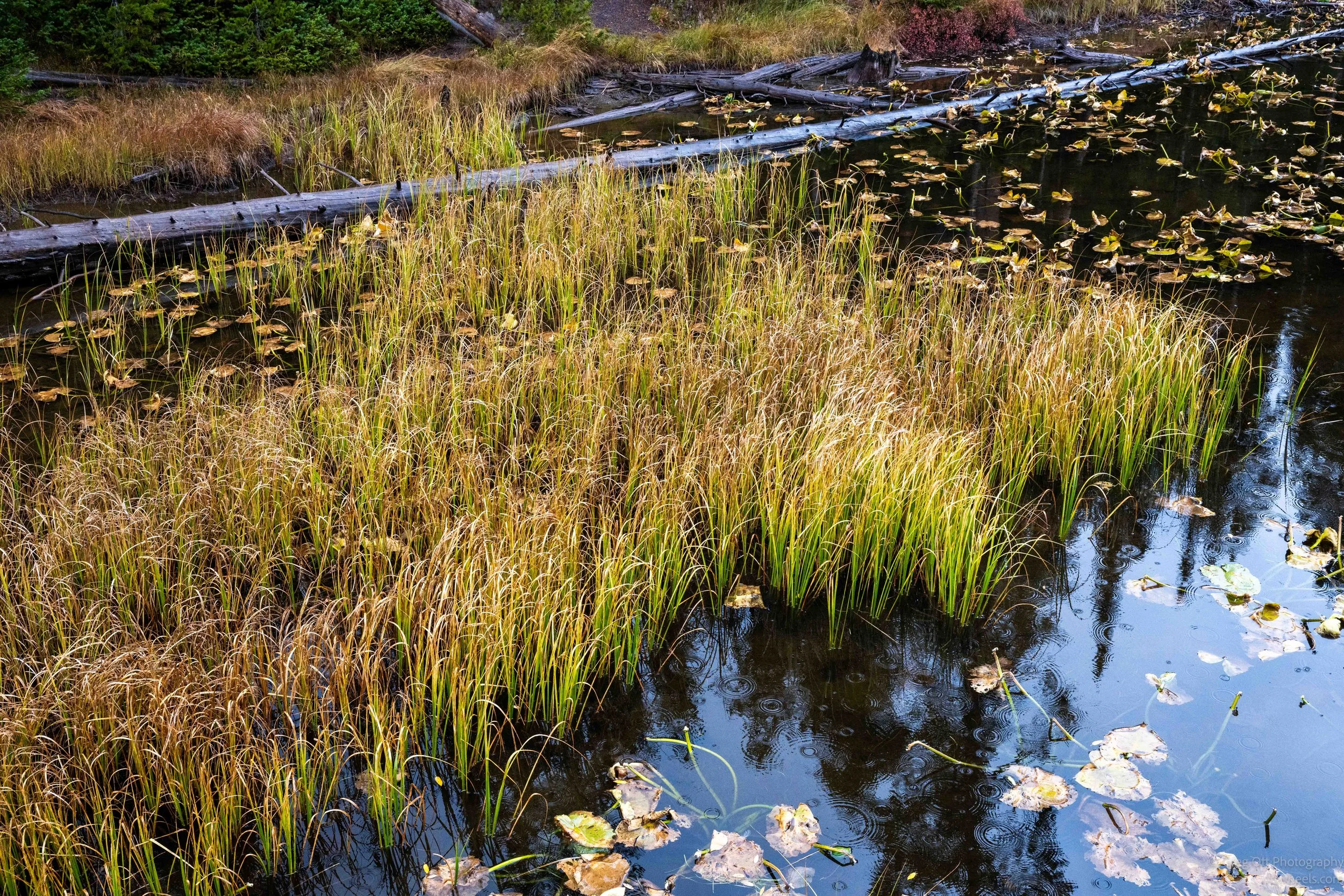
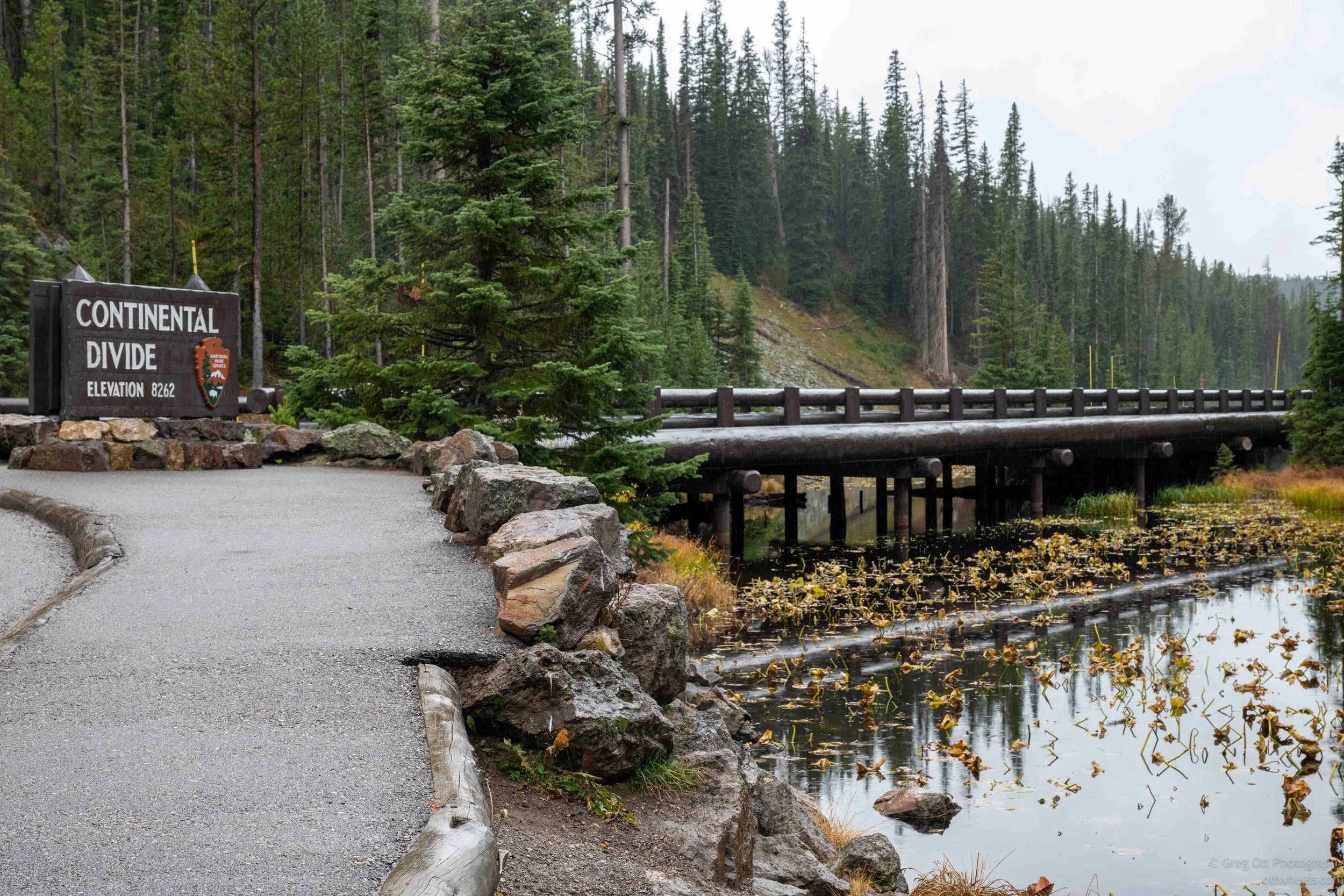
I made it to the campground, checked in and went to my site. I was once again surrounded by four people running generators. It was mid afternoon and I wanted to visit Old Faithful.
Old Faithful
I've been to Yellowstone National Park several times, and it never gets old. I've spent much of the past month reading about the geology of the area, and I'm beginning to understand just how remarkable Old Faithful really is.
Yellowstone sits above a volcanic hotspot, where extremely hot material rises from deep within the Earth's mantle. The North American tectonic plate is slowly moving southwest over this relatively stationary hotspot, at a rate of roughly an inch a year. As the plate moves, volcanic activity develops in new locations, leaving older volcanic areas behind.
What's fascinating is that you can trace this movement back through millions of years of geological history. A chain of ancient volcanic centers stretches southwest from Yellowstone across Idaho's Snake River Plain, eventually reaching the Oregon-Nevada border. The oldest of these volcanic areas formed roughly 16 million years ago. Yellowstone is simply the most recent chapter in that history.
I found this particularly interesting because I'd recently traveled through much of southern Idaho, including Bruneau and Twin Falls. I hadn't realized at the time that I was passing through areas shaped by the same hotspot that now lies beneath Yellowstone.
It was Saturday afternoon, and the park was nearing the end of its regular visitor season. Within a few weeks, most of the roads and facilities would be closing for the winter. There were still plenty of visitors around, but I knew the season was winding down.
When I arrived at the Old Faithful area, I recognized the historic Old Faithful Inn immediately, although the surroundings looked quite different from what I remembered. I didn't recall the enormous visitor education center, and there was now a much larger viewing area with benches and seating around the geyser. The whole area seemed more developed and organized than on my previous visits.
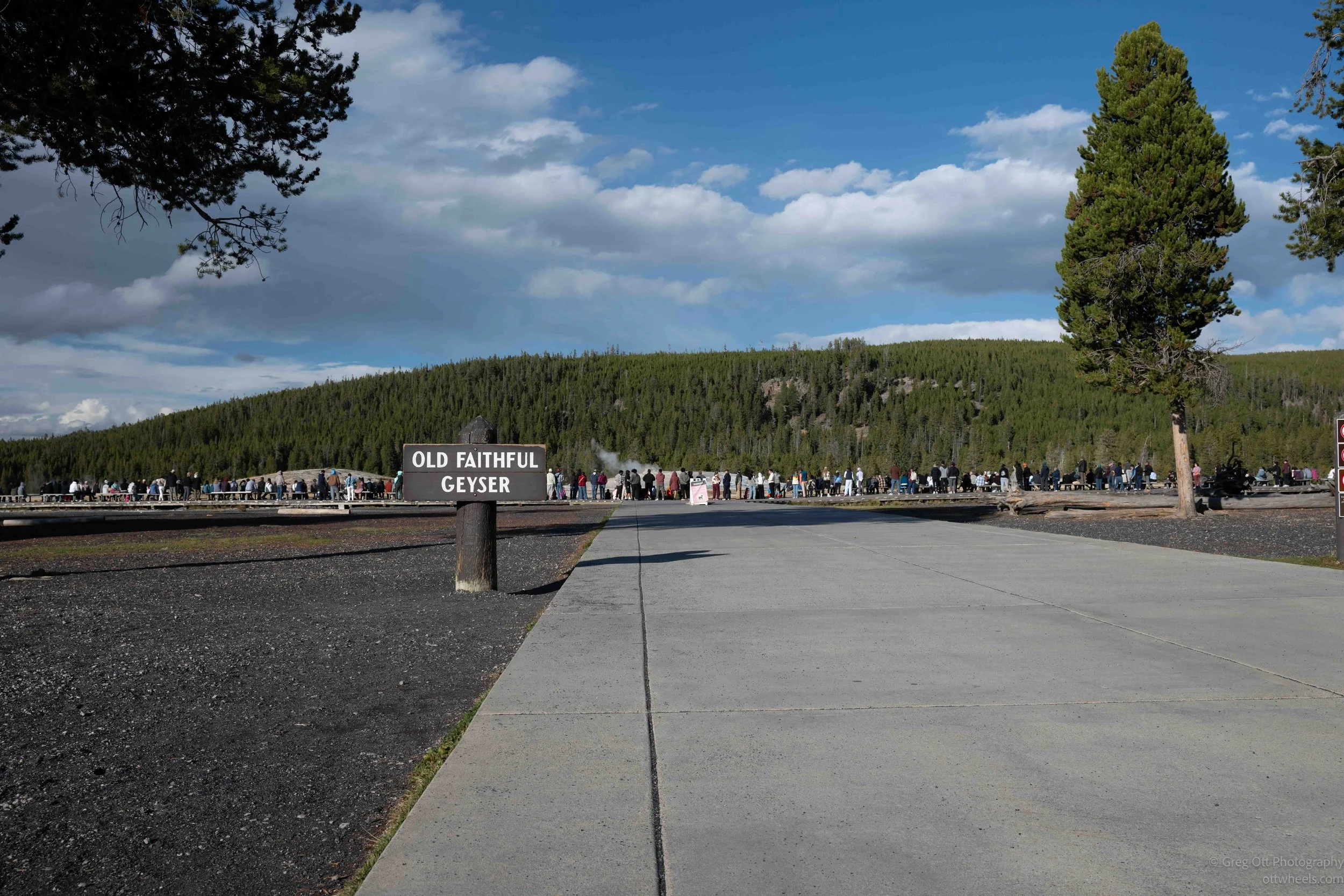
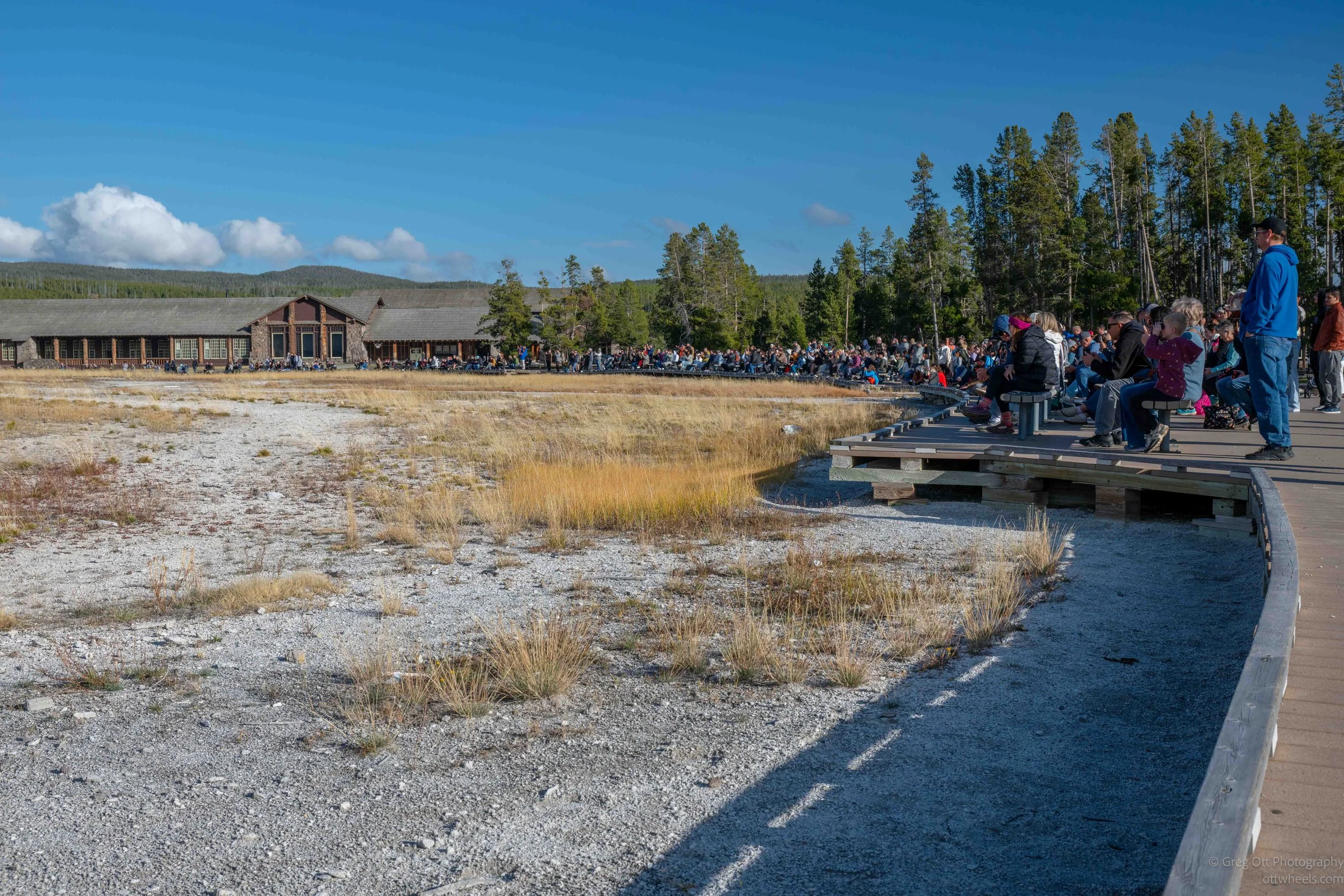
The magma beneath Yellowstone provides the heat that powers its geysers, hot springs and other thermal features. Old Faithful is probably the best-known example of this enormous underground heating system, although the geyser itself is powered by water and steam rather than erupting molten rock.
Rain and snowmelt seep into the ground through cracks and fractures in the rock. As the water travels deeper, it's heated by the surrounding rock, which gets its heat from the magma system below. Some of that water becomes trapped in narrow underground passages where pressure prevents it from boiling at the usual temperature. Eventually, steam bubbles begin to form, some water escapes, and the resulting drop in pressure causes more of the superheated water to flash into steam. The expanding steam forces water upward, producing the eruption we see at the surface.
What's remarkable about Old Faithful is how regularly this happens. It currently erupts about every 90 minutes on average, although the interval varies. Its underground plumbing is constantly changing, which makes its relatively predictable behavior even more interesting.
When you stand watching Old Faithful erupt, it's easy to think of it as an isolated attraction. But it's really just one visible part of an enormous geological system that has been active for millions of years. The water shooting into the air is being heated by rocks warmed by the same volcanic system that helped shape hundreds of miles of landscape across Idaho.
Knowing a little more about what's happening beneath my feet gives me a completely different perspective on Yellowstone. What looks like a peaceful landscape of forests, rivers and mountains is actually sitting above one of the most remarkable geothermal systems on Earth.
Hiking Around Old Faithful
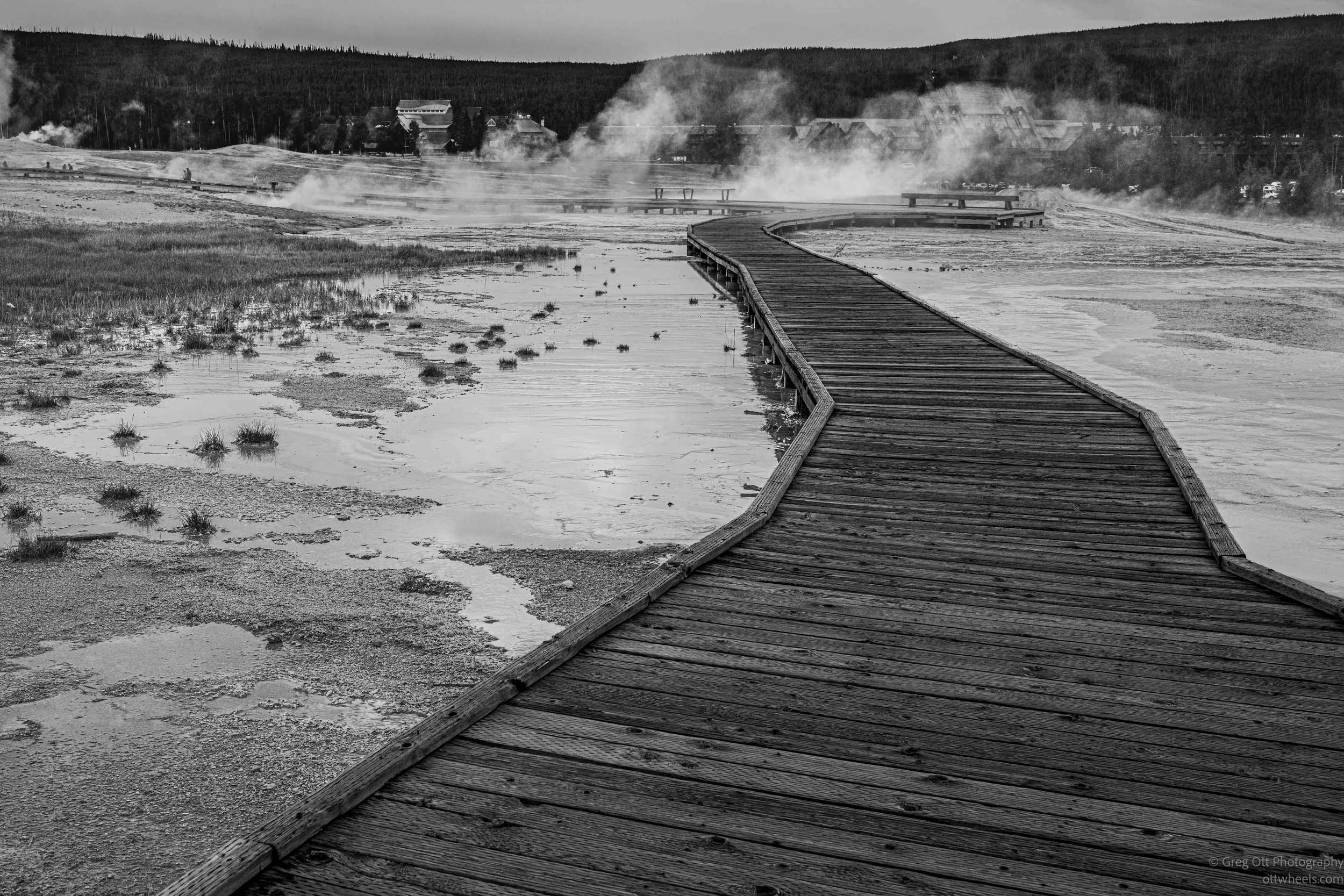
After spending time at Old Faithful, I wandered out onto the boardwalks that spread across the Upper Geyser Basin. The first impression was not of one dramatic geyser, but of a whole steaming landscape. The boardwalk curved out across wet ground and pale mineral flats, leading toward low clouds of steam and the dark outline of the Old Faithful Inn in the distance. In one photograph I converted to black and white, the whole area felt almost timeless, as if the boardwalk were leading into another world.
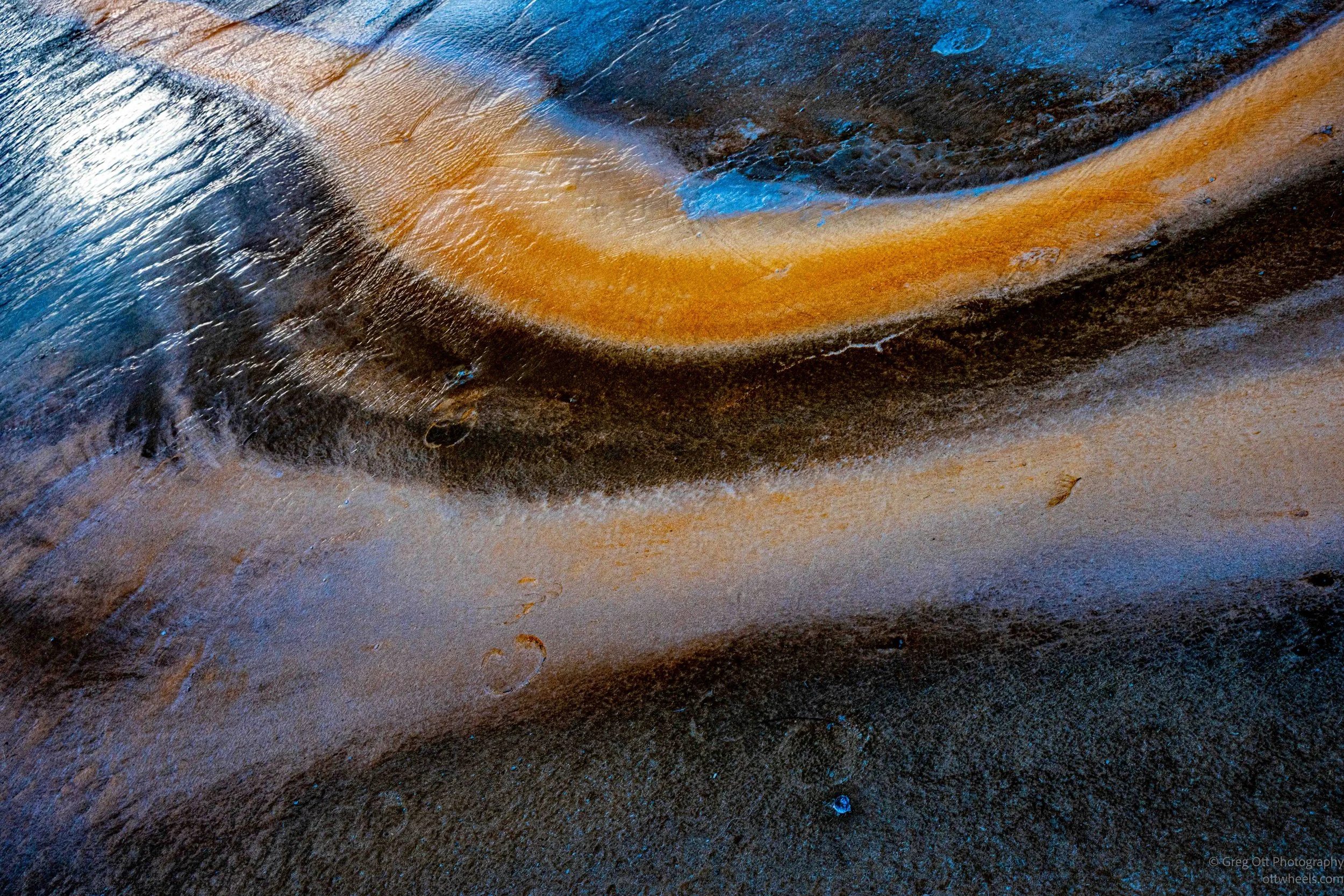
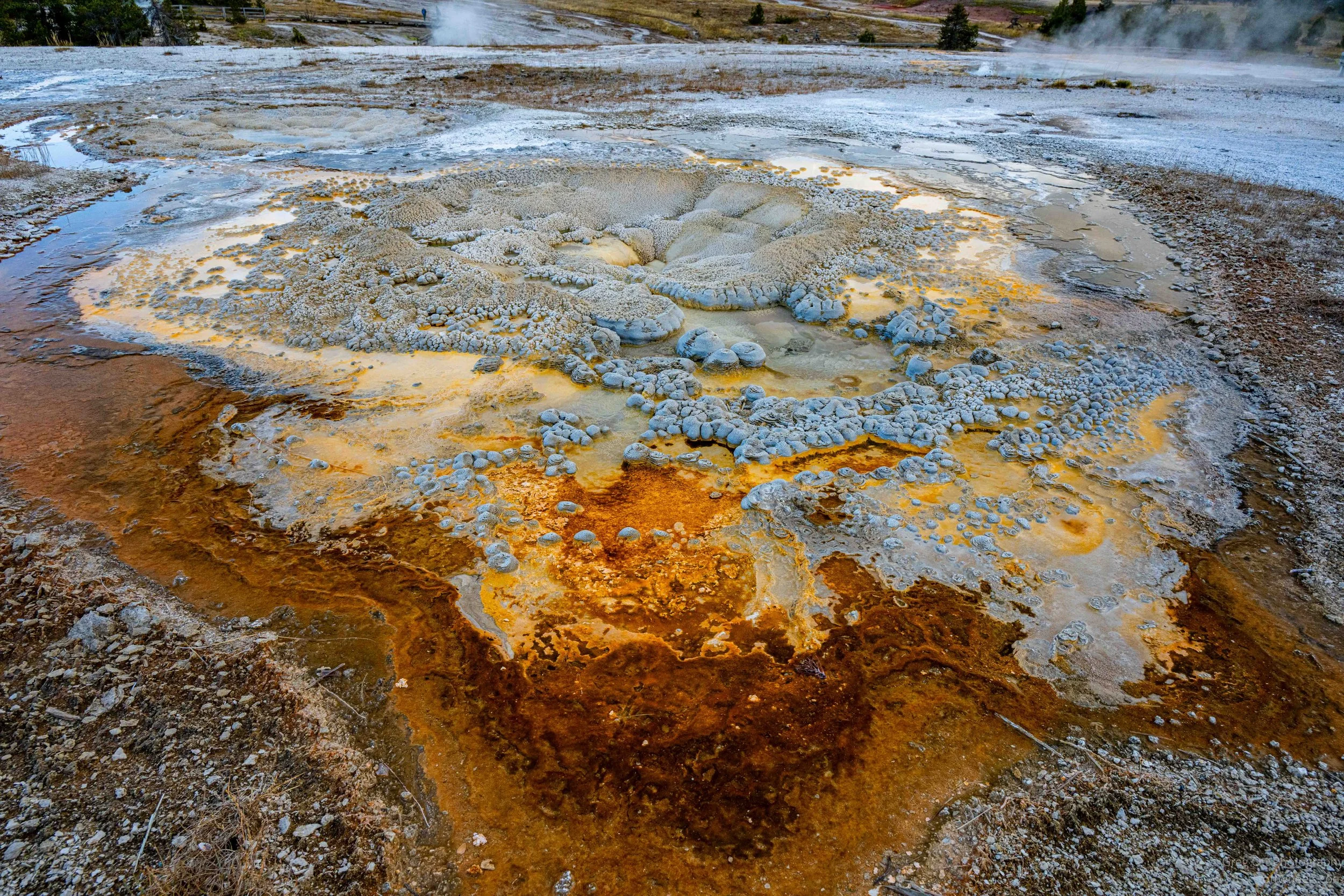
As I walked farther, I began noticing smaller details. One of the things that caught my eye was an abstract pattern in the mineral deposits and shallow water. It was just a sweep of color and texture, but it had all the things I was starting to love about this area—blue reflections, orange mineral staining, and smooth curves shaped by flowing water. Yellowstone often works that way. You come to see something famous, but then find yourself looking down at details only a few feet wide.
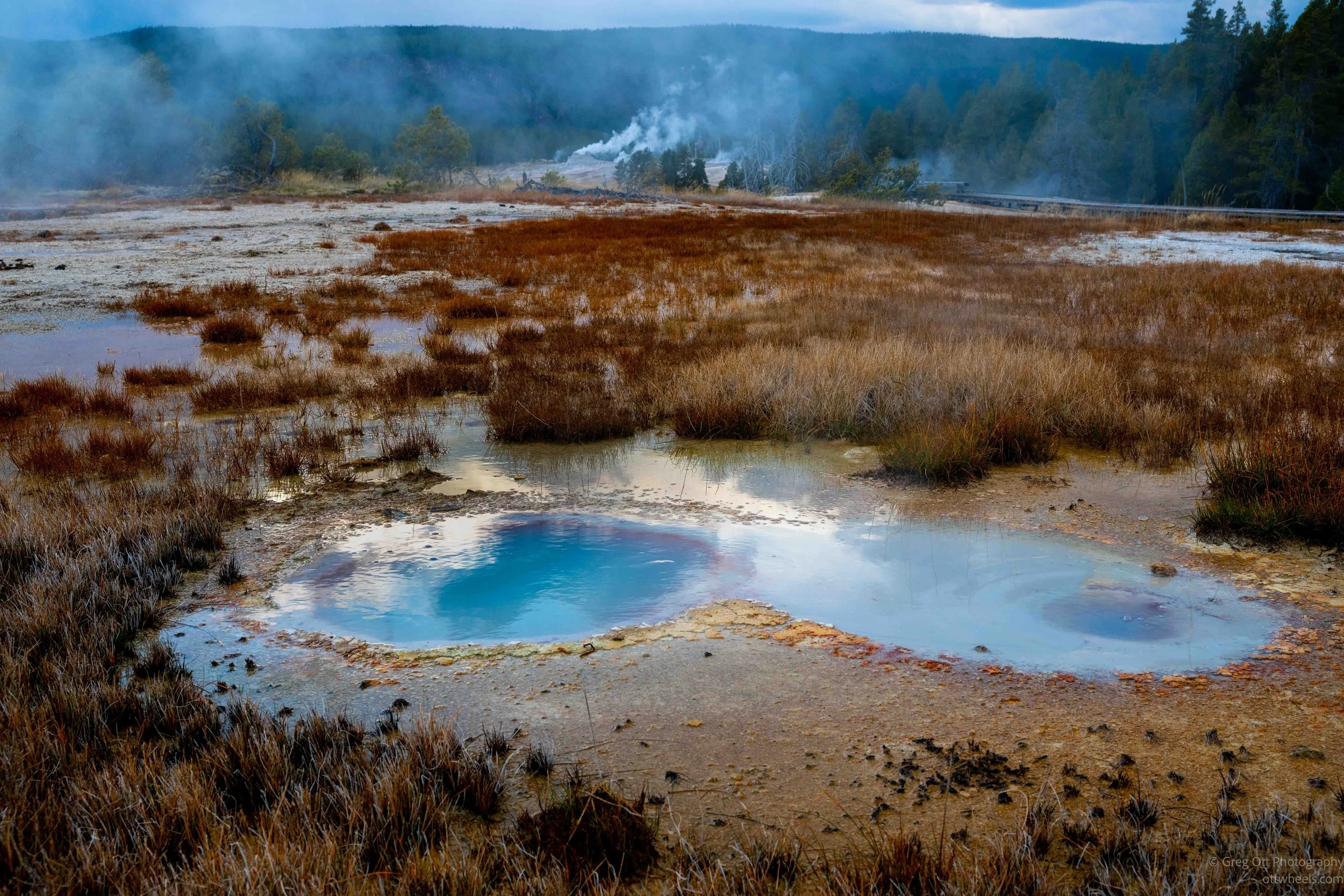
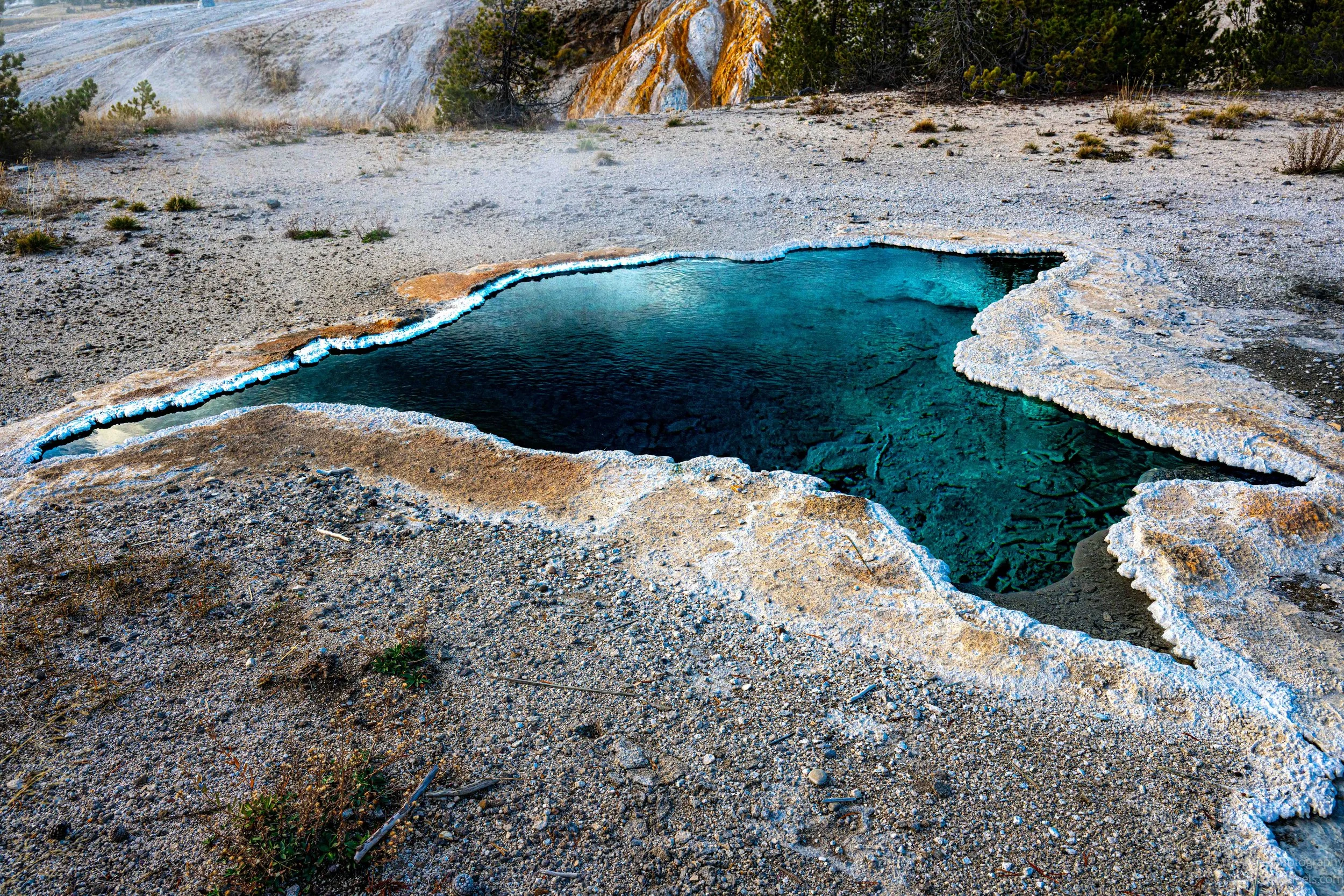
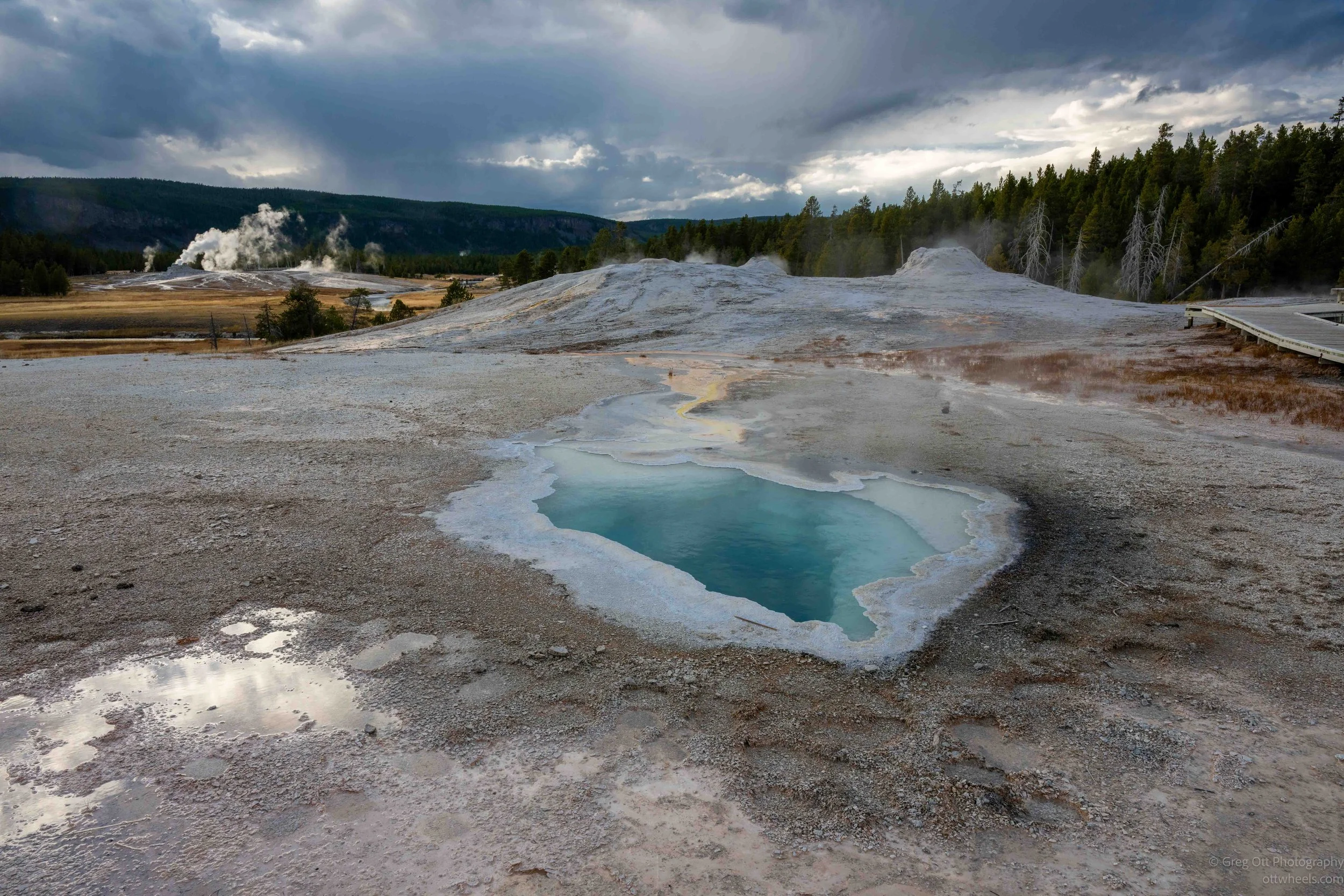
There were pools everywhere, each one a little different. Some were broad and pale, edged with orange and gray deposits, with steam drifting across them and the afternoon light reflecting softly off the water. Others were much smaller, set in wet grassy areas, with brilliant blue centers that almost looked artificial. The colors were extraordinary. The pale mineral crusts, the rusty orange edges, and the cold blue water created combinations that didn’t seem quite real.
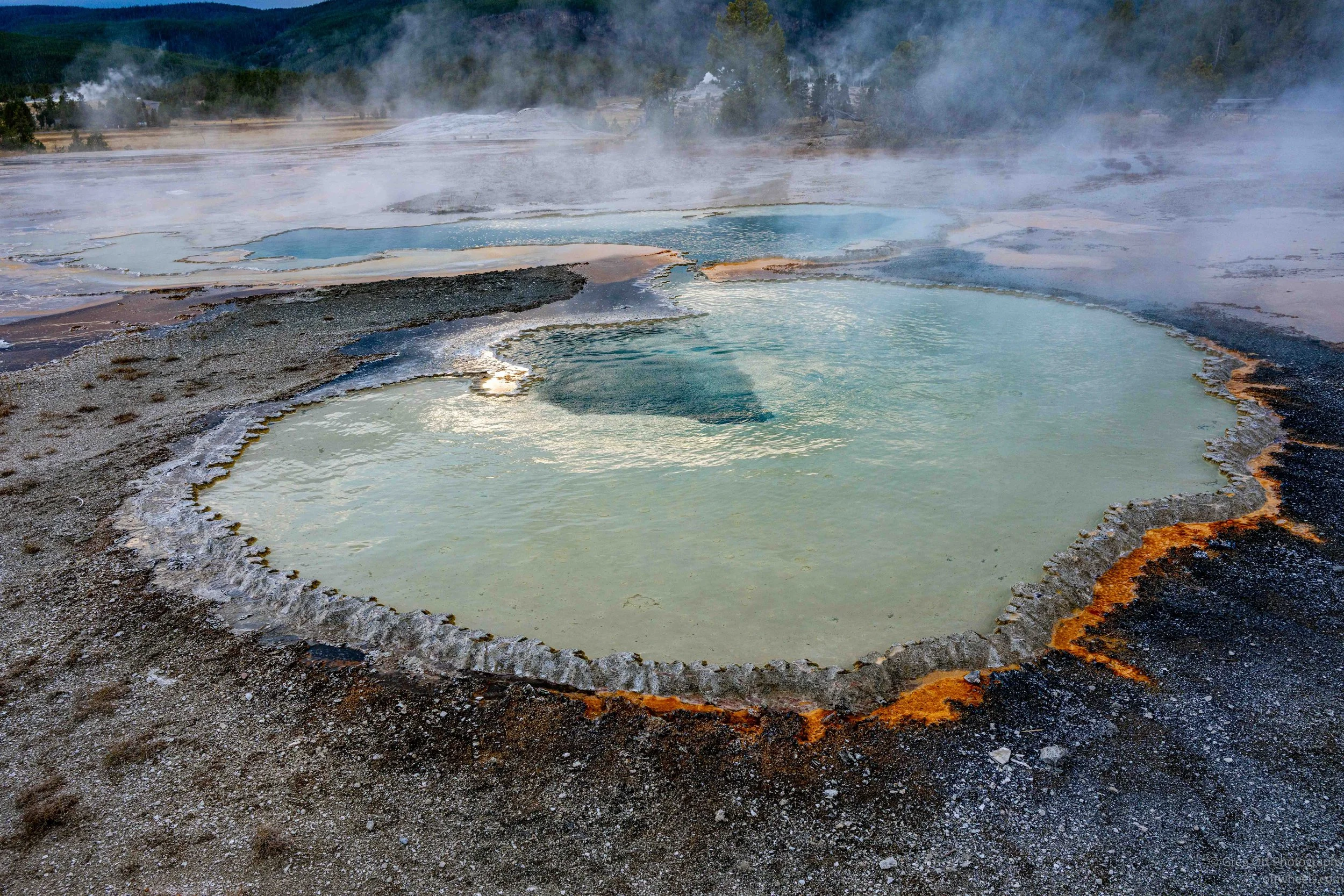
The boardwalk itself became part of the experience. In one direction it stretched across the basin toward rising steam, while in another it passed close to small vents and pools. I liked the way it slowed everything down. You couldn’t rush through a place like this. The boardwalk guided you safely through a fragile area where the ground was alive with heat and water.
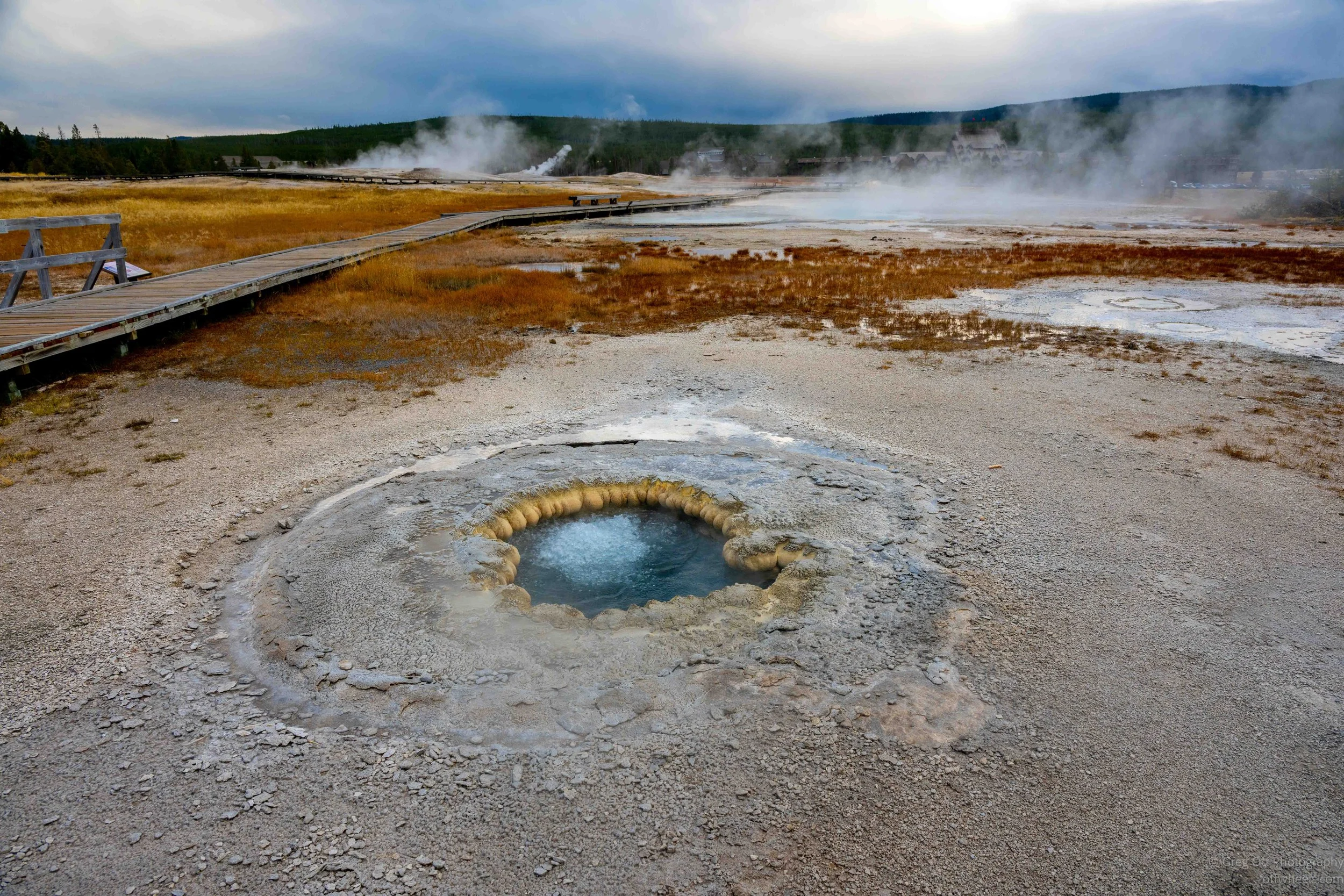
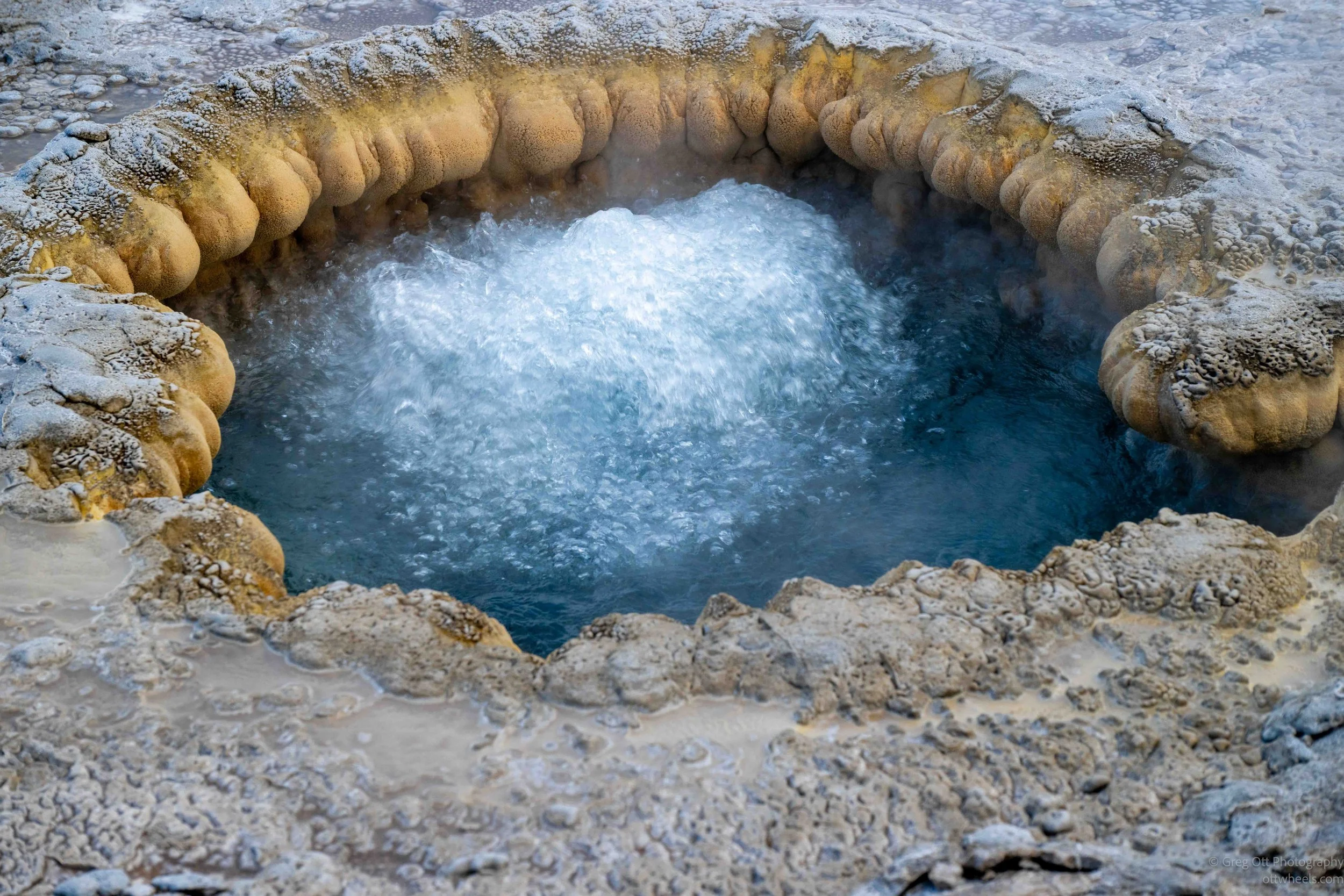
Some of the smaller geysers and vents were as interesting to me as Old Faithful. One was a round opening with a thick mineral rim, quietly churning and bubbling. Another sat in a more open area beneath a dramatic sky, its blue water surrounded by white deposits and bare mineral ground. Up close, the rims of these openings were beautifully sculpted, built up over time by minerals left behind as hot water cooled. They looked almost handmade.
I was especially drawn to the bubbling pools. In close-up photographs, you can see the water swelling upward and collapsing again, as if the earth were breathing. Some of these features were delicate and symmetrical; others seemed rougher and more irregular, with crusty edges and mineral textures that looked almost organic. Around them were channels and mats of orange, yellow, and white where the runoff had spread across the ground.
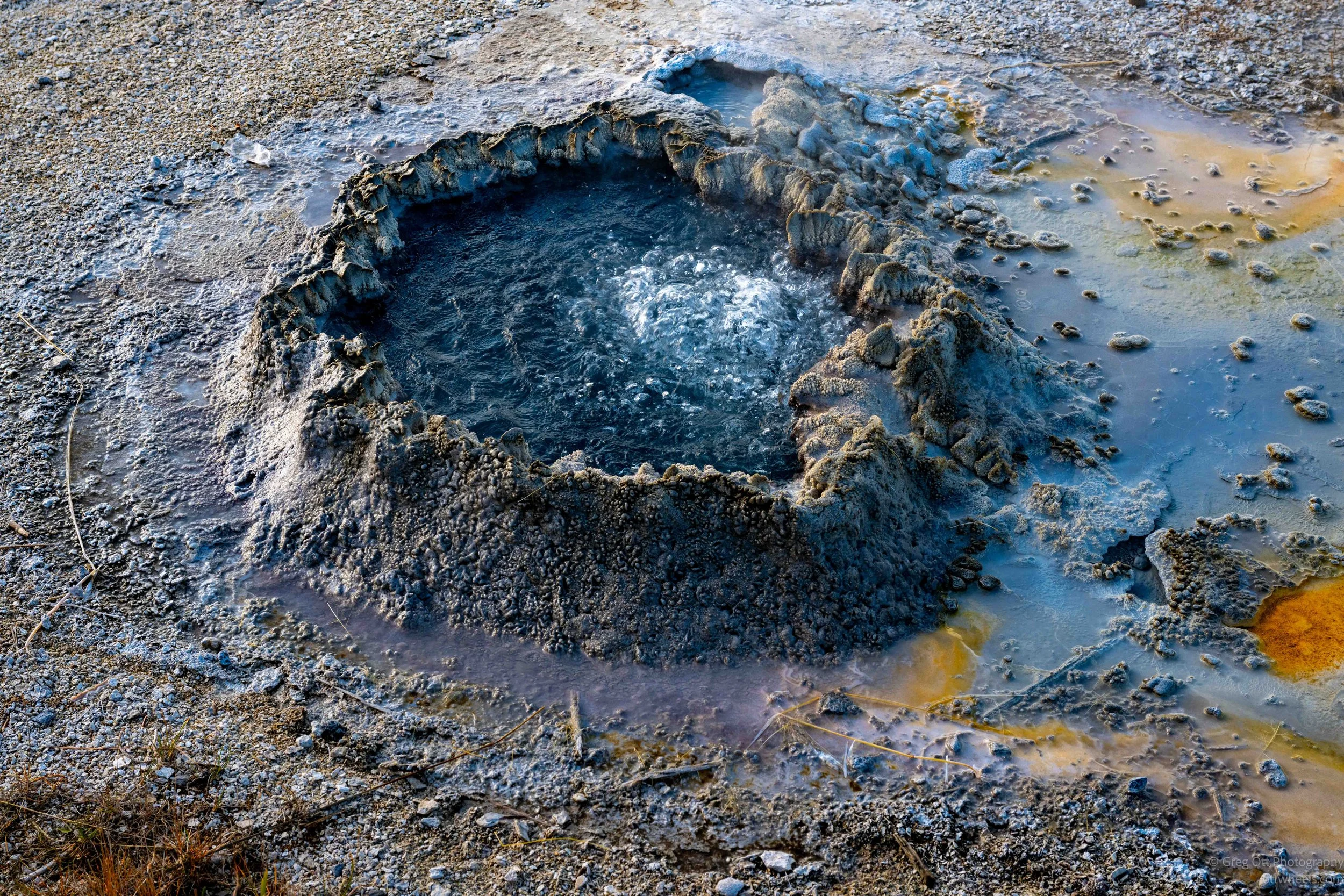
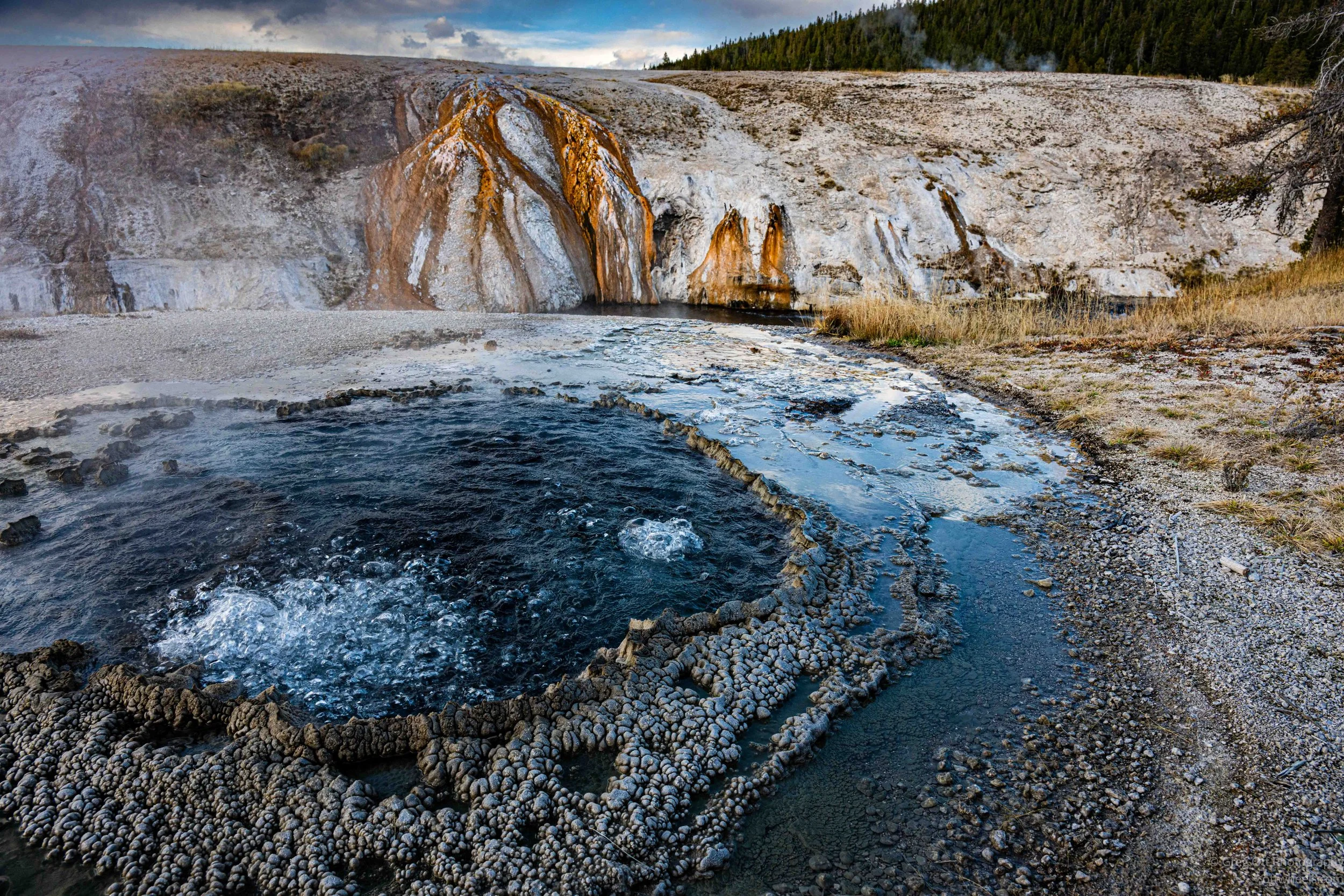
Farther along, I came to some of the most colorful formations of the walk. There were bright mineral flats streaked with orange and rust, deep blue pools tucked into white crusts, and dark bubbling basins set against terraces stained by years of flowing water. One pool, a deep intense blue, sat below a mineral wall streaked in orange and white. Another nearby vent boiled in a darker basin surrounded by rough, gray mineral buildup. Everywhere I looked there was something different—color, texture, movement, steam.
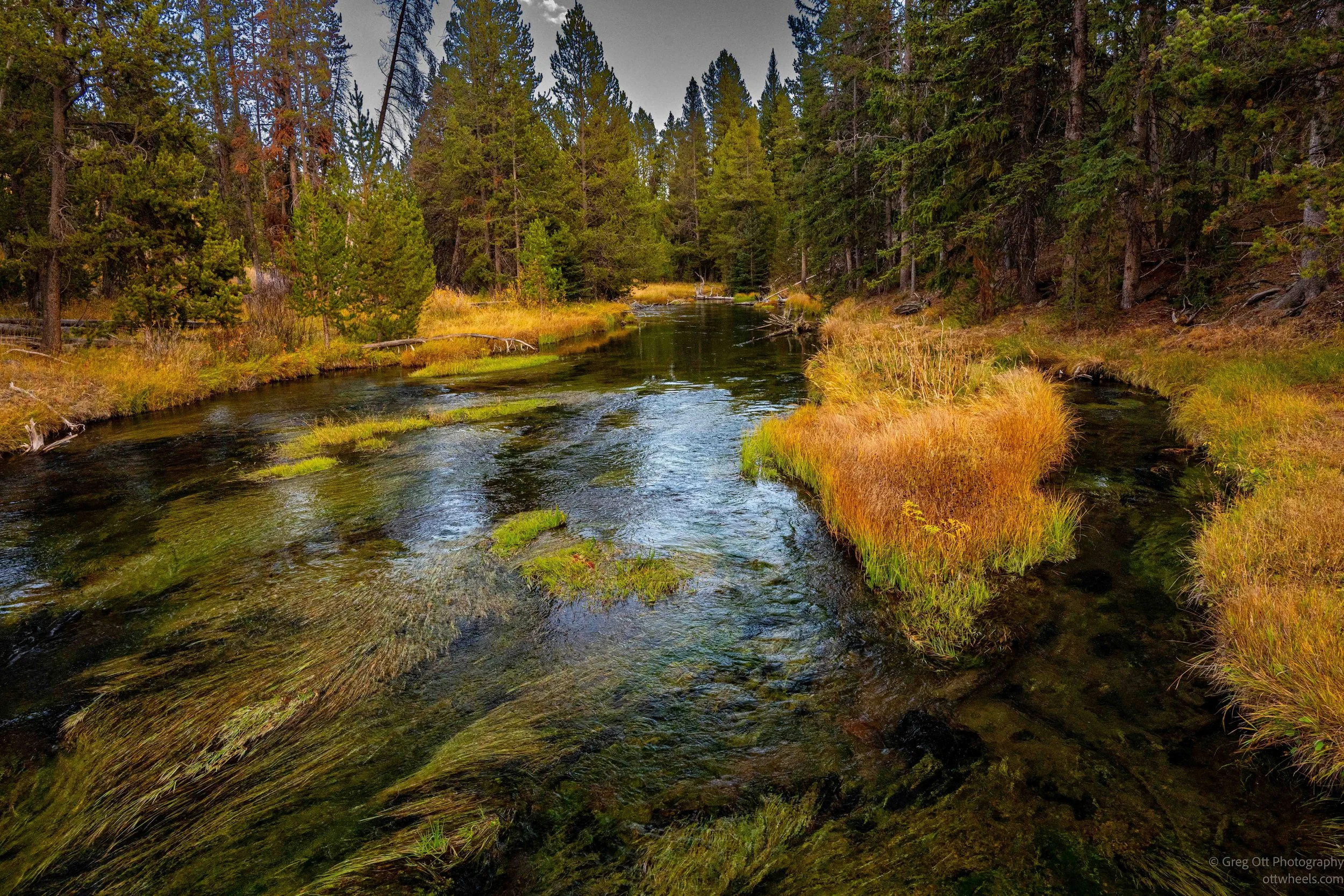
Then, quite unexpectedly, there was a small stream. After all the mineral flats and steaming vents, this clear water felt almost gentle. Aquatic plants flowed beneath the surface, and the grasses along the banks were turning yellow and gold. It was a quiet scene, but one of my favorites. The contrast between the cold, clear stream and the hot thermal landscape around it made the whole area feel even more varied.
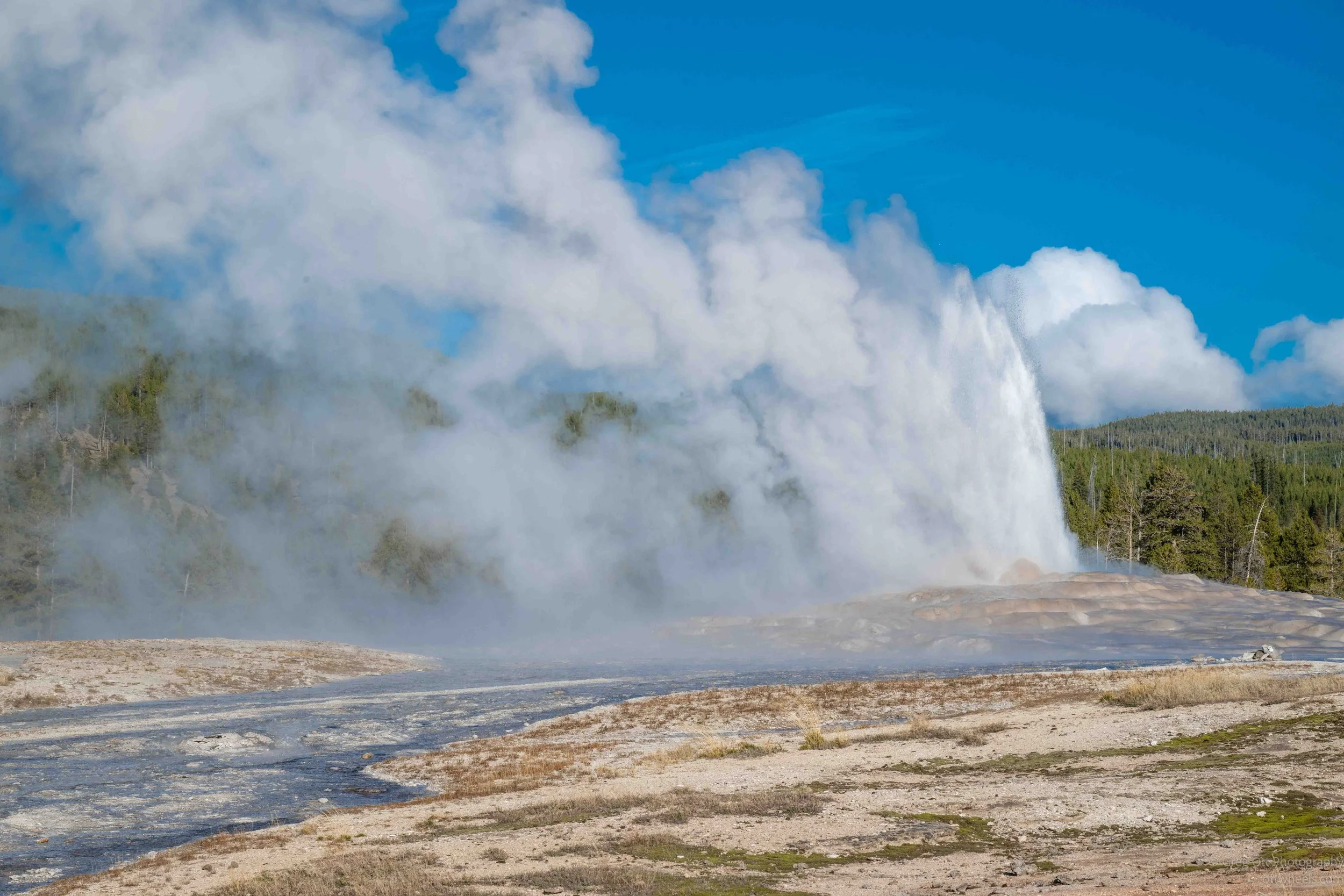
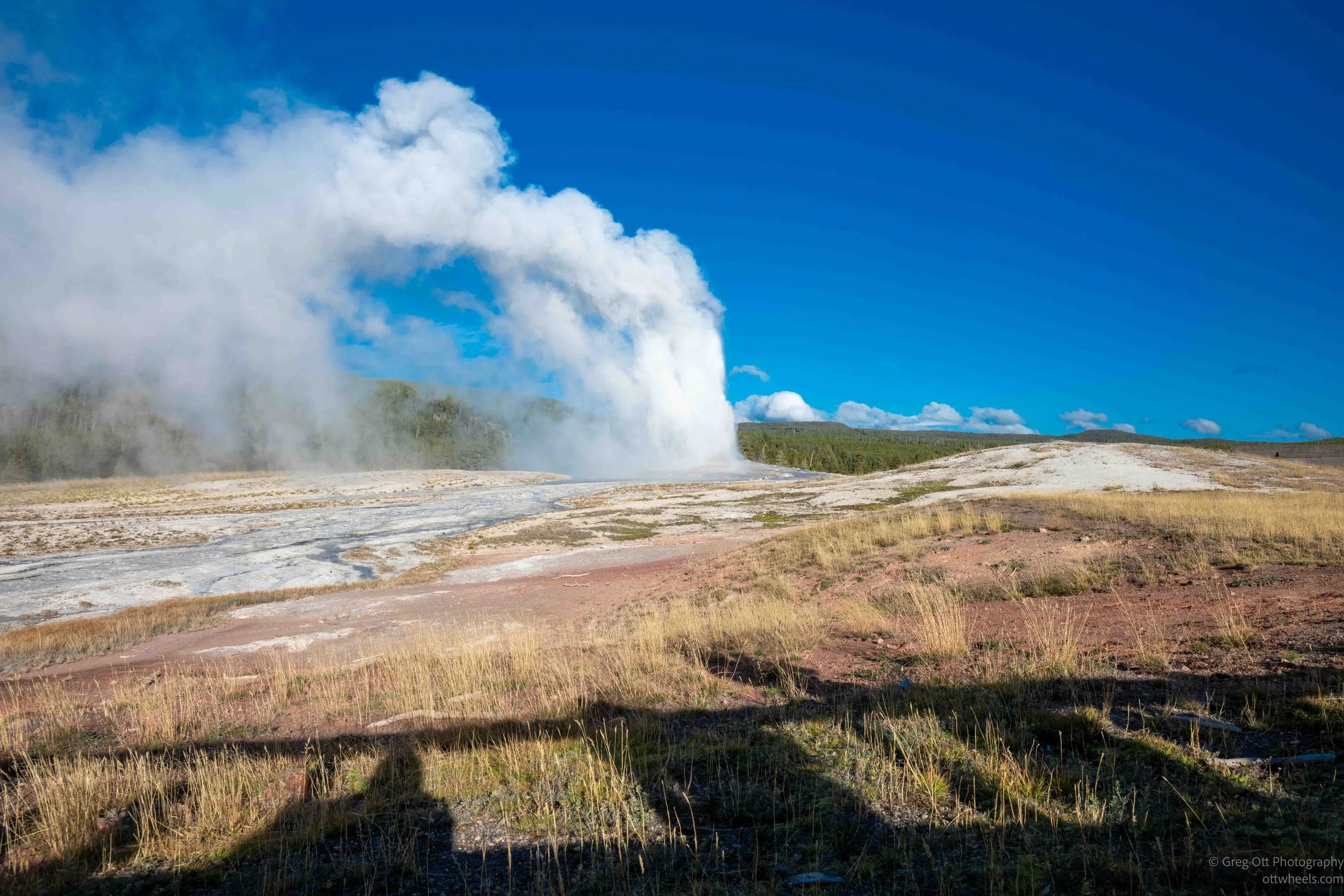
In the distance, Old Faithful erupted again. From farther away, the plume seemed even larger, rising into a bright blue sky and drifting into the wind. Seen first from a distance and then closer, it reminded me that all of these smaller pools, vents, and steaming flats were part of the same geothermal world. Old Faithful may be the star attraction, but the walk around it was just as memorable. In many ways, the smaller details—the bubbling pools, the saturated colors, the drifting steam, and the quiet stream—were what stayed with me most.
Old Faithful Inn
After finishing my walk, I headed over to the historic Old Faithful Inn, hoping to find something to eat. Unfortunately, the dining room was reservations only, and every table was booked. As it turned out, this was the last meal they would be serving before closing for the season. I met a couple later who had eaten there, and they described the meal as first-class.
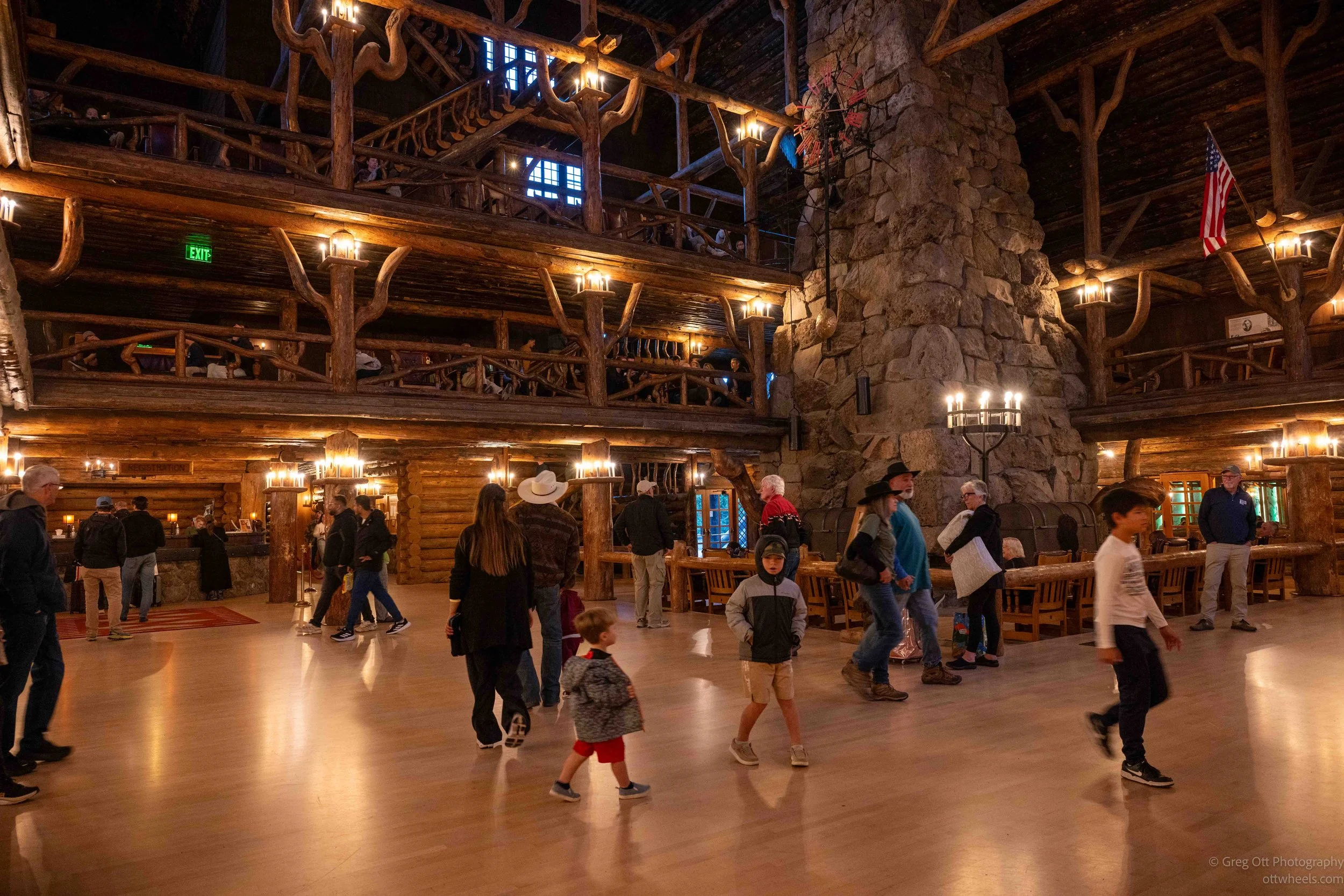
I spent a little time looking around the inn. For some reason, the interior also seemed different from what I remembered on previous visits. It's an extraordinary building, with its enormous stone fireplace, exposed timber construction and multiple levels of balconies overlooking the lobby. I couldn't quite put my finger on what seemed different.
There wasn't anywhere else nearby where I could get a meal, so I returned to the van and made the 40-minute drive back to Madison Campground. It had been a full day of exploring, hiking and photography, and despite missing dinner at the inn, I'd thoroughly enjoyed myself.